Demoiselle crane
Anthropoides virgo
Avilumen editorial team ·

The demoiselle crane is a species of crane found in central Eurosiberia, ranging from the Black Sea to Mongolia and Northeast China. There is also a small breeding population in Turkey. These cranes are migratory birds. Birds from western Eurasia will spend the winter in Africa while the birds from Asia, Mongolia and China will spend the winter in the Indian subcontinent.
The demoiselle crane (Grus virgo) is a species of crane found in central Eurosiberia, ranging from the Black Sea to Mongolia and Northeast China. There is also a small breeding population in Turkey. These cranes are migratory birds. Birds from western Eurasia will spend the winter in Africa while the birds from Asia, Mongolia and China will spend the winter in the Indian subcontinent. The bird is symbolically significant in the culture of India, where it is known as koonj or kurjaa.
Taxonomy
The demoiselle crane was formally described in 1758 by the Swedish naturalist Carl Linnaeus in the tenth edition of his Systema Naturae. He placed it with the herons and cranes in the genus Ardea and coined the binomial name Ardea virgo. He specified the type locality as the orient but this has been restricted to India. Linnaeus cited the accounts by earlier authors. The English naturalist Eleazar Albin had described and illustrated the "Numidian crane" in 1738. Albin explained that: "This Bird is called Demoiselles by reason of certain ways of acting that it has, wherein it seems to imitate the Gestures of a Woman who affects a Grace in her Walking, Obeisances, and Dancing". Linnaeus also cited the English naturalist George Edwards who had described and illustrated the "Demoiselle of Numidia" in 1750. The name "la demoiselle de Numidie" had been used in 1676 by the French naturalist Claude Perrault. The demoiselle crane is now placed in the genus Grus that was introduced in 1760 by the French zoologist Mathurin Jacques Brisson. The species is treated as monospecific: no subspecies are recognised. The genus name Grus is the Latin word for a "crane". The specific epithet virgo is Latin meaning "maiden". Some authorities place this species together with the closely related blue crane (Grus paradisea) in the genus Anthropoides.
Description
The demoiselle is 85–100 cm (33.5–39.5 in) long, 76 cm (30 in) tall and has a 155–180 cm (61–71 in) wingspan. It weighs 2–3 kg (4.4–6.6 lb). It is the smallest species of crane. The demoiselle crane is slightly smaller than the common crane but has similar plumage. It has a long white neck stripe and the black on the foreneck extends down over the chest in a plume.
It has a loud trumpeting call, higher-pitched than the common crane. Like other cranes it has a dancing display, more balletic than the common crane, with less leaping.
Distribution and habitat
The demoiselle crane breeds in central Eurasia from the Black Sea east to Mongolia and northeast China. It breeds in open habitats with sparse vegetation, usually near water. In winter it migrates either to the Sahel region of Africa, from Lake Chad eastwards to southern Ethiopia, or to western regions of the Indian subcontinent. There was previously a small population in Turkey and an isolated resident population in the Atlas Mountains of northwest Africa. These are both now extinct. On its Indian wintering grounds it forms large flocks which gather on agricultural land. It roosts at night in shallow open water.
Breeding
Eggs are laid between April and May. The minimal nest is placed on an open patch of grass or bare ground. The clutch is normally two eggs. These are laid at daily intervals and incubation begins after the first egg. Incubation is by both sexes but mainly by the female. The eggs hatch asynchronously after 27 to 29 days. The chicks are pale brown above and greyish white below. They are fed and cared for by both parents. The fledgeling period is between 55 and 65 days. They first breed when they are two years old.
In culture
The demoiselle crane is known as the koonj/kurjan in the languages of North India, and figure prominently in the literature, poetry and idiom of the region. Beautiful women are often compared to the koonj because its long and thin shape is considered graceful. Metaphorical references are also often made to the koonj for people who have ventured far from home or undertaken hazardous journeys.
The name koonj is derived from the Sanskrit word kraunch, which is a cognate Indo-European term for crane itself. In the ancient story of Valmiki, the composer of the Hindu epic Ramayana, it is claimed that his first verse was inspired by the sight of a hunter kill the male of a pair of demoiselle cranes that were courting. Observing the lovelorn female circling and crying in grief, he cursed the hunter in verse. Since tradition held that all poetry prior to this moment had been revealed rather than created by man, this verse concerning the demoiselle cranes is regarded as the first human-composed meter.
The flying formation of the koonj during migrations also inspired infantry formations in ancient India. The Mahabharata epic describes both warring sides adopting the koonj formation on the second day of the Kurukshetra War.
Text adapted from Wikipedia · CC BY-SA 4.0
Distribution

Taxonomy
- Order
- Gruiformes
- Family
- Gruidae
- Genus
- Anthropoides
- Conservation status
- Least concern
Listen to its call
No recording yet
Illustration gallery
6 illustrations of Anthropoides virgo (Demoiselle crane) in different styles, true to its real plumage. Shown watermarked; the art pack includes the high-resolution originals, ready to print.
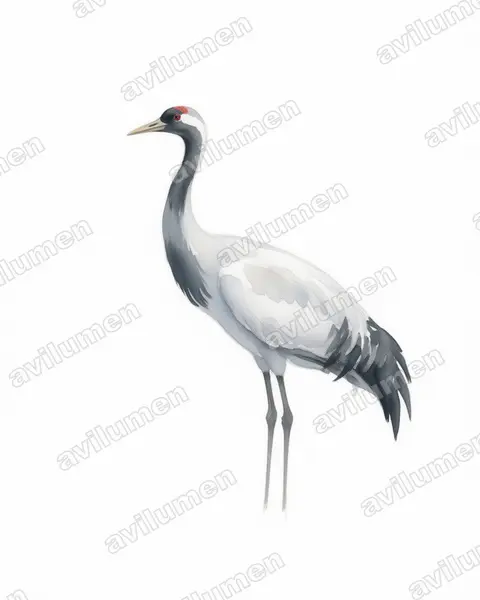
Watercolor 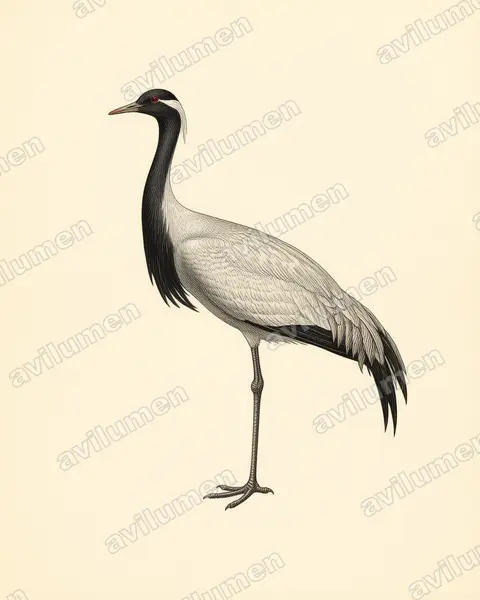
Vintage plate 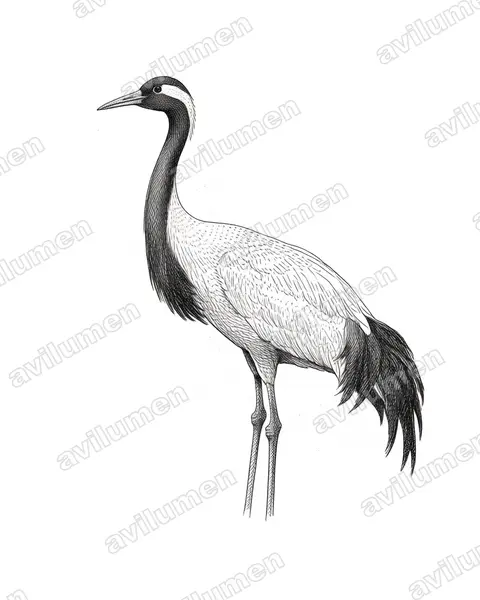
Ink 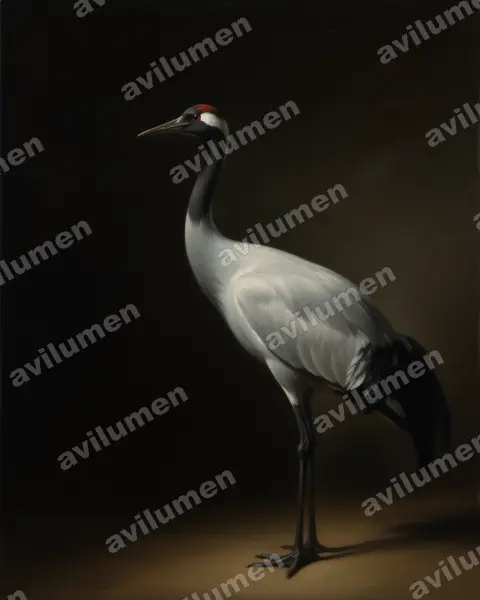
Oil 
Realistic 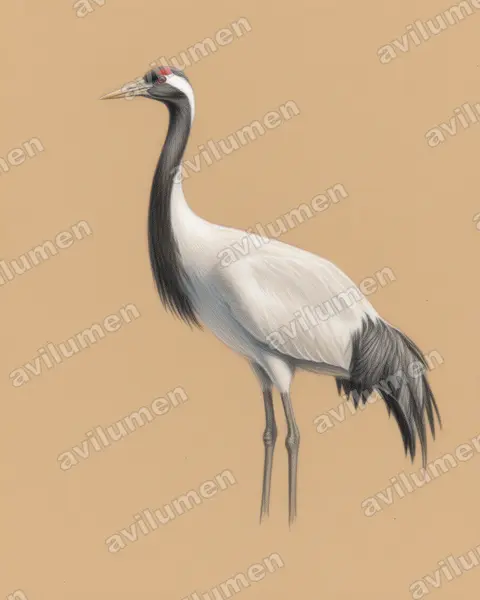
Colored pencil
Illustrations based on the photograph by Sumeet Moghe (CC BY-SA 3.0), from Wikimedia Commons.
Digital editions
HD Digital Art Pack — Demoiselle crane
Digital download: 6 high-resolution illustrations of the Demoiselle crane (Anthropoides virgo), print-ready. This is a digital file; no animal or physical item is included.
AI Avatar — Demoiselle crane
Generate an avatar fusing your face with the Demoiselle crane (Anthropoides virgo). Delivered digitally in 8K, watermark-free. Digital product; no animals are sold or brokered.
Instant download. No live birds are sold.
Frequently asked questions
- Is Anthropoides virgo (Demoiselle crane) endangered?
- The IUCN Red List places Anthropoides virgo, commonly known as the Demoiselle crane, in the «Least concern» category. «Least concern» means it is not currently threatened.
- Where does Anthropoides virgo (Demoiselle crane) live?
- Anthropoides virgo (Demoiselle crane) is found in Africa.
- What family does Anthropoides virgo (Demoiselle crane) belong to?
- Anthropoides virgo (Demoiselle crane) belongs to the family Gruidae, in the order Gruiformes.
- What colour is Anthropoides virgo (Demoiselle crane)?
- The plumage of Anthropoides virgo (Demoiselle crane) combines these colours: Grey and White.
More from the same family
 Vulnerable
Blue crane
Anthropoides paradiseus
The blue crane, also known as the Stanley crane and the paradise crane, is the national bird of South Africa. The species is listed as Vulnerable by the IUCN.
from $1.99
 Not evaluated
Sarus crane
Antigone antigone
The sarus crane is a large nonmigratory crane found in parts of the Indian subcontinent, Southeast Asia, and northern Australia. The tallest of the flying birds, standing at a height of up to 1.8 m, they are a conspicuous species of open wetlands in South Asia, seasonally flooded Dipterocarpus forests in Southeast Asia, and Eucalyptus-dominated woodlands and grasslands in Australia.
from $1.99
 Not evaluated
White-naped crane
Antigone vipio
The white-naped crane is a bird in the crane family, Gruidae. It breeds in shallow wetlands and wet meadows in northeastern Mongolia, northeastern China, and adjacent areas of southeastern Russia. It is a large bird measuring 112–125 cm (44–49 in) long, about 130 cm (4.3 ft) tall, and weighing about 5.6 kg (12 lb), with pinkish legs, a grey-and-white-striped neck, and a red face patch.
from $1.99
 Vulnerable
Black Crowned Crane
Balearica pavonina
The black crowned crane is a part of the family Gruidae, along with its sister species, the grey crowned crane. It is topped with its characteristic bristle-feathered golden crown.
from $1.99