Sarus crane
Antigone antigone
Avilumen editorial team ·

The sarus crane is a large nonmigratory crane found in parts of the Indian subcontinent, Southeast Asia, and northern Australia. The tallest of the flying birds, standing at a height of up to 1.8 m, they are a conspicuous species of open wetlands in South Asia, seasonally flooded Dipterocarpus forests in Southeast Asia, and Eucalyptus-dominated woodlands and grasslands in Australia.
The sarus crane (Antigone antigone) is a large nonmigratory crane found in parts of the Indian subcontinent, Southeast Asia, and northern Australia. The tallest of the flying birds, standing at a height of up to 1.8 m (5 ft 11 in), they are a conspicuous species of open wetlands in South Asia, seasonally flooded Dipterocarpus forests in Southeast Asia, and Eucalyptus-dominated woodlands and grasslands in Australia.
The sarus crane is easily distinguished from other cranes in the region by its overall grey colour and the contrasting red head and upper neck. They forage on marshes and shallow wetlands for roots, tubers, insects, crustaceans, and small vertebrate prey. Like other cranes, they form long-lasting pair bonds and maintain territories within which they perform territorial and courtship displays that include loud trumpeting, leaps, and dance-like movements. In India, they are considered symbols of marital fidelity, believed to mate for life and pine the loss of their mates, even to the point of starving to death.
The main breeding season is during the wet season, when the pair builds an enormous nest "island," a circular platform of reeds and grasses nearly two meters in diameter and high enough to stay above the shallow water surrounding it. Increased agricultural intensity is often thought to have led to declines in sarus crane numbers, but the largest known population of Sarus cranes are in northern India's Uttar Pradesh where small-holder agriculture, favorable farmer attitudes, wet crops such as flooded paddy and the extensive network of canals has benefitted the species. The stronghold of the species is in India, where it is traditionally revered and lives in agricultural lands in close proximity to humans. Elsewhere, the species has been extirpated in many parts of its former range.
Taxonomy
In 1743 the English naturalist George Edwards included an illustration and a description of the sarus crane in the first volume of his A Natural History of Uncommon Birds. He used the English name "The Greater Indian Crane". Edwards based his hand-coloured etching on a live specimen that he had drawn at the London home of the Admiral Charles Wager. When in 1758 the Swedish naturalist Carl Linnaeus updated his Systema Naturae for the tenth edition, he placed the sarus crane (Grus major Indica in Latin) with the herons and cranes in the genus Ardea. Linnaeus included a brief description, coined the binomial name Ardea antigone and cited Edwards' work. The specific epithet is based on Greek mythology. Antigone was the daughter of the Trojan king Laomedon. She was turned into a stork for comparing her own beauty with the goddess Hera. Linnaeus appears to have confused this myth with that of Gerana, queen of the pigmies, who considered herself more beautiful than Hera and was turned into a crane. The sarus crane was formerly placed in the genus Grus, but a molecular phylogenetic study published in 2010 found that the genus, as then defined, was polyphyletic. In the resulting rearrangement to create monophyletic genera, four species, including the sarus crane, were placed in the resurrected genus Antigone that had originally been erected by German naturalist Ludwig Reichenbach in 1853.
Edward Blyth published a monograph on the cranes in 1881, in which he considered the "sarus crane" of India to be made up of two species, Grus collaris and Grus antigone. Most modern authors recognize one species with three disjunct populations that are sometimes treated as subspecies, although the status of one extinct population from the Philippines is uncertain. The sarus cranes in India (referred to as A. a. antigone) are the largest, and in Myanmar to the east are replaced by a population that extends into Southeast Asia (referred to as A. a. sharpii). Sarus cranes from the Indian subcontinent are differentiated from the south-eastern population by the white collar below their bare head and upper neck, and their white tertiary flight feathers. The population in Australia (initially placed in A. a. sharpii (sometimes spelt sharpei but amended to conform to the rules of Latin grammar) was separated and named A. a. gilliae, sometimes spelt gillae or gillii), prior to a genetic analysis. A 2005 genetic analysis suggests that these three populations are representatives of a formerly continuous population that varied clinally. The Australian subspecies was designated only in 1988, with the species itself was first noticed in Australia in 1966 and regarded as a recent immigrant. Native Australians, however, differentiated between the sarus and the brolga, calling the sarus "the crane that dips its head in blood." Sarus cranes of the Australian population are similar to those in Southeast Asia in having no white on the neck and tertiary remiges, but are distinguished by a larger grey patch of ear coverts. The Australian population shows the most recent divergence from the ancestral form with an estimated 3000 generations of breeding within Australia. An additional subspecies, A. a. luzonica, was suggested for the population — now extinct — in the Philippines. No distinctive characteristic is known of this disappeared population.
Analysis of mitochondrial DNA from a limited number of specimens suggests that gene flow occurred within the continental Asian populations until the 20th-century reductions in range, and that Australia was colonized only in the Late Pleistocene, some 35,000 years ago. This has been corroborated by DNA microsatellite analyses on a large and widely distributed set of individuals in the sample. This study suggests further that the Australian population shows low genetic variability. As there exists the possibility of (limited) hybridization with the genetically distinct brolga, the Australian sarus crane can be expected to be an incipient species.
The common name 'sarus' is from the Hindi name (sāras) for the species. The Hindi word is derived from the Sanskrit word sarasa for the "lake bird", (sometimes corrupted to sārhans). British soldiers in colonial India who hunted the birds corrupted the name to serious or even cyrus.
Description
The adult sarus crane is very large, with grey wings and body, a bare red head, collar and nape, a greyish crown, and a long, greenish-grey, pointed bill. In flight, the long neck is held straight, unlike that of a heron (which folds it back), and the black wing tips can be seen; the crane's long, pink legs trail behind them. This bird has a grey ear covert patch, orange-red irises, and a greenish-grey bill. Juveniles have a yellowish base to the bill and the brown-grey head is fully feathered.
The bare red skin of the adult's head and neck is brighter during the breeding season. This skin is rough and covered by feather follicles, and a narrow area around and behind the head is covered by black, bristly feathers. The sexes do not differ in plumage, although males are on average larger than females; males of the Indian population can attain a maximum height around 180 cm (5.9 ft), making them the world's tallest extant flying bird. The weight of nominate race individuals is 6.8–7.8 kg (15–17 lb), while five adults of A. a. sharpii averaged 8.4 kg (19 lb). Across the distribution range, their weight can vary from 5 to 12 kg (11 to 26 lb), height typically from 115 to 167 cm (45 to 66 in), and wingspan from 220 to 250 cm (87 to 98 in).
While individuals from northern Indian populations are among the heaviest cranes, alongside the red-crowned and wattled cranes, and the largest in their range, birds from Australia tend to be smaller. In Australia, the sarus can easily be mistaken for the more widespread brolga. The brolga has the red colouring confined to the head and not extending onto the neck. Body mass in Australian sarus cranes was found to average 6.68 kg (14.7 lb) in males and 5.25 kg (11.6 lb) in females, with a range for both sexes of 5.0 to 6.9 kg (11.0 to 15.2 lb). Thus, Australian sarus cranes average about 25% lighter than the northern counterparts and are marginally lighter on average than brolgas.
Text adapted from Wikipedia · CC BY-SA 4.0
Distribution

Taxonomy
- Order
- Gruiformes
- Family
- Gruidae
- Genus
- Antigone
- Conservation status
- Not evaluated
Listen to its call
No recording yet
Illustration gallery
6 illustrations of Antigone antigone (Sarus crane) in different styles, true to its real plumage. Shown watermarked; the art pack includes the high-resolution originals, ready to print.
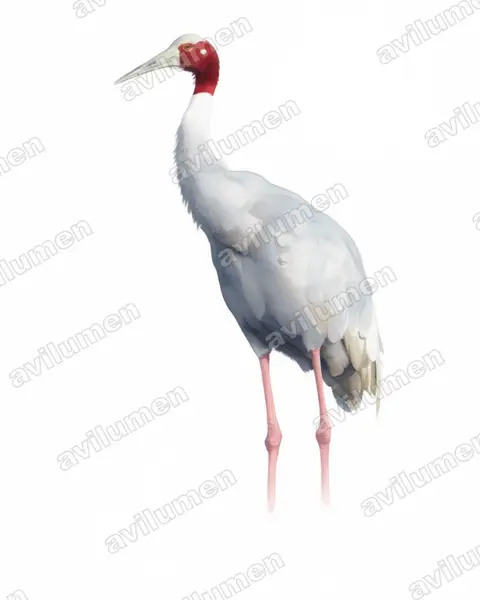
Watercolor 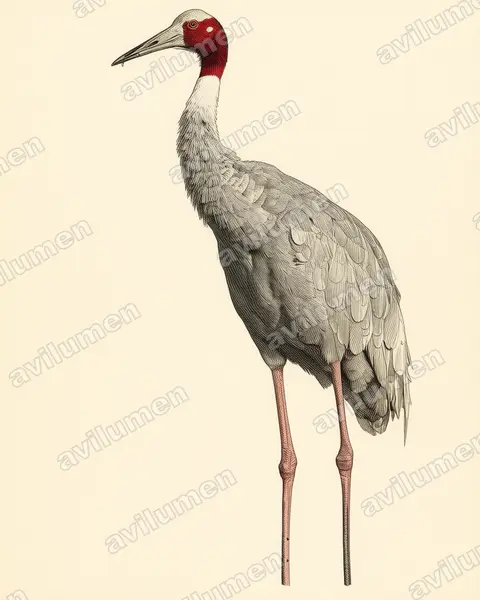
Vintage plate 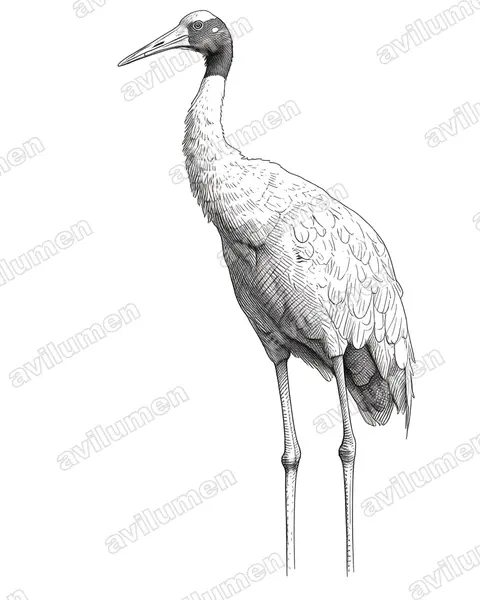
Ink 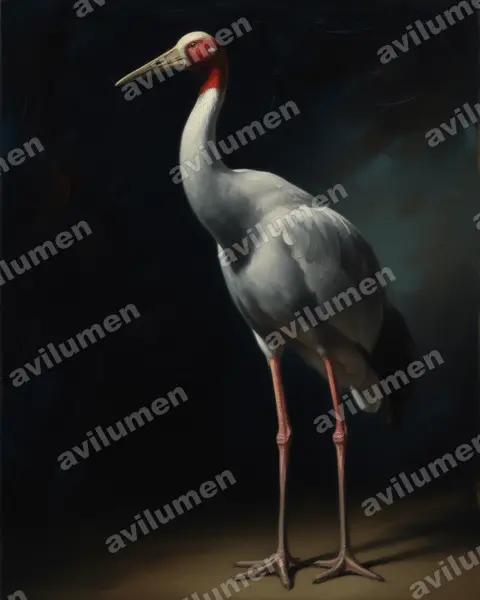
Oil 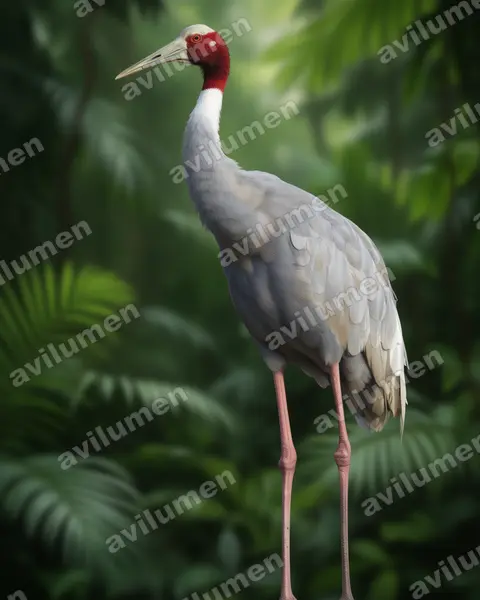
Realistic 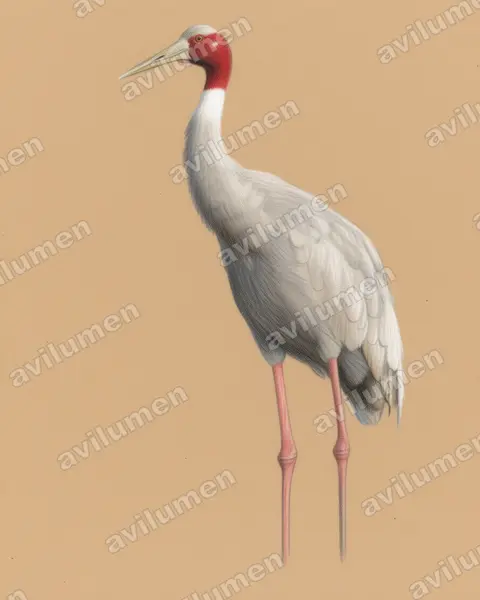
Colored pencil
Illustrations based on the photograph by Charles J. Sharp (CC BY-SA 4.0), from Wikimedia Commons.
Digital editions
HD Digital Art Pack — Sarus crane
Digital download: 6 high-resolution illustrations of the Sarus crane (Antigone antigone), print-ready. This is a digital file; no animal or physical item is included.
AI Avatar — Sarus crane
Generate an avatar fusing your face with the Sarus crane (Antigone antigone). Delivered digitally in 8K, watermark-free. Digital product; no animals are sold or brokered.
Instant download. No live birds are sold.
Frequently asked questions
- Is Antigone antigone (Sarus crane) endangered?
- The IUCN Red List places Antigone antigone, commonly known as the Sarus crane, in the «Not evaluated» category. «Not evaluated» means the IUCN has not yet assessed this species.
- What family does Antigone antigone (Sarus crane) belong to?
- Antigone antigone (Sarus crane) belongs to the family Gruidae, in the order Gruiformes.
- What colour is Antigone antigone (Sarus crane)?
- The plumage of Antigone antigone (Sarus crane) combines these colours: Grey and White.
More from the same family
 Vulnerable
Blue crane
Anthropoides paradiseus
The blue crane, also known as the Stanley crane and the paradise crane, is the national bird of South Africa. The species is listed as Vulnerable by the IUCN.
from $1.99
 Least concern
Demoiselle crane
Anthropoides virgo
The demoiselle crane is a species of crane found in central Eurosiberia, ranging from the Black Sea to Mongolia and Northeast China. There is also a small breeding population in Turkey. These cranes are migratory birds. Birds from western Eurasia will spend the winter in Africa while the birds from Asia, Mongolia and China will spend the winter in the Indian subcontinent.
from $1.99
 Not evaluated
White-naped crane
Antigone vipio
The white-naped crane is a bird in the crane family, Gruidae. It breeds in shallow wetlands and wet meadows in northeastern Mongolia, northeastern China, and adjacent areas of southeastern Russia. It is a large bird measuring 112–125 cm (44–49 in) long, about 130 cm (4.3 ft) tall, and weighing about 5.6 kg (12 lb), with pinkish legs, a grey-and-white-striped neck, and a red face patch.
from $1.99
 Vulnerable
Black Crowned Crane
Balearica pavonina
The black crowned crane is a part of the family Gruidae, along with its sister species, the grey crowned crane. It is topped with its characteristic bristle-feathered golden crown.
from $1.99