Brolga
Grus rubicunda
Avilumen editorial team ·

The brolga, formerly known as the native companion, is a bird in the crane family. It has also been given the name Australian crane, a term coined in 1865 by well-known ornithologist John Gould in his Birds of Australia.
The brolga (Antigone rubicunda), formerly known as the native companion, is a bird in the crane family. It has also been given the name Australian crane, a term coined in 1865 by well-known ornithologist John Gould in his Birds of Australia.
The brolga is a common, gregarious wetland bird species of tropical and south-eastern Australia and New Guinea. It is a tall, upright bird with a small head, long beak, slender neck, and long legs. Its plumage is mainly grey, with black wing tips, and it has an orange-red band on its head. The brolga's courting dance is similar to that of other cranes. The nest is built of wetland vegetation, either on an elevated piece of land or floating on shallow water in marshland, and usually two eggs are laid. Incubation takes 32 days, and the newly hatched young are precocial. The adult diet is omnivorous and includes plant matter, invertebrates, and small vertebrates.
Although the bird is not considered endangered over the majority of its range, populations are showing some decline, especially in southern Australia, and local action plans are being undertaken in some areas. It has featured on the Queensland coat of arms since 1977 and was formally declared as the bird emblem of the state in 1986.
Taxonomy
When first described by the naturalist George Perry in 1810, the brolga was misclassified as a species of Ardea, the genus that includes the herons and egrets. It is, in fact, a member of the Gruiformes—the order that includes the crakes, rails, and cranes, and a member of the genus Antigone. Ornithologist John Gould used the name Grus australasianus when he wrote about it and noted it to be widespread in the north and east of Australia. He also recorded that it was easy to tame, and that James Macarthur had kept a pair at his home in Camden. Calling it the Australian crane, he mentioned that its early colonial name had been native companion. The Royal Australasian Ornithologists Union made brolga, a popular name derived from Gamilaraay burralga, the official name for the bird in 1926.
In 1976, it was suggested that the brolga, sarus crane (Antigone antigone), and white-naped crane (Antigone vipio) formed a natural group on the basis of similarities in their calls. This was further confirmed by molecular studies of their DNA. These also showed that the brolga is more closely related to the white-naped crane than it is to the morphologically more similar sarus crane.
The brolga was formerly placed in the genus Grus, but a molecular phylogenetic study published in 2010 found that the genus, as then defined, was polyphyletic. In the resulting rearrangement to create monophyletic genera, four species, including the brolga, were placed in the resurrected genus Antigone that had originally been erected by German naturalist Ludwig Reichenbach in 1853
Two subspecies were suspected to exist: A. r. argentea found in Western Australia, the Northern Territory and western Queensland and A. r. rubicunda, occurring in New Guinea, Queensland, New South Wales, Victoria, and South Australia. However, mitochondrial analyses have shown both populations sharing haplotypes indicating that they are a single taxon, though microsatellite markers show limited gene flow between the two populations.
Description
The brolga is a tall bird with a large beak, a long and slender neck, and stilt-like legs. The sexes are indistinguishable in appearance, though females are usually a little smaller. The adult has a grey-green, skin-covered crown, and the face, cheeks, and throat pouch are also featherless and are coral red. Other parts of the head are olive green and clothed in dark bristles. The gular pouch, which is particularly pendulous in adult males, is covered with such dense bristles as to make it appear black. The beak is greyish-green in adult birds, long and slender, and the irises are yellowish-orange. The ear coverts appear as a grey patch of small feathers surrounded by red naked skin and the body plumage is silvery-grey. The feathers on the back and the wing coverts have pale margins. The primary wing feathers are black and the secondaries grey. The legs and feet are greyish-black. Juveniles lack the red band and have fully feathered heads with dark irises. A fully grown brolga can reach a height of 0.7 to 1.4 m (2 ft 4 in to 4 ft 7 in) and has a wingspan of 1.7 to 2.4 m (5 ft 7 in to 7 ft 10 in). Adult males have an average body mass of 6.8 kg (15 lb) with females averaging 5.66 kg (12.5 lb). The weight can range from 3.6 to 8.7 kg (7.9 to 19.2 lb). Heights up to 1.8 m (5 ft 11 in) in male brolga have been reported but presumably need confirmation. The brolga is the heaviest flying bird regularly found in mainland Australia, averaging slightly higher in body mass than other large resident species such as black swan, Australian pelican and the Australian race of sarus crane (Asian sarus cranes are heavier and significantly taller). Brolgas are as well as much heavier on average than the biggest flying land birds such as the very sexually-dimorphic Australian bustard and wedge-tailed eagle), although heavier birds such as wandering albatross may be seen as marine vagrants off the mainland. Brolgas probably rival black-necked storks and sarus cranes as the tallest flying birds in Australia.
The brolga can easily be confused with the sarus crane, but the latter's red head-colouring extends partly down the neck, while the brolga's is confined to the head. The brolga is more silvery-grey in colour than the sarus, the legs are blackish rather than pink, and the trumpeting and grating calls it makes are at a lower pitch. Additionally, in Australia, sarus crane distribution is limited to north-eastern areas, compared to the more widespread distribution of the brolga.
Distribution and habitat
Brolgas are widespread and often abundant in north and north-east Australia, especially north-east Queensland, and are common as far south as Victoria. They are also found in southern New Guinea and as rare vagrants in New Zealand and the northern part of Western Australia. The population in northern Australia is estimated at between 20,000 and 100,000 birds and in southern Australia, 1,000 birds. The number of individuals in New Guinea is unknown. Until 1961, brolgas were thought to be the only species of crane in Australia, until the sarus crane was also located in Queensland.
Brolga movements in Australia are poorly understood, though seasonal flocks are observed in eastern Queensland in nonbreeding areas regularly, and a few coastal populations are suspected to move up to 500 km (310 mi) inland. Little is known of the movements and habitats of the New Guinea populations.
Further south, in Victoria and New South Wales, rainfall is spread more evenly throughout the year and the driest season lasts from December to May. At this time, southern populations congregate in inland flocking areas, which include upland marshes, the edges of reservoirs and lakes, pastures, and agricultural land. When rain arrives in June and July, they disperse to the coastal freshwater marshes, shallow lakes, wet meadows, and other wetlands where they breed. In south-west Victoria, breeding sites during and immediately after spring are freshwater wetlands, while freshwater, brackish and saline wetland sites are used for flocking during the autumn.
Queensland has the greatest numbers of brolgas, and sometimes flocks of over 1,000 individuals are seen. The bird is the official bird emblem for the state and also appears on its coat of arms. Breeding pairs and flocks are distributed across several floodplains along the Gulf of Carpentaria. Brolgas here preferentially use two grassland-dominated regional ecosystems (2.3.1 and 2.3.4), though over 30% of the cranes share four additional Eucalyptus-dominated woodland regional ecosystems with sarus cranes. Brolga numbers were highest in floodplains where grassland habitats dominated, and the largest flocks were also found in grassland habitats.
Ecology and behaviour
The social unit of brolgas is very similar to that observed in sarus cranes. In breeding areas, breeding pairs defend territories against other brolgas, and when breeding efforts are successful, they remain in territories with one or two chicks. Nonbreeding birds, being young birds of past years as well as adults that do not yet have breeding territories, are also found in breeding areas, likely throughout the year. In the nonbreeding season, they gather into large flocks, which appear to be many self-contained individual groups rather than a single social unit. Within the flock, families sometimes remain separate and coordinate their activities with one another rather than with the flock as a whole. In south-western Queensland, 26–40% of all crane sightings were breeding pairs and families in the Gilbert and Flinders river floodplains. Flocks were relatively rarer, but birds in flocks in the Flinders river floodplain constituted 80% of all brolgas counted. In south-west Victoria, distinct breeding (spring) and flocking (autumn) seasons are noted.
When taking off from the ground, their flight is ungainly, with much flapping of wings. The bird's black wingtips are visible while it is in the air, and once it gathers speed, its flight is much more graceful and it often ascends to great heights. Here, it may be barely discernible as it wheels in great circles, sometimes emitting its hoarse cry.
Diet
Brolgas are omnivorous and forage in wetlands, saltwater marshes, and farmlands. They tear up the ground with their powerful beaks in search of bulbs and edible roots. Northern populations have a very varied diet, with minimal contribution of vegetation. They also eat the shoots and leaves of wetland and upland plants, cereal grains, seeds, insects, mollusks, crustaceans, frogs, and lizards. In saltwater marshes, they may drink saline water, as they have glands near their eyes through which they can excrete excess salt. Isotopic analyses of molted feathers in their breeding grounds along the Gulf of Carpentaria showed their diet to be diverse across multiple trophic levels, with minimal contribution of vegetation. Analyses showed strong niche separation between brolgas and sarus cranes by diet. Their diet in dry season flocks at Atherton Highlands likely are very different owing to the largely agricultural landscape.
Mating and breeding
Brolgas are monogamous and usually bond for life, though new pairings may follow the death of one individual. A feature of a bonded couple is the synchronous calling, which the female usually initiates. She stands with her wings folded and beak pointed to the sky and emits a series of trumpeting calls. The male stands alongside in a similar posture, but with his wings flared and primaries drooping, which is the only time when sex can be differentiated reliably. The male emits one longer call for every two emitted by the female.
Brolgas are well known for their ritualised, intricate mating dances. The performance begins with a bird picking up some grass and tossing it into the air before catching it in its bill. The bird then jumps a metre (yard) into the air with outstretched wings and continues by stretching its neck, bowing, strutting around, calling, and bobbing its head up and down. Sometimes, just one brolga dances for its mate; often they dance in pairs; and sometimes a whole group of about a dozen dance together, lining up roughly opposite each other before they start.
Text adapted from Wikipedia · CC BY-SA 4.0
Distribution

Taxonomy
- Order
- Gruiformes
- Family
- Gruidae
- Genus
- Grus
- Conservation status
- Least concern
Listen to its call
No recording yet
Illustration gallery
6 illustrations of Grus rubicunda (Brolga) in different styles, true to its real plumage. Shown watermarked; the art pack includes the high-resolution originals, ready to print.
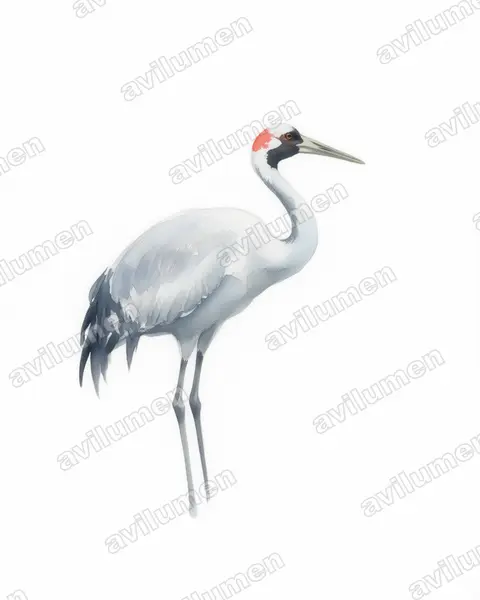
Watercolor 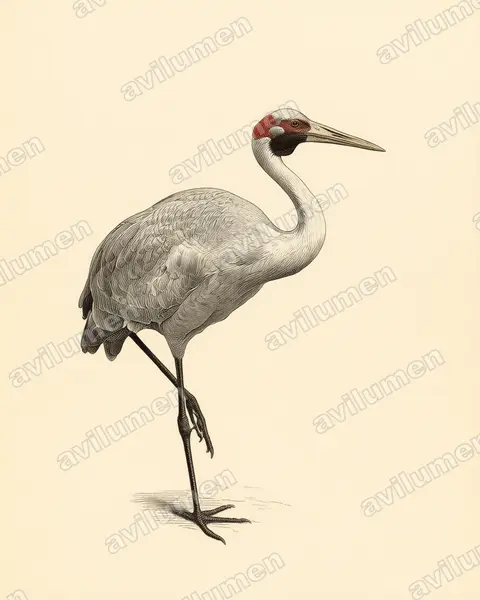
Vintage plate 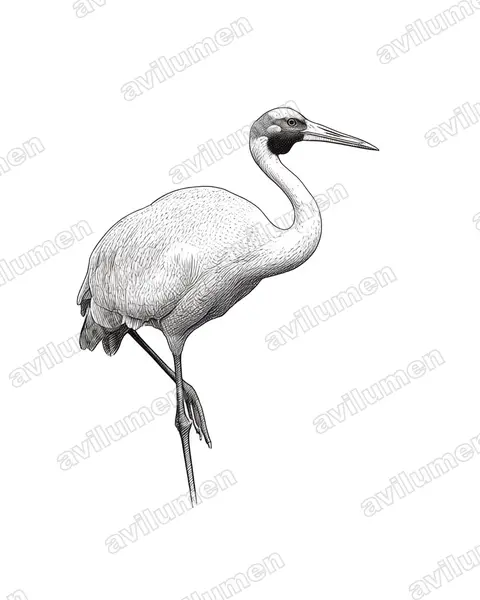
Ink 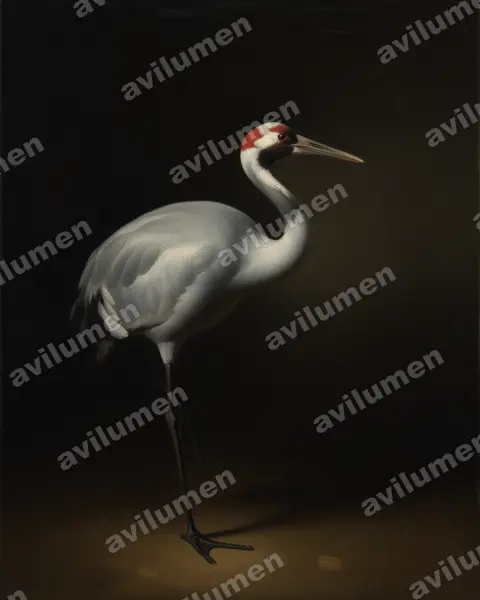
Oil 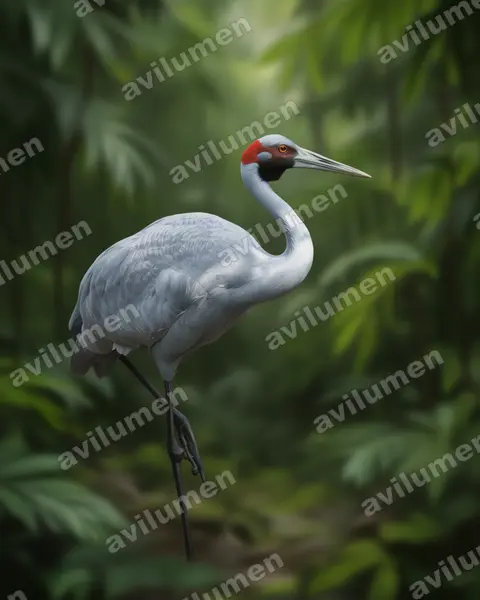
Realistic 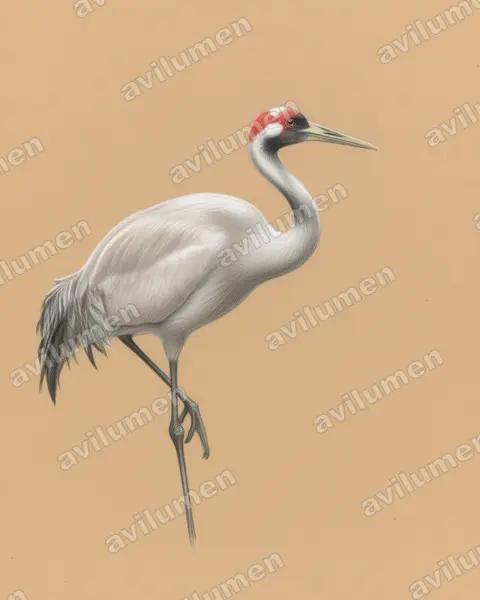
Colored pencil
Illustrations based on the photograph by jjron, edited by Fir0002 (CC BY-SA 3.0), from Wikimedia Commons.
Digital editions
HD Digital Art Pack — Brolga
Digital download: 6 high-resolution illustrations of the Brolga (Grus rubicunda), print-ready. This is a digital file; no animal or physical item is included.
AI Avatar — Brolga
Generate an avatar fusing your face with the Brolga (Grus rubicunda). Delivered digitally in 8K, watermark-free. Digital product; no animals are sold or brokered.
Instant download. No live birds are sold.
Frequently asked questions
- Is Grus rubicunda (Brolga) endangered?
- The IUCN Red List places Grus rubicunda, commonly known as the Brolga, in the «Least concern» category. «Least concern» means it is not currently threatened.
- Where does Grus rubicunda (Brolga) live?
- Grus rubicunda (Brolga) is found in Australia.
- What family does Grus rubicunda (Brolga) belong to?
- Grus rubicunda (Brolga) belongs to the family Gruidae, in the order Gruiformes.
- What colour is Grus rubicunda (Brolga)?
- The plumage of Grus rubicunda (Brolga) combines these colours: Grey.
More from the same family
 Vulnerable
Blue crane
Anthropoides paradiseus
The blue crane, also known as the Stanley crane and the paradise crane, is the national bird of South Africa. The species is listed as Vulnerable by the IUCN.
from $1.99
 Least concern
Demoiselle crane
Anthropoides virgo
The demoiselle crane is a species of crane found in central Eurosiberia, ranging from the Black Sea to Mongolia and Northeast China. There is also a small breeding population in Turkey. These cranes are migratory birds. Birds from western Eurasia will spend the winter in Africa while the birds from Asia, Mongolia and China will spend the winter in the Indian subcontinent.
from $1.99
 Not evaluated
Sarus crane
Antigone antigone
The sarus crane is a large nonmigratory crane found in parts of the Indian subcontinent, Southeast Asia, and northern Australia. The tallest of the flying birds, standing at a height of up to 1.8 m, they are a conspicuous species of open wetlands in South Asia, seasonally flooded Dipterocarpus forests in Southeast Asia, and Eucalyptus-dominated woodlands and grasslands in Australia.
from $1.99
 Not evaluated
White-naped crane
Antigone vipio
The white-naped crane is a bird in the crane family, Gruidae. It breeds in shallow wetlands and wet meadows in northeastern Mongolia, northeastern China, and adjacent areas of southeastern Russia. It is a large bird measuring 112–125 cm (44–49 in) long, about 130 cm (4.3 ft) tall, and weighing about 5.6 kg (12 lb), with pinkish legs, a grey-and-white-striped neck, and a red face patch.
from $1.99