Black-capped Kingfisher
Halcyon pileata
Avilumen editorial team ·

The black-capped kingfisher is a tree kingfisher which is widely distributed in tropical Asia from India east to China, Korea and Southeast Asia. This most northerly of the tree kingfishers is resident over much of its range, but northern populations are migratory, wintering south of their range in Sri Lanka, Thailand, Borneo and Java.
The black-capped kingfisher (Halcyon pileata) is a tree kingfisher which is widely distributed in tropical Asia from India east to China, Korea and Southeast Asia. This most northerly of the tree kingfishers is resident over much of its range, but northern populations are migratory, wintering south of their range in Sri Lanka, Thailand, Borneo and Java. It is distinctive in having a black cap that contrasts with the whitish throat, purple-blue wings and the coral red bill. The species is mainly found in coastal and mangrove habitats but can sometimes be found far inland.
Taxonomy
The black-capped kingfisher was described by the French polymath Georges-Louis Leclerc, Comte de Buffon in his Histoire Naturelle des Oiseaux in 1780. The bird was also illustrated in a hand-coloured plate engraved by François-Nicolas Martinet in the Planches Enluminées D'Histoire Naturelle, which was produced under the supervision of Edme-Louis Daubenton to accompany Buffon's text. Neither the plate caption nor Buffon's description included a scientific name, but in 1783 the Dutch naturalist Pieter Boddaert coined the binomial name Alcedo pileata in his catalogue of the Planches Enluminées. The type locality is China. The present genus Halcyon was introduced by the English naturalist and artist William Swainson in 1821. Halcyon is a name for a bird in Greek mythology generally associated with the kingfisher. The specific epithet pileata is from the Latin pileatus meaning '-capped'. The species is monotypic.
Description
This kingfisher is about 28 centimetres (11 in) long. The adult has purple-blue wings and back, black head and shoulders, white neck collar and throat, and rufous underparts. The large bill and legs are bright red. In flight, large white patches or "mirrors" at the base of the primaries are visible on the blue and black wings. Sexes are similar, but juveniles are a duller version of the adult and show streaks on the throat. The call of this kingfisher is a cackling ki-ki-ki-ki-ki.
Usually seen on coastal waters and especially in mangroves, it is easily disturbed. It perches conspicuously and dives to catch fish, and also feeds on large insects. The flight of the black-capped kingfisher is rapid and direct, the short rounded wings whirring.
The breeding season is in summer. The nest is a tunnel in an earth bank. A single clutch of 4-5 round, white eggs is typical.
A subspecies palawanensis has been described, but the species is considered to be monotypic with no clear plumage differences across its range.
Distribution and habitat
The species is found mainly near the coast in mangrove forests and along estuaries and rivers. The distribution ranges from India (including the Andaman and Nicobar Islands where they occur even on remote islands like Narcondam), Sri Lanka, Kansu, Shansi, Korea, Malay Peninsula, Thailand, Burma, Ryukyu Islands, Bangladesh, Hainan, Philippines (Palawan, Balabac, Basilan, Tawi Tawi), Borneo, Sumatra east to Sulawesi where it occurs only in winter. Vagrants in winter have been recorded in Pakistan, while movements related to rainfall may lead to their being found far inland and away from their usual distribution.
In culture
Like many other kingfishers, this species was much sought for the blue feathers for use in the millinery trade. Feathers were used in making fans in China. In Hong Kong, their feathers were cut and glued over ornaments used by women.
Text adapted from Wikipedia · CC BY-SA 4.0
Where it lives
Taxonomy
- Order
- Coraciiformes
- Family
- Alcedinidae
- Genus
- Halcyon
- Conservation status
- Vulnerable
Listen to its call
No recording yet
Illustration gallery
6 illustrations of Halcyon pileata (Black-capped Kingfisher) in different styles, true to its real plumage. Shown watermarked; the art pack includes the high-resolution originals, ready to print.
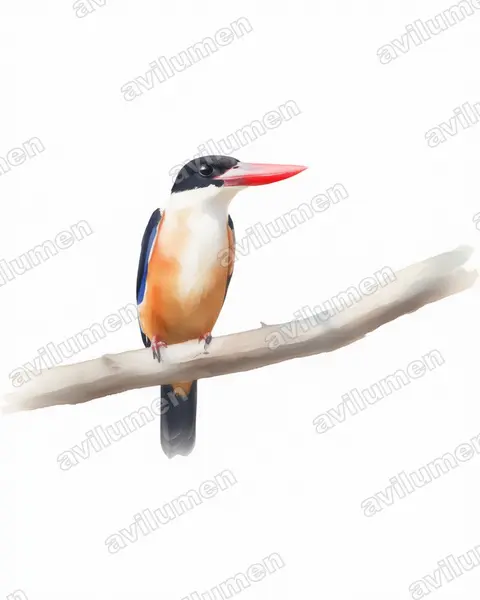
Watercolor 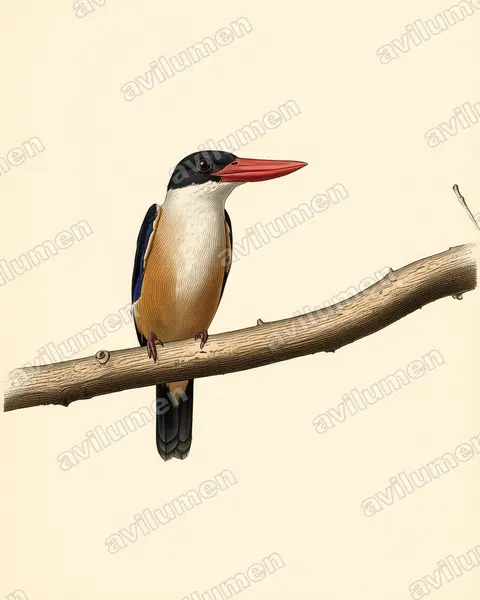
Vintage plate 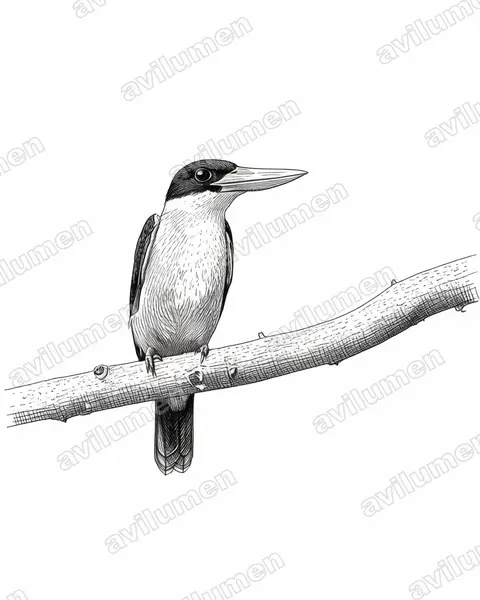
Ink 
Oil 
Realistic 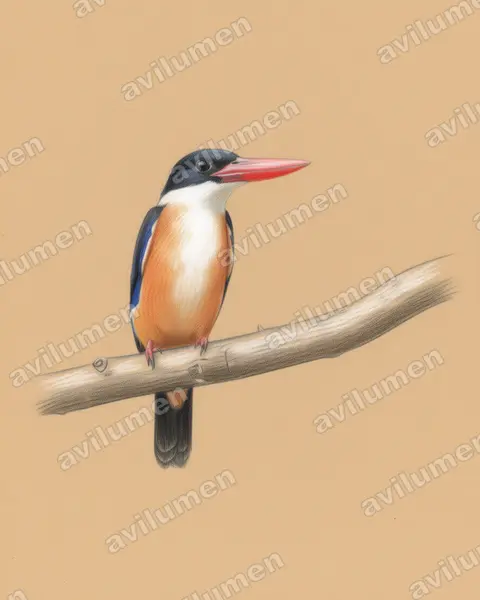
Colored pencil
Illustrations based on the photograph by JJ Harrison (https://www.jjharrison.com.au/) (CC BY-SA 3.0), from Wikimedia Commons.
Digital editions
HD Digital Art Pack — Black-capped Kingfisher
Digital download: 6 high-resolution illustrations of the Black-capped Kingfisher (Halcyon pileata), print-ready. This is a digital file; no animal or physical item is included.
AI Avatar — Black-capped Kingfisher
Generate an avatar fusing your face with the Black-capped Kingfisher (Halcyon pileata). Delivered digitally in 8K, watermark-free. Digital product; no animals are sold or brokered.
Instant download. No live birds are sold.
Frequently asked questions
- Is Halcyon pileata (Black-capped Kingfisher) endangered?
- The IUCN Red List places Halcyon pileata, commonly known as the Black-capped Kingfisher, in the «Vulnerable» category. «Vulnerable» means it faces a high risk of extinction in the medium term.
- Where does Halcyon pileata (Black-capped Kingfisher) live?
- Halcyon pileata (Black-capped Kingfisher) is found in People's Republic of China.
- What family does Halcyon pileata (Black-capped Kingfisher) belong to?
- Halcyon pileata (Black-capped Kingfisher) belongs to the family Alcedinidae, in the order Coraciiformes.
- What colour is Halcyon pileata (Black-capped Kingfisher)?
- The plumage of Halcyon pileata (Black-capped Kingfisher) combines these colours: Black and Blue.
More from the same family
 Least concern
Moustached Kingfisher
Actenoides bougainvillei
The moustached kingfisher, also called Bougainville moustached kingfisher, is a species of bird in the family Alcedinidae. It is endemic to Bougainville Island in Papua New Guinea. An estimated 1,300–7,000 mature individuals are left.
from $1.99
 Near threatened
Rufous-collared Kingfisher
Actenoides concretus
The rufous-collared kingfisher is a species of bird in the family Alcedinidae. It is found in Brunei, Indonesia, Malaysia, Myanmar, and Thailand. Its natural habitats are subtropical or tropical moist lowland forest and subtropical or tropical moist montane forest. It is threatened by habitat loss.
from $1.99
 Least concern
Hombron's Kingfisher
Actenoides hombroni
The blue-capped kingfisher, also known as Hombron's kingfisher, is a species of bird in the family Alcedinidae endemic to the Philippines and found only on Mindanao. It is one of the most colorful kingfishers in the country having a dark blue cap and wings with rufous spots, a striped rufous belly, white chin and red bill.
from $1.99
 Least concern
Spotted Wood Kingfisher
Actenoides lindsayi
The spotted wood kingfisher or spotted kingfisher is a species of bird in the family Alcedinidae. It is endemic to the Philippines found on the islands of Luzon, Catanduanes, Marinduque, Negros and Panay where its natural habitat is tropical moist lowland forests.
from $1.99