Woodland Kingfisher
Halcyon senegalensis
Avilumen editorial team ·

The woodland kingfisher is a tree kingfisher that is widely distributed in Africa south of the Sahara.
The woodland kingfisher (Halcyon senegalensis) is a tree kingfisher that is widely distributed in Africa south of the Sahara.
Taxonomy
The Swedish naturalist Carl Linnaeus included the woodland kingfisher with the binomial name Alcedo senegalensis in the twelfth edition of his Systema Naturae which was published in 1766. Linnaeus based his formal description on "Le Grand Martin-Pescher du Sénégal" that the French naturalist Mathurin Jacques Brisson had described and illustrated in 1760. The current genus Halcyon was introduced by the English naturalist and artist William Swainson in 1821, with the woodland kingfisher as the type species.
Three subspecies are recognised:
H. s. fuscopileus Reichenow, 1906 – Sierra Leone to south Nigeria and south to DR Congo and north Angola
H. s. senegalensis (Linnaeus, 1766) – Senegal and Gambia to Ethiopia and north Tanzania
H. s. cyanoleuca (Vieillot, 1818) – south Angola and west Tanzania to South Africa
Description
This is a medium-sized kingfisher, 23 cm (9.1 in) in length. The adult has a bright blue back, wing panel and tail. Its head, neck and underparts are white, and its shoulders are black. The flight of the woodland kingfisher is rapid and direct. The large bill has a red upper mandible and black lower mandible. The legs and feet are dark grey. Some birds may have greyish heads, causing confusion with mangrove kingfisher.
However, the lores are dark, creating a dark stripe through the eye (the stripe does not extend through the eye in mangrove kingfisher), and the underwing, primaries and secondaries are black with white underwing coverts (there is a black carpal patch on the white coverts in mangrove kingfisher). The inner webs of the base of the flight feathers are white, creating an indistinct white wingbar (white completely absent from wings in mangrove kingfisher). The breast is white (tends to be much greyer in mangrove kingfisher). The sexes are similar, but juveniles are duller than adults and have a brown bill.
The call of this noisy kingfisher is a loud trill sounding like a nail run down the teeth of a comb.
Distribution and habitat
The woodland kingfisher is widely distributed in tropical Africa south of the Sahara and from Pretoria northwards. This kingfisher is essentially resident within 8° of the equator, but northern and southern populations are migratory, moving into the equatorial zone in the dry season.
It is a common species of a variety of wooded habitats with some trees, especially Acacias, including around human habitation. Although it is a "kingfisher", it prefers drier habitats in more traditional woodland and can be far from water. It is often solitary but can occur in small groups.
Behaviour
The woodland kingfisher is aggressively territorial, attacking intruders including humans. It has a striking display in which the wings are spread to show the white linings.
Breeding
The nest is a tree hole excavated by a woodpecker or barbet. A single clutch of three round white eggs is typical. The young are cared for by both parents for up to five weeks after leaving the nest. Woodland Kingfisher breeding in the Transvaal takes place from November until March, peaking in December and January.
Feeding
It hunts from an exposed perch, often on a dead branch of a tree, or perches quietly in semi-shade while seeking food.
Interspecific relationships
The medium-sized, electric-blue-backed kingfisher distribution overlaps almost everywhere with the Brown-hooded Kingfisher H. albiventris, and they frequently occur alongside each other. Although it is similar to the Mangrove Kingfisher in appearance, the two are largely allopatric, use different habitats and differ in diet.
Text adapted from Wikipedia · CC BY-SA 4.0
Taxonomy
- Order
- Coraciiformes
- Family
- Alcedinidae
- Genus
- Halcyon
- Conservation status
- Least concern
Listen to its call
No recording yet
Illustration gallery
6 illustrations of Halcyon senegalensis (Woodland Kingfisher) in different styles, true to its real plumage. Shown watermarked; the art pack includes the high-resolution originals, ready to print.
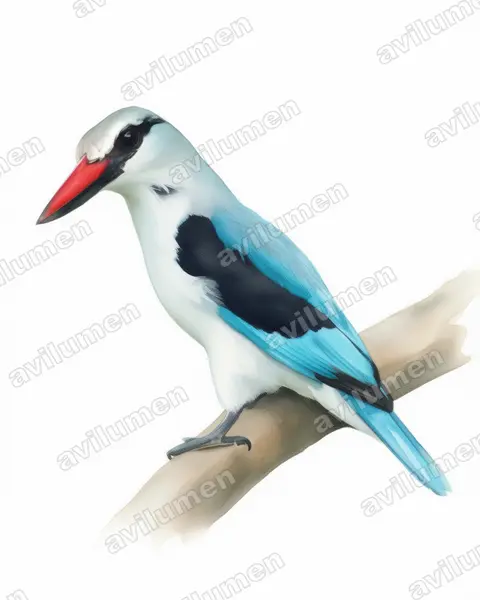
Watercolor 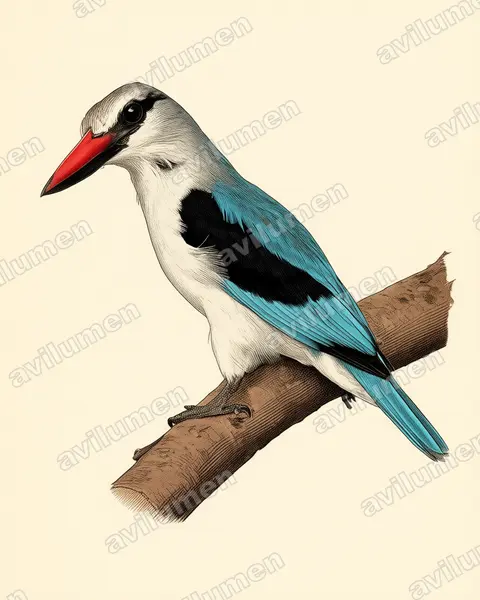
Vintage plate 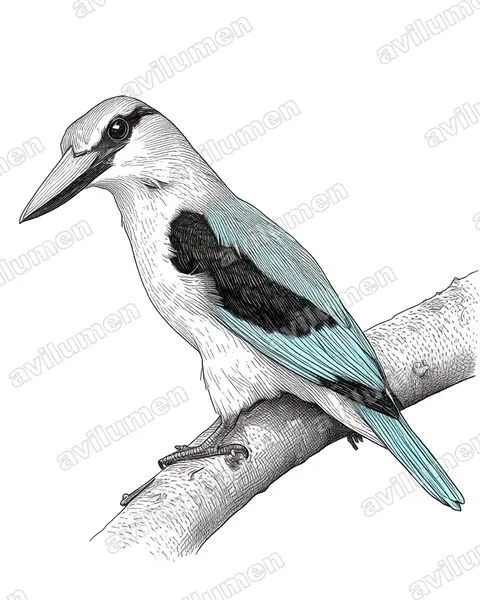
Ink 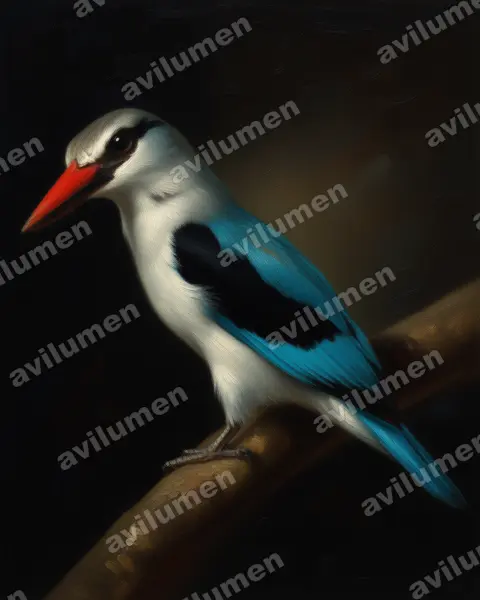
Oil 
Realistic 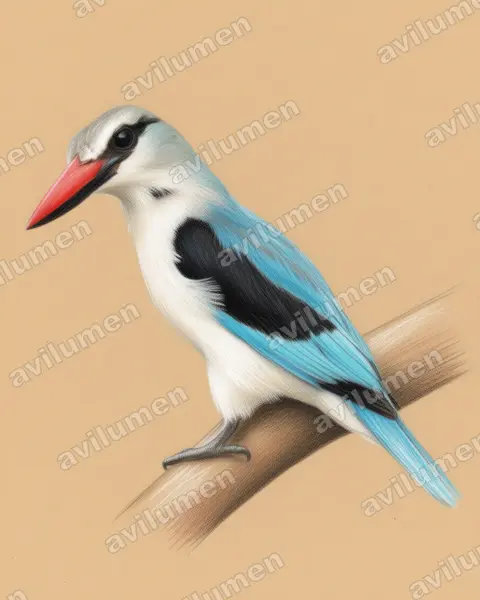
Colored pencil
Illustrations based on the photograph by Bernard DUPONT from FRANCE (CC BY-SA 2.0), from Wikimedia Commons.
Digital editions
HD Digital Art Pack — Woodland Kingfisher
Digital download: 6 high-resolution illustrations of the Woodland Kingfisher (Halcyon senegalensis), print-ready. This is a digital file; no animal or physical item is included.
AI Avatar — Woodland Kingfisher
Generate an avatar fusing your face with the Woodland Kingfisher (Halcyon senegalensis). Delivered digitally in 8K, watermark-free. Digital product; no animals are sold or brokered.
Instant download. No live birds are sold.
Frequently asked questions
- Is Halcyon senegalensis (Woodland Kingfisher) endangered?
- The IUCN Red List places Halcyon senegalensis, commonly known as the Woodland Kingfisher, in the «Least concern» category. «Least concern» means it is not currently threatened.
- Where does Halcyon senegalensis (Woodland Kingfisher) live?
- Halcyon senegalensis (Woodland Kingfisher) is found in Africa.
- What family does Halcyon senegalensis (Woodland Kingfisher) belong to?
- Halcyon senegalensis (Woodland Kingfisher) belongs to the family Alcedinidae, in the order Coraciiformes.
- What colour is Halcyon senegalensis (Woodland Kingfisher)?
- The plumage of Halcyon senegalensis (Woodland Kingfisher) combines these colours: Blue and White.
More from the same family
 Least concern
Moustached Kingfisher
Actenoides bougainvillei
The moustached kingfisher, also called Bougainville moustached kingfisher, is a species of bird in the family Alcedinidae. It is endemic to Bougainville Island in Papua New Guinea. An estimated 1,300–7,000 mature individuals are left.
from $1.99
 Near threatened
Rufous-collared Kingfisher
Actenoides concretus
The rufous-collared kingfisher is a species of bird in the family Alcedinidae. It is found in Brunei, Indonesia, Malaysia, Myanmar, and Thailand. Its natural habitats are subtropical or tropical moist lowland forest and subtropical or tropical moist montane forest. It is threatened by habitat loss.
from $1.99
 Least concern
Hombron's Kingfisher
Actenoides hombroni
The blue-capped kingfisher, also known as Hombron's kingfisher, is a species of bird in the family Alcedinidae endemic to the Philippines and found only on Mindanao. It is one of the most colorful kingfishers in the country having a dark blue cap and wings with rufous spots, a striped rufous belly, white chin and red bill.
from $1.99
 Least concern
Spotted Wood Kingfisher
Actenoides lindsayi
The spotted wood kingfisher or spotted kingfisher is a species of bird in the family Alcedinidae. It is endemic to the Philippines found on the islands of Luzon, Catanduanes, Marinduque, Negros and Panay where its natural habitat is tropical moist lowland forests.
from $1.99