Mangrove Kingfisher
Halcyon senegaloides
Avilumen editorial team ·

The mangrove kingfisher is a kingfisher in the genus Halcyon. It is similar in appearance to the woodland kingfisher. It is found along the eastern coastline of Sub-Saharan Africa, living in woodland, along rivers, and in estuaries and mangrove. The International Union for Conservation of Nature (IUCN) has assessed it as being of least concern.
The mangrove kingfisher (Halcyon senegaloides) is a kingfisher in the genus Halcyon. It is similar in appearance to the woodland kingfisher. It is found along the eastern coastline of Sub-Saharan Africa, living in woodland, along rivers, and in estuaries and mangrove. The International Union for Conservation of Nature (IUCN) has assessed it as being of least concern.
Taxonomy
This species was described by Andrew Smith in 1834, using a specimen collected around Port Natal (now Durban). It is a close relative of the woodland kingfisher (Halcyon senegalensis). The mangrove kingfisher is a monotypic species. Northern populations are sometimes separated as subspecies ranivorus, but the differences do not appear to be large enough.
Description
The mangrove kingfisher is about 22 cm (8.7 in) long. The male and female are alike. The head is dark grey-brown, with black lores and a narrow white line above the eye, and the cheeks and sides of the neck are brown-grey. The grey breast and flanks are vermiculated (having dense, irregular lines). There is a black patch under the wing. The rest of the plumage is similar to the woodland kingfisher, having black and blue covert and flight feathers. The beak of the mangrove kingfisher is red, the eyes are dark brown, and the legs are dark grey-brown. The juvenile bird is duller, has coarser vermiculations and a yellowish-buff wash on the breast, and has a brown beak. Birds in the south tend to have slightly longer wings and narrower beaks.
Distribution and habitat
This species is found near the eastern coast of Africa, from Somalia, south through Kenya, Tanzania and Mozambique, to South Africa. One individual has been recorded in eastern Zambia. It usually occurs within 20 km (12 mi) of the coast, but is also found inland along the Jubba and Zambezi rivers. It is considered a partial migrant. When not breeding, it lives in estuaries and mangrove, and also wooded shores, thornveld, forest, cultivated land, parks and gardens. To breed, it leaves estuaries and mangrove, moving to woodland and wooded rivers; these are generally farther inland, an exception being that they breed in the Zanzibar Archipelago.
Behaviour
This kingfisher catches fish and also eats crabs, prawns, lizards and insects. The song is a raucous, accelerating series of tchi notes, and the breeding display includes spreading the wings. Breeding has been recorded from October to January. Nests have been recorded in tree holes and termite nests.
Status
The population appears to be declining because of habitat loss, but the decline is not rapid, and the species has a large range, so the IUCN has assessed it as a least-concern species. Juveniles sometimes collide with human structures while migrating.
Text adapted from Wikipedia · CC BY-SA 4.0
Taxonomy
- Order
- Coraciiformes
- Family
- Alcedinidae
- Genus
- Halcyon
- Conservation status
- Least concern
Listen to its call
No recording yet
Illustration gallery
6 illustrations of Halcyon senegaloides (Mangrove Kingfisher) in different styles, true to its real plumage. Shown watermarked; the art pack includes the high-resolution originals, ready to print.
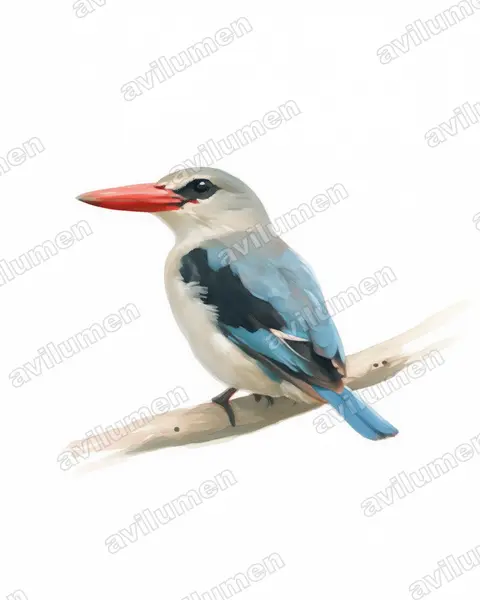
Watercolor 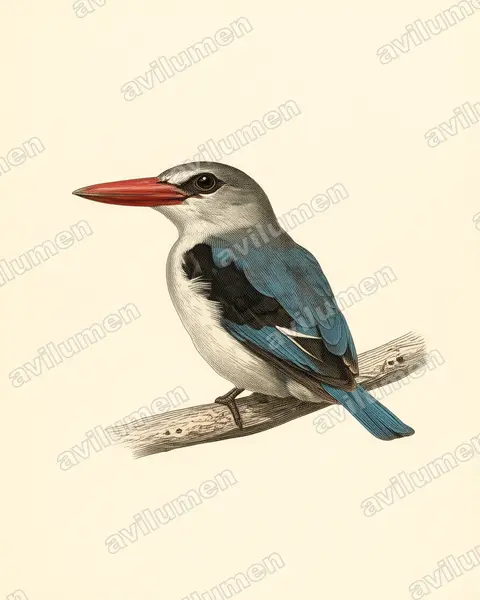
Vintage plate 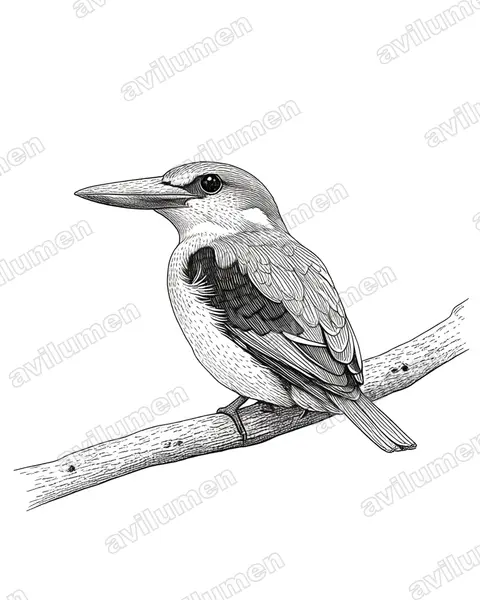
Ink 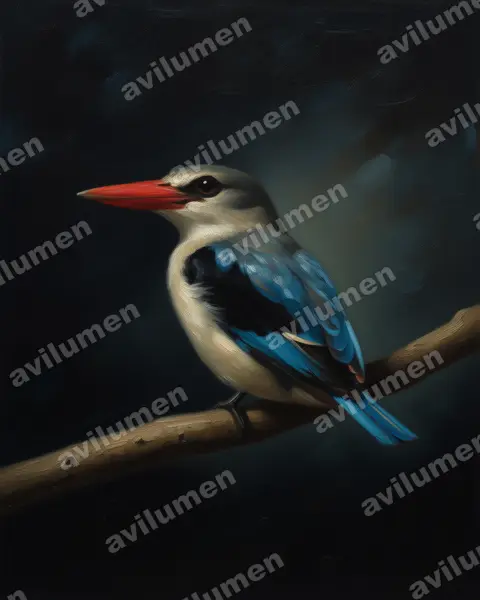
Oil 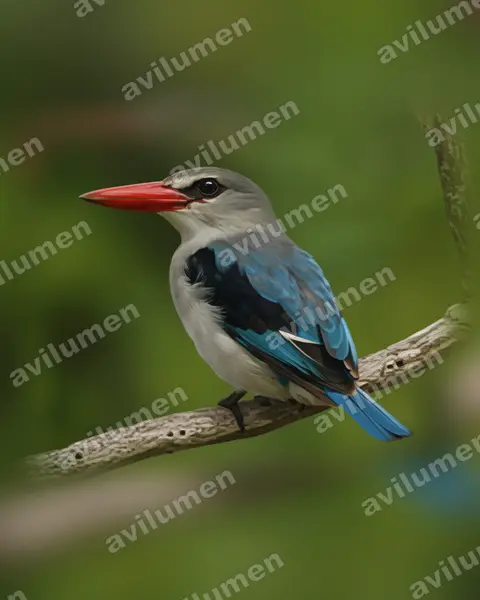
Realistic 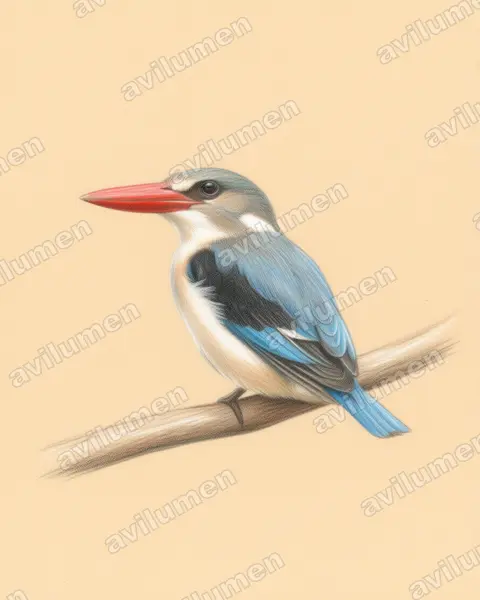
Colored pencil
Illustrations based on the photograph by Steve Garvie from Dunfermline, Fife, Scotland (CC BY-SA 2.0), from Wikimedia Commons.
Digital editions
HD Digital Art Pack — Mangrove Kingfisher
Digital download: 6 high-resolution illustrations of the Mangrove Kingfisher (Halcyon senegaloides), print-ready. This is a digital file; no animal or physical item is included.
AI Avatar — Mangrove Kingfisher
Generate an avatar fusing your face with the Mangrove Kingfisher (Halcyon senegaloides). Delivered digitally in 8K, watermark-free. Digital product; no animals are sold or brokered.
Instant download. No live birds are sold.
Frequently asked questions
- Is Halcyon senegaloides (Mangrove Kingfisher) endangered?
- The IUCN Red List places Halcyon senegaloides, commonly known as the Mangrove Kingfisher, in the «Least concern» category. «Least concern» means it is not currently threatened.
- Where does Halcyon senegaloides (Mangrove Kingfisher) live?
- Halcyon senegaloides (Mangrove Kingfisher) is found in Africa.
- What family does Halcyon senegaloides (Mangrove Kingfisher) belong to?
- Halcyon senegaloides (Mangrove Kingfisher) belongs to the family Alcedinidae, in the order Coraciiformes.
- What colour is Halcyon senegaloides (Mangrove Kingfisher)?
- The plumage of Halcyon senegaloides (Mangrove Kingfisher) combines these colours: Blue and White.
More from the same family
 Least concern
Moustached Kingfisher
Actenoides bougainvillei
The moustached kingfisher, also called Bougainville moustached kingfisher, is a species of bird in the family Alcedinidae. It is endemic to Bougainville Island in Papua New Guinea. An estimated 1,300–7,000 mature individuals are left.
from $1.99
 Near threatened
Rufous-collared Kingfisher
Actenoides concretus
The rufous-collared kingfisher is a species of bird in the family Alcedinidae. It is found in Brunei, Indonesia, Malaysia, Myanmar, and Thailand. Its natural habitats are subtropical or tropical moist lowland forest and subtropical or tropical moist montane forest. It is threatened by habitat loss.
from $1.99
 Least concern
Hombron's Kingfisher
Actenoides hombroni
The blue-capped kingfisher, also known as Hombron's kingfisher, is a species of bird in the family Alcedinidae endemic to the Philippines and found only on Mindanao. It is one of the most colorful kingfishers in the country having a dark blue cap and wings with rufous spots, a striped rufous belly, white chin and red bill.
from $1.99
 Least concern
Spotted Wood Kingfisher
Actenoides lindsayi
The spotted wood kingfisher or spotted kingfisher is a species of bird in the family Alcedinidae. It is endemic to the Philippines found on the islands of Luzon, Catanduanes, Marinduque, Negros and Panay where its natural habitat is tropical moist lowland forests.
from $1.99