Long-billed starthroat
Heliomaster longirostris
Avilumen editorial team ·

The long-billed starthroat is a species of hummingbird in the "mountain gems", tribe Lampornithini in subfamily Trochilinae. It is found in Mexico, Central America, Trinidad, and all but the four southernmost countries of South America.
The long-billed starthroat (Heliomaster longirostris) is a species of hummingbird in the "mountain gems", tribe Lampornithini in subfamily Trochilinae. It is found in Mexico, Central America, Trinidad, and all but the four southernmost countries of South America.
Taxonomy and systematics
At one time the long-billed starthroat was placed in genus Anthoscenus but since the mid-1900s has had its current placement in Heliomaster. It has three subspecies, the nominate H. l. longirostris, H. l. pallidicepts, and H. l. albicrissa.
Description
The long-billed starthroat is 11 to 12 cm (4.3 to 4.7 in) long. Males weigh 5.5 to 7.1 g (0.19 to 0.25 oz) and females about 6.5 g (0.23 oz). Both sexes of all subspecies have a long, almost straight, black bill and a small white spot behind the eye.
Males of the nominate subspecies have a glittering blue to greenish blue crown; the rest of its upperparts are dark bronzy green with the exception of a white stripe down the center of the rump. The face is black below the crown and has a white malar stripe below the black. Its tail is rather short and square-tipped. The feathers are bronzy green near the body and black away from it, and the outer two or three pairs have white tips. The chin is black, the gorget dark metallic purple, the breast gray with bronzy green sides, and the lower breast and belly dull white. The undertail coverts are gray with white edges. Nominate females are very similar but the blue of the crown is much reduced or absent and the gorget is narrower and dusky gray.
Subspecies H. l. pallidicepts has a more greenish blue crown than the nominate and the sides of the breast are golden bronze. H. l. albicrissa is identical to the nominate except that its undertail coverts are mostly to entirely white.
Distribution and habitat
Subspecies H. l. pallidicepts of long-billed starthroat is the northernmost; it is found from southern Mexico through Belize, Guatemala, Honduras, and El Salvador into Nicaragua. The nominate H. l. longirostris is the most widespread. It is found from Costa Rica through Panama, into South America as far south as eastern Peru and eastern Bolivia and east through the Guianas well into Brazil, and on Trinidad. H. l. albicrissa has a restricted range in western Ecuador and northwestern Peru. The species inhabits a variety of humid semi-open landscapes including the edges of woodland, isolated woodlands, pastures with trees, gallery forest, and secondary forest. It shuns the interior of closed forest. It is a bird of the lowlands and foothills that ranges in elevation from sea level to about 1,500 m (4,900 ft).
Movement
The long-billed starthroat has erratic and poorly understood movements. It seems to move in response to the flowering of different plant communities.
Feeding
The long-billed starthroat feeds on nectar, especially at the flowers of large trees but also those of vines, shrubs, and Heliconia. It forages both by trap-lining (visiting a circuit of flowering plants) and by defending flower-laden trees. It also feeds on small insects, often capturing them on the wing high in the air and sometimes by gleaning from vegetation.
Breeding
The long-billed starthroat breeds from the late wet season into the early dry season in the northern parts of its range. The span in Mexico and Central America is from October/November to February/March. Two broods per season have been observed in Central America. In northern Colombia it nests at least in September/October and March. The timing of breeding is not known in the rest of the species' range. The nest is a shallow cup made of plant down, moss, and liverworts cemented with spider silk and covered with lichen. It is typically placed between 4.5 and 12 m (15 and 39 ft) above the ground in a shrub, on an exposed branch, and even on a telephone wire. The female incubates the two white eggs for 18 to 19 days; fledging occurs 25 to 26 days after hatch.
Vocalization
The long-billed starthroat's calls include "a rich liquid 'tseep' or 'tsew'" and "sqeaky twitters"; the latter is made during chases.
Status
The IUCN has assessed the long-billed starthroat as being of Least Concern. It has a very large range and a population of at least 500,000 mature individuals. The population, however, is believed to be decreasing. No immediate threats have been identified. It is considered uncommon in most of its range but occurs in several protected areas. It is "evidently able to tolerate much disturbance, and perhaps even favoured by deforestation, as long as scattered trees and groves remain."
Text adapted from Wikipedia · CC BY-SA 4.0
Where it lives
Distribution

Taxonomy
- Order
- Apodiformes
- Family
- Trochilidae
- Genus
- Heliomaster
- Conservation status
- Least concern
Listen to its call
No recording yet
Illustration gallery
6 illustrations of Heliomaster longirostris (Long-billed starthroat) in different styles, true to its real plumage. Shown watermarked; the art pack includes the high-resolution originals, ready to print.
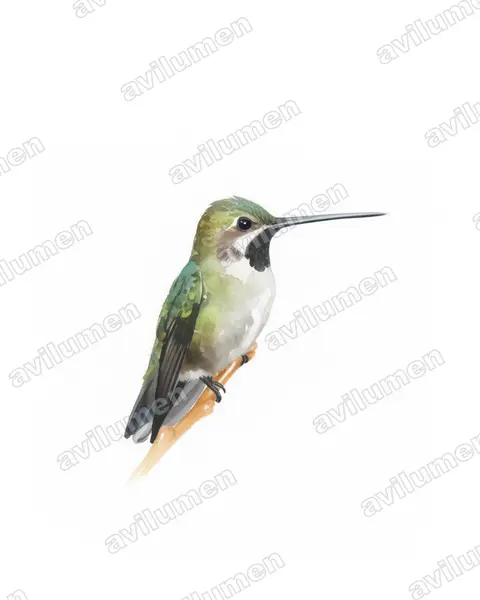
Watercolor 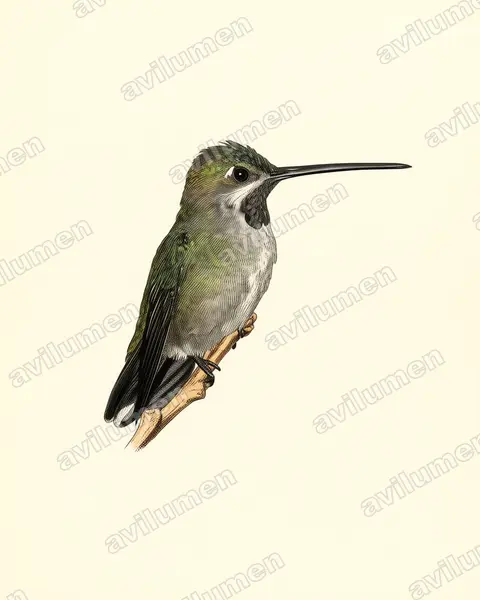
Vintage plate 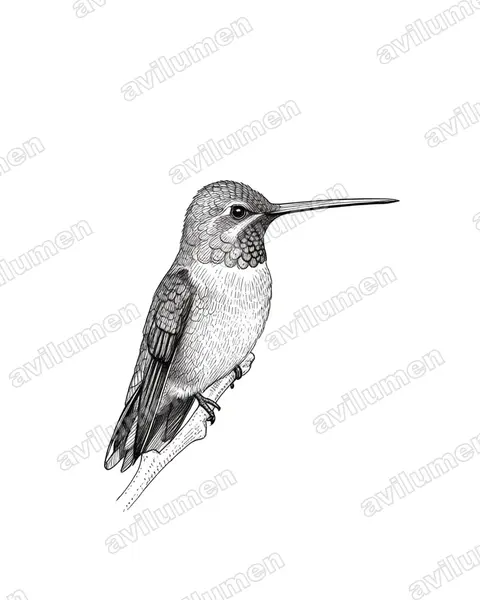
Ink 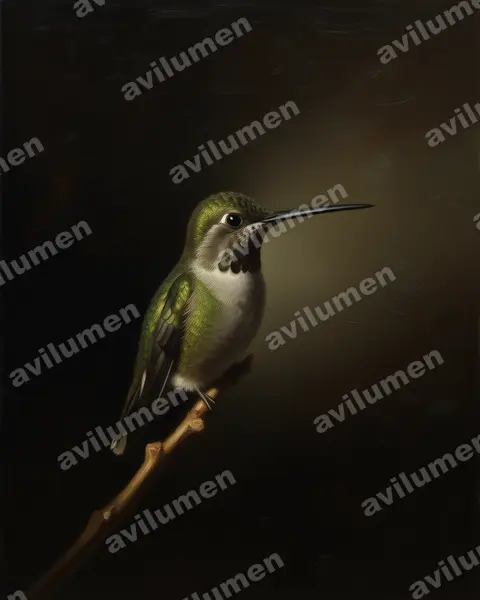
Oil 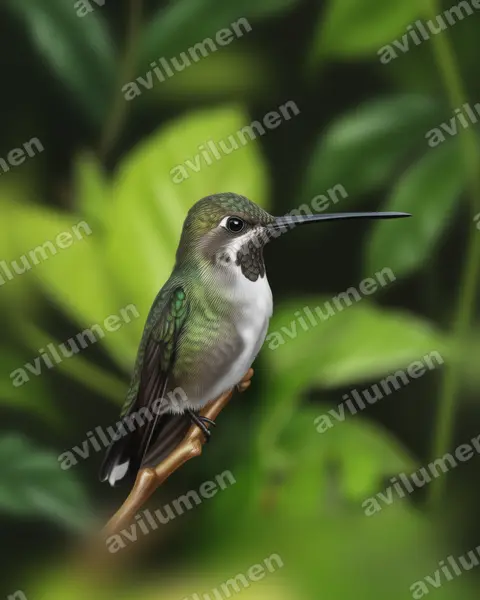
Realistic 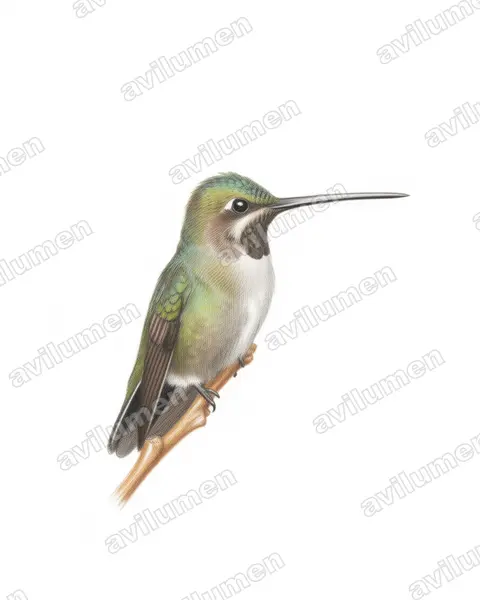
Colored pencil
Illustrations based on the photograph by Charles J. Sharp (CC BY-SA 4.0), from Wikimedia Commons.
Digital editions
HD Digital Art Pack — Long-billed starthroat
Digital download: 6 high-resolution illustrations of the Long-billed starthroat (Heliomaster longirostris), print-ready. This is a digital file; no animal or physical item is included.
AI Avatar — Long-billed starthroat
Generate an avatar fusing your face with the Long-billed starthroat (Heliomaster longirostris). Delivered digitally in 8K, watermark-free. Digital product; no animals are sold or brokered.
Instant download. No live birds are sold.
Frequently asked questions
- Is Heliomaster longirostris (Long-billed starthroat) endangered?
- The IUCN Red List places Heliomaster longirostris, commonly known as the Long-billed starthroat, in the «Least concern» category. «Least concern» means it is not currently threatened.
- Where does Heliomaster longirostris (Long-billed starthroat) live?
- Heliomaster longirostris (Long-billed starthroat) is found in Brazil and South America.
- What family does Heliomaster longirostris (Long-billed starthroat) belong to?
- Heliomaster longirostris (Long-billed starthroat) belongs to the family Trochilidae, in the order Apodiformes.
- What colour is Heliomaster longirostris (Long-billed starthroat)?
- The plumage of Heliomaster longirostris (Long-billed starthroat) combines these colours: Green and Blue.
More from the same family
 Least concern
Emerald-chinned Hummingbird
Abeillia abeillei
The emerald-chinned hummingbird is a species of hummingbird in the "emeralds", tribe Trochilini of subfamily Trochilinae.
from $1.99
 Least concern
Speckled hummingbird
Adelomyia melanogenys
The speckled hummingbird is a species of hummingbird. It is the only member of the genus Adelomyia. It inhabits Neotropical montane cloud forests at elevations of 1,000–2,500 meters and is confined to the Andes of Argentina, Bolivia, Peru, Ecuador, Colombia and Venezuela; as well as to some isolated montane forests in western Ecuador and Venezuela.
from $1.99
 Vulnerable
Purple-backed sunbeam
Aglaeactis aliciae
The purple-backed sunbeam is a bird species in the family Trochilidae. It is found only in Peru.
from $1.99
 Near threatened
White-tufted sunbeam
Aglaeactis castelnaudii
The white-tufted sunbeam is a species of hummingbird in the family Trochilidae. It is found only in Peru. Its natural habitats are subtropical or tropical moist montane forest and subtropical or tropical high-altitude shrubland.
from $1.99