African Pygmy Kingfisher
Ispidina picta
Avilumen editorial team ·

The African pygmy kingfisher is a small insectivorous kingfisher found in the Afrotropics, mostly in woodland habitats.
The African pygmy kingfisher (Ispidina picta) is a small insectivorous kingfisher found in the Afrotropics, mostly in woodland habitats.
Taxonomy
The African pygmy kingfisher was described by the French polymath Georges-Louis Leclerc, Comte de Buffon in 1780 in his Histoire Naturelle des Oiseaux. The bird was also illustrated in a hand-coloured plate engraved by François-Nicolas Martinet in the Planches Enluminées D'Histoire Naturelle which was produced under the supervision of Edme-Louis Daubenton to accompany Buffon's text. Neither the plate caption nor Buffon's description included a scientific name but in 1783 the Dutch naturalist Pieter Boddaert coined the binomial name Todier de Juida in his catalogue of the Planches Enluminées. The type locality is Saint Louis, Senegal. The African pygmy kingfisher is now placed in the genus Ispidina that was introduced by the German naturalist Johann Jakob Kaup in 1848.
The specific epithet picta is from the Latin pictus meaning "painted". Some texts refer to this species as Ceyx pictus.
There are three subspecies:
I. p. picta (Boddaert, 1783) — Senegal and Gambia to Ethiopia, and south to Uganda
I. p. ferrugina Clancey, 1984 — Guinea-Bissau to western Uganda, and south to Angola, Zambia, and northern Tanzania
I. p. natalensis (Smith, A, 1832) — southern Angola to central Tanzania south to northern and eastern South Africa
Description
The African pygmy kingfisher is 12 cm (4.7 in) in length. The sexes are alike. It is a very small kingfisher with rufous underparts and a blue back extending down to the tail. The dark blue crown of the adult separates it from the African dwarf kingfisher. The smaller size and violet wash on the ear coverts distinguish it from the similar malachite kingfisher.
The natalensis subspecies occurring in the south of the range has paler underparts and a blue spot above the white ear patch. Juveniles have less extensive violet on their ear coverts and a black rather than orange bill.
The call is a high-pitched insect-like "tsip-tsip" given in flight.
Distribution and habitat
The African pygmy kingfisher is distributed widely in Africa south of the Sahara, where it is a common resident and intra-African migrant. It is absent from much of the horn of Africa, and also the drier western regions of Southern Africa. It is found in woodland, savanna and coastal forest, and it is not bound to water. It is usually found either singly or in pairs and is secretive and unobtrusive.
Breeding
African pygmy kingfishers nest in burrows that are dug by both sexes in sandy soil banks or into a ground termite nest. The burrows are between 30 and 60 cm (12 and 24 in) in length. The clutch is four to six white eggs. Both parents care for the young. They can have several broods in a year.
Feeding
The African pygmy kingfisher's diet consists of insects like grasshoppers, praying mantis, worms, crickets, dragonflies, cockroaches, and moths. They are also known to take spiders which make up quite a large part of their diet. They also take geckos and lizards that are easily their length and small frogs and even occasionally small crabs. Prey are hunted from low perches and once caught are either crushed in the beak or smashed against the perch.
Migration
The southern subspecies overwinters as far north as 2°N (DRC, Uganda, South Sudan, and Kenya). They are thought to migrate mainly at night; most leave their breeding grounds in March and April, and return in September or October.
Text adapted from Wikipedia · CC BY-SA 4.0
Taxonomy
- Order
- Coraciiformes
- Family
- Alcedinidae
- Genus
- Ispidina
- Conservation status
- Least concern
Listen to its call
No recording yet
Illustration gallery
6 illustrations of Ispidina picta (African Pygmy Kingfisher) in different styles, true to its real plumage. Shown watermarked; the art pack includes the high-resolution originals, ready to print.

Watercolor 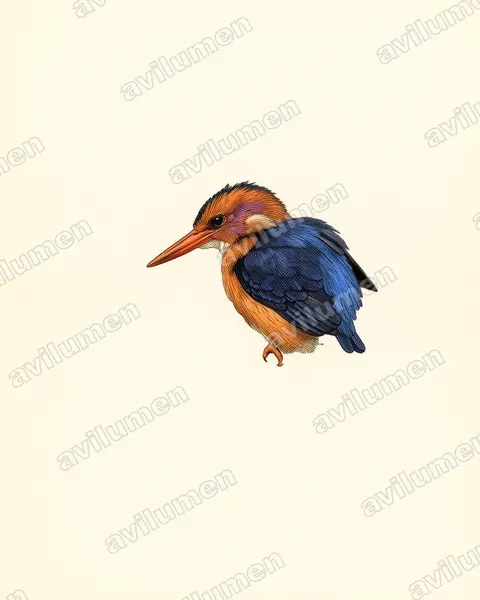
Vintage plate 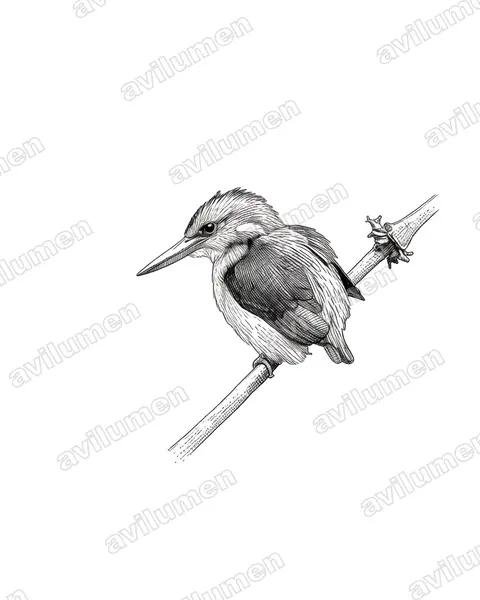
Ink 
Oil 
Realistic 
Colored pencil
Illustrations based on the photograph by Giles Laurent (CC BY-SA 4.0), from Wikimedia Commons.
Digital editions
HD Digital Art Pack — African Pygmy Kingfisher
Digital download: 6 high-resolution illustrations of the African Pygmy Kingfisher (Ispidina picta), print-ready. This is a digital file; no animal or physical item is included.
AI Avatar — African Pygmy Kingfisher
Generate an avatar fusing your face with the African Pygmy Kingfisher (Ispidina picta). Delivered digitally in 8K, watermark-free. Digital product; no animals are sold or brokered.
Instant download. No live birds are sold.
Frequently asked questions
- Is Ispidina picta (African Pygmy Kingfisher) endangered?
- The IUCN Red List places Ispidina picta, commonly known as the African Pygmy Kingfisher, in the «Least concern» category. «Least concern» means it is not currently threatened.
- Where does Ispidina picta (African Pygmy Kingfisher) live?
- Ispidina picta (African Pygmy Kingfisher) is found in Africa.
- What family does Ispidina picta (African Pygmy Kingfisher) belong to?
- Ispidina picta (African Pygmy Kingfisher) belongs to the family Alcedinidae, in the order Coraciiformes.
- What colour is Ispidina picta (African Pygmy Kingfisher)?
- The plumage of Ispidina picta (African Pygmy Kingfisher) combines these colours: Green and Yellow.
More from the same family
 Least concern
Moustached Kingfisher
Actenoides bougainvillei
The moustached kingfisher, also called Bougainville moustached kingfisher, is a species of bird in the family Alcedinidae. It is endemic to Bougainville Island in Papua New Guinea. An estimated 1,300–7,000 mature individuals are left.
from $1.99
 Near threatened
Rufous-collared Kingfisher
Actenoides concretus
The rufous-collared kingfisher is a species of bird in the family Alcedinidae. It is found in Brunei, Indonesia, Malaysia, Myanmar, and Thailand. Its natural habitats are subtropical or tropical moist lowland forest and subtropical or tropical moist montane forest. It is threatened by habitat loss.
from $1.99
 Least concern
Hombron's Kingfisher
Actenoides hombroni
The blue-capped kingfisher, also known as Hombron's kingfisher, is a species of bird in the family Alcedinidae endemic to the Philippines and found only on Mindanao. It is one of the most colorful kingfishers in the country having a dark blue cap and wings with rufous spots, a striped rufous belly, white chin and red bill.
from $1.99
 Least concern
Spotted Wood Kingfisher
Actenoides lindsayi
The spotted wood kingfisher or spotted kingfisher is a species of bird in the family Alcedinidae. It is endemic to the Philippines found on the islands of Luzon, Catanduanes, Marinduque, Negros and Panay where its natural habitat is tropical moist lowland forests.
from $1.99