Grey-tailed mountaingem
Lampornis cinereicauda
Avilumen editorial team ·

The white-throated mountaingem or white-throated mountain-gem is a species of hummingbird in tribe Lampornithini of subfamily Trochilinae. It is endemic to the highlands of Costa Rica and Panama.
The white-throated mountaingem or white-throated mountain-gem (Lampornis castaneoventris) is a species of hummingbird in tribe Lampornithini of subfamily Trochilinae. It is endemic to the highlands of Costa Rica and Panama.
Taxonomy
The white-throated mountaingem was formally described in 1851 by the English ornithologist John Gould based on a specimen collected by the Polish botanist Józef Warszewicz at an altidude of 1,800 m (6,000 ft) in the Cordillera de Chiriquí of western Panama. Gould coined the binomial name Trichilus castaneoventris where the specific epithet combines the Latin castaneus meaning "chestnut-brown" with venter, ventris meaning "belly". The white-throated mountaingem is now one of seven species placed in the genus Lampornis that was introduced in 1827 by the English zoologist William Swainson.
Two subspecies are recognised:
L. c. cinereicauda (Lawrence, GN, 1867) – southern Costa Rica (Cordillera de Talamanca)
L. c. castaneoventris (Gould, J, 1851) – montane forest of far western Panama
The subspecies L. c. cinereicauda has sometimes been considered a separate species, the gray-tailed mountaingem. In 1999 Karl-Ludwig Schuchmann in the Handbook of Birds of the World treated both the purple-throated mountaingem and the gray-tailed mountaingem as conspecific with the white-throated mountaingem, and used the English name, "Variable mountain-gem". Molecular genetic analyses using both mitochondrial and nuclear DNA sequences found that L. c. cinereicauda, L. c. castaneoventris and the purple-throated mountaingem (Lampornis calolaemus) formed a shallow unresolved clade.
Description
The grey-tailed mountaingem is about 12 cm (4.7 in) long and weighs about 5 to 6 g (0.18 to 0.21 oz). It has a medium-length straight black bill, dark cheeks, and a white stripe behind the eye. Males have mostly dark bronzy green upperparts with an emerald green crown and a black to bluish black tail. Their chin and throat are white, the sides of the neck and upper breast bright green, and the lower breast and vent area dark gray. Females have entirely bright green upperparts. Their central tail feathers are dark metallic to bronze green and the outer ones paler. Their throat and belly are dark rufous and the undertail coverts are gray with white or buff edges.
Distribution and habitat
The white-throated mountaingem is found only in the mountains of western Panama's Chiriquí Province and south-central Costa Rica. It inhabits the interior, edges, and shrubby clearings of oak forest and also gardens in communities near the forest. In elevation it ranges from 1,500 m (4,900 ft) up to timberline.
Movement
The white-throated mountaingem is a year-round resident.
Feeding
The white-throated mountaingem feeds on nectar from a variety of flowering plants. Males typically feed at epiphytes in the forest interior while females more often feed in shrubby areas. Males are territorial, defending flower patches. They are dominant over smaller hummingbirds and subordinate to larger ones like the fiery-throated hummingbird (Panterpe insignis). The species also feeds on small arthropods gleaned from foliage.
Breeding
The white-throated mountaingem's breeding season spans from October to April. Its nest is a cup of fine fibers with moss and some lichen on the outside. The incubation length and time to fledging are not known.
Vocalization
The white-throated mountaingem makes high pitched calls described as "ziit or ziip" and also "a 'sputtery, bubbly' song".
Status
The IUCN has assessed the white-throated mountaingem as being of Least Concern, though it has a small range and its population size and trend are unknown. It is considered common. However, "this hummingbird is potentially threatened by human activities" such as deforestation for timber and agriculture.
Text adapted from Wikipedia · CC BY-SA 4.0
Distribution

Taxonomy
- Order
- Apodiformes
- Family
- Trochilidae
- Genus
- Lampornis
- Conservation status
- Least concern
Listen to its call
No recording yet
Illustration gallery
6 illustrations of Lampornis cinereicauda (Grey-tailed mountaingem) in different styles, true to its real plumage. Shown watermarked; the art pack includes the high-resolution originals, ready to print.
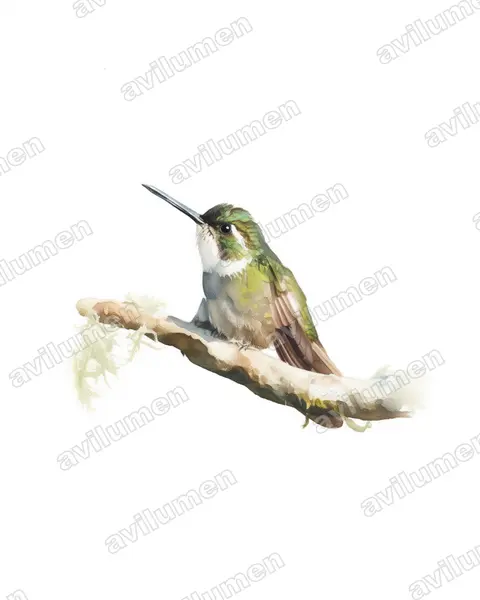
Watercolor 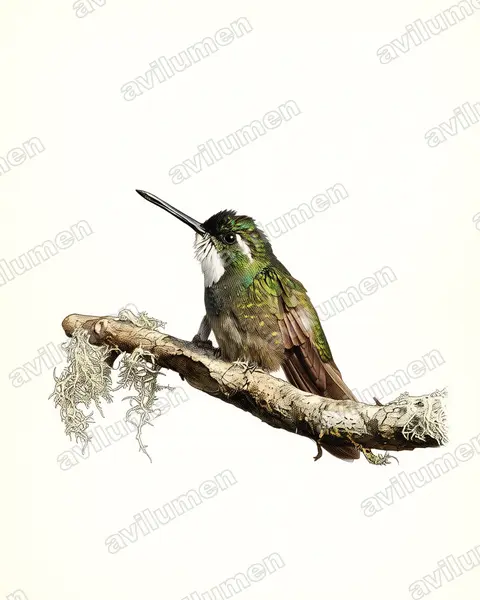
Vintage plate 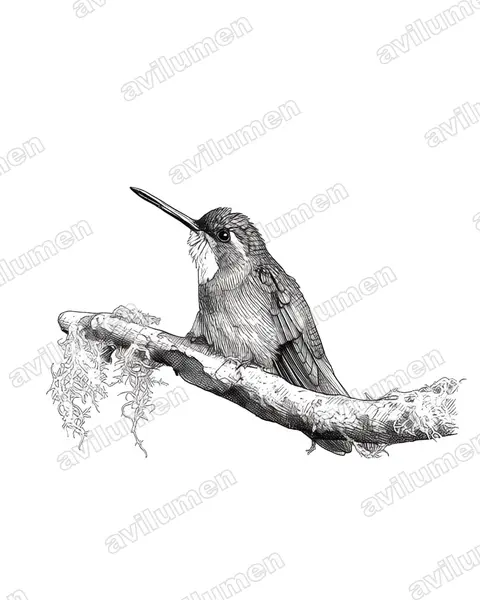
Ink 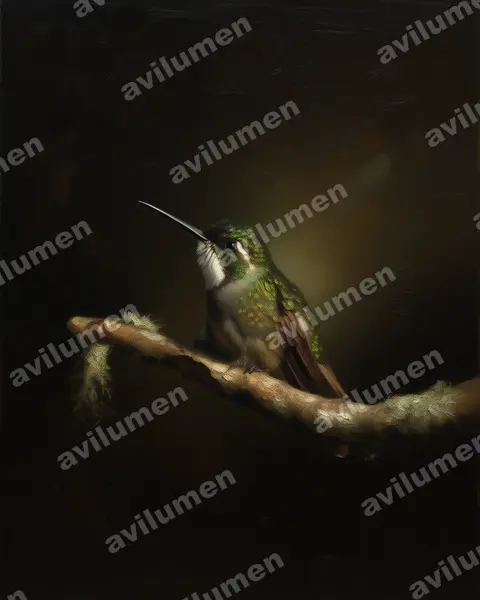
Oil 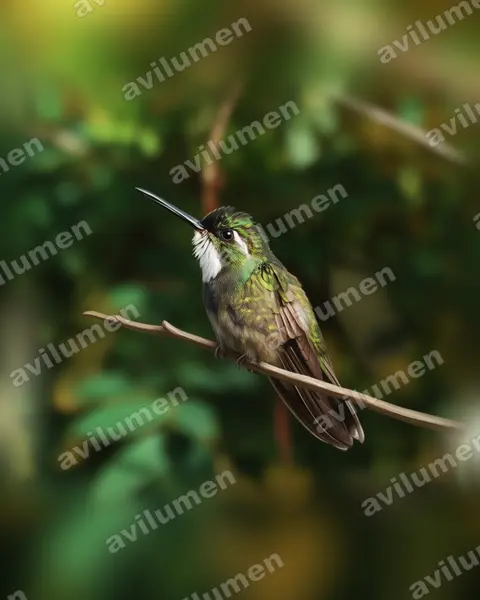
Realistic 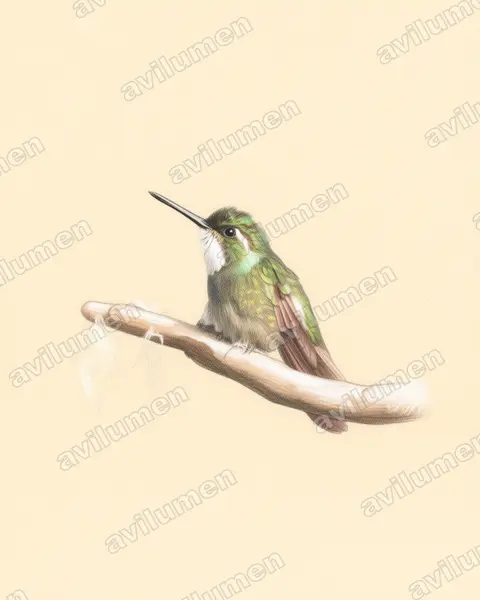
Colored pencil
Illustrations based on the photograph by Jerry Oldenettel from Socorro, NM, USA (CC BY-SA 2.0), from Wikimedia Commons.
Digital editions
HD Digital Art Pack — Grey-tailed mountaingem
Digital download: 6 high-resolution illustrations of the Grey-tailed mountaingem (Lampornis cinereicauda), print-ready. This is a digital file; no animal or physical item is included.
AI Avatar — Grey-tailed mountaingem
Generate an avatar fusing your face with the Grey-tailed mountaingem (Lampornis cinereicauda). Delivered digitally in 8K, watermark-free. Digital product; no animals are sold or brokered.
Instant download. No live birds are sold.
Frequently asked questions
- Is Lampornis cinereicauda (Grey-tailed mountaingem) endangered?
- The IUCN Red List places Lampornis cinereicauda, commonly known as the Grey-tailed mountaingem, in the «Least concern» category. «Least concern» means it is not currently threatened.
- What family does Lampornis cinereicauda (Grey-tailed mountaingem) belong to?
- Lampornis cinereicauda (Grey-tailed mountaingem) belongs to the family Trochilidae, in the order Apodiformes.
- What colour is Lampornis cinereicauda (Grey-tailed mountaingem)?
- The plumage of Lampornis cinereicauda (Grey-tailed mountaingem) combines these colours: Grey and Green.
More from the same family
 Least concern
Emerald-chinned Hummingbird
Abeillia abeillei
The emerald-chinned hummingbird is a species of hummingbird in the "emeralds", tribe Trochilini of subfamily Trochilinae.
from $1.99
 Least concern
Speckled hummingbird
Adelomyia melanogenys
The speckled hummingbird is a species of hummingbird. It is the only member of the genus Adelomyia. It inhabits Neotropical montane cloud forests at elevations of 1,000–2,500 meters and is confined to the Andes of Argentina, Bolivia, Peru, Ecuador, Colombia and Venezuela; as well as to some isolated montane forests in western Ecuador and Venezuela.
from $1.99
 Vulnerable
Purple-backed sunbeam
Aglaeactis aliciae
The purple-backed sunbeam is a bird species in the family Trochilidae. It is found only in Peru.
from $1.99
 Near threatened
White-tufted sunbeam
Aglaeactis castelnaudii
The white-tufted sunbeam is a species of hummingbird in the family Trochilidae. It is found only in Peru. Its natural habitats are subtropical or tropical moist montane forest and subtropical or tropical high-altitude shrubland.
from $1.99