Marvelous spatuletail
Loddigesia mirabilis
Avilumen editorial team ·

The marvelous spatuletail is an endangered species of hummingbird in the "brilliants", tribe Heliantheini in subfamily Lesbiinae. It is endemic to northern Peru.
The marvelous spatuletail (Loddigesia mirabilis) is an endangered species of hummingbird in the "brilliants", tribe Heliantheini in subfamily Lesbiinae. It is endemic to northern Peru.
Taxonomy and systematics
The marvelous spatuletail is currently (early 2022) treated by worldwide taxonomic systems as the only member of its genus. However, a molecular phylogenetic study of the hummingbirds published in 2014 found that the marvelous spatuletail was embedded in genus Eriocnemis, the "pufflegs". Moving it to Eriocnemis would require that the colorful puffleg (currently E. mirabilis) receive a new specific epithet because the spatuletail's mirabilis has priority.
Description
The male marvelous spatuletail is 15 to 17 cm (5.9 to 6.7 in) long including its 11 to 13 cm (4.3 to 5.1 in) tail. Females are 9 to 10 cm (3.5 to 3.9 in) long with a 5 to 7 cm (2.0 to 2.8 in) tail. The male's signature feature is its two outer tail feathers with bare shafts that cross each other and end in large purplish black racquets or "spatules". The remaining tail feathers are very short and are supported by two long undertail coverts. The female's outer tail feathers are also long, but shorter than the male's, and do not have the racquets.
Both sexes have a slightly decurved black bill and a white spot behind the eye. Males have mostly green upperparts with a blue crest and a brownish hindneck. Their gorget is glossy blue-green and the rest of the underparts are white with a black line down the center. Females are also green above but do not have a crest or gorget. Their underparts are white without the male's black central line.
Distribution and habitat
The marvelous spatuletail is found only in a small area in the Andes of northern Peru. Most records are from the valley of the Utcubamba River in Amazonas Department with a few further east in the Department of San Martín. It inhabits the edges of mature forest, secondary forest, and montane scrublands. It is partial to thickets of thorny Rubus with alder (Alnus). In elevation it ranges between 2,100 and 2,900 m (6,900 and 9,500 ft) though there are unconfirmed reports both higher and lower.
Movement
The marvelous spatuletail is a year-round resident of its range.
Feeding
The marvelous spatuletail forages by trap-lining, visiting a circuit of flowering plants where it perches to feed. It is most often seen feeding at a red-flowered lily (Bomarea formosissima) but has been observed feeding in at least five other species of flowering plants. It is dominated by other hummingbird species that share its range.
Breeding
Little is known about the marvelous spatuletail's breeding phenology. Its breeding season appears to be between December and February but may extend from October to May. Males gather at leks and perform an aerial display.
Vocalization
The male marvelous spatuletail gives "a repeated high-pitched buzzy metallic note...'tzzz...tzzz...'" during its aerial display. Its calls include "an upslurred high-pitched sweet note 'tswee'" and "a more strident 'tsik'".
Status
The IUCN originally assessed the marvelous spatuletail as Threatened, then in 1994 rated it as Vulnerable, in 2000 as Endangered, then moved it down to Near Threatened in 2023. It is known from only two general areas and its population is thought to be smaller than 1000 mature individuals. Deforestation is rampant in its range though the species' preference for edge and scrubby habitats may somewhat ameliorate its effects. Males are hunted for traditional medicine, as their hearts are believed to be an aphrodisiac.
In 2005, American Bird Conservancy provided Peruvian conservation partner ECOAN with support to sign a conservation easement with the Pomacochas Community to protect and manage about 100 acres (0.40 km2) of significant habitat for the marvelous spatuletail. Over 30,000 saplings of native trees and bushes have been planted there. This conservation easement is the first of its kind in Peru.
In popular media
The marvelous spatuletail has been featured on the PBS TV series Nature and three BBC TV series, Natural World, Life and The Americas (Season 1, Episode 7).
Text adapted from Wikipedia · CC BY-SA 4.0
Where it lives
Plumage colours
Distribution

Taxonomy
- Order
- Apodiformes
- Family
- Trochilidae
- Genus
- Loddigesia
- Conservation status
- Near threatened
Listen to its call
No recording yet
Illustration gallery
6 illustrations of Loddigesia mirabilis (Marvelous spatuletail) in different styles, true to its real plumage. Shown watermarked; the art pack includes the high-resolution originals, ready to print.
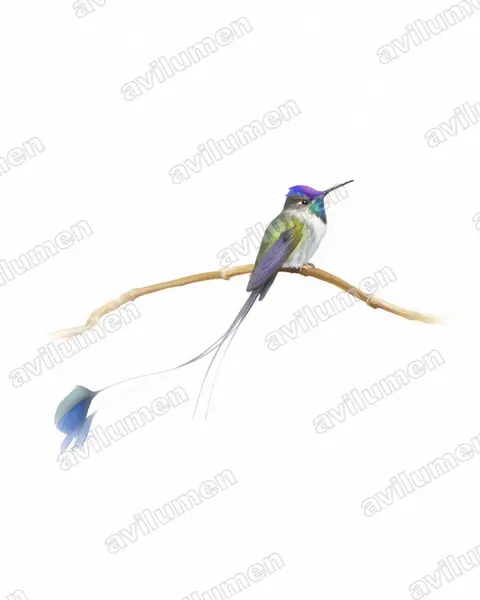
Watercolor 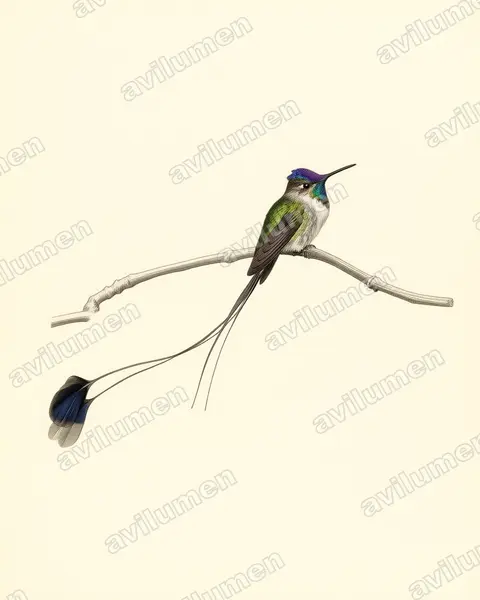
Vintage plate 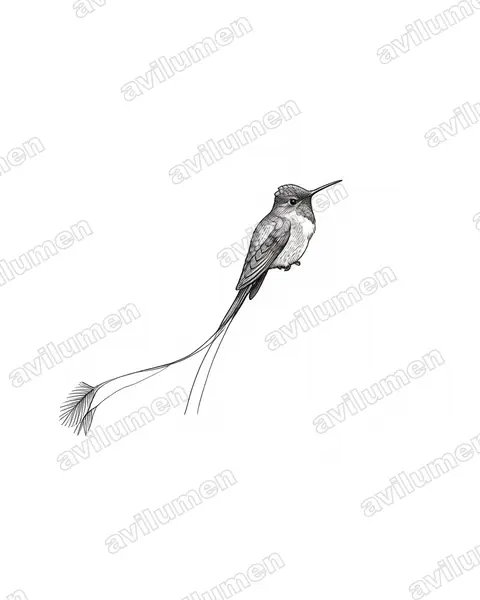
Ink 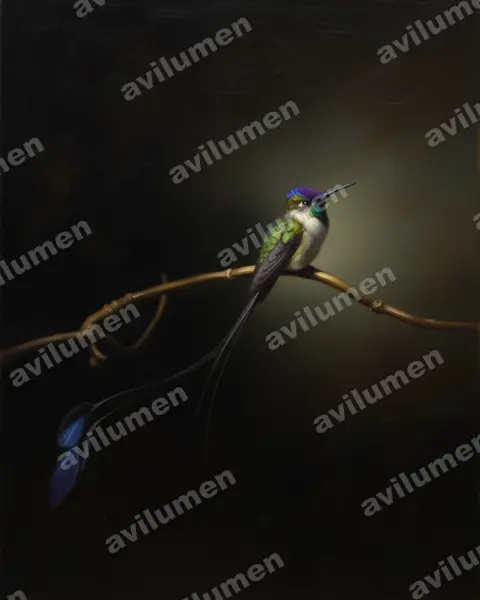
Oil 
Realistic 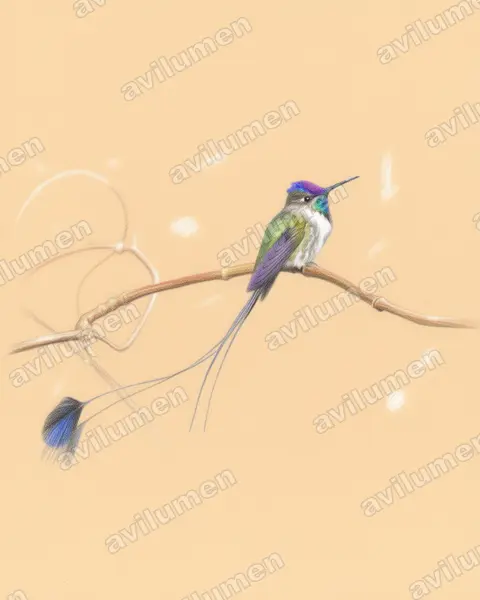
Colored pencil
Illustrations based on the photograph by thibaudaronson (CC BY-SA 4.0), from Wikimedia Commons.
Digital editions
HD Digital Art Pack — Marvelous spatuletail
Digital download: 6 high-resolution illustrations of the Marvelous spatuletail (Loddigesia mirabilis), print-ready. This is a digital file; no animal or physical item is included.
AI Avatar — Marvelous spatuletail
Generate an avatar fusing your face with the Marvelous spatuletail (Loddigesia mirabilis). Delivered digitally in 8K, watermark-free. Digital product; no animals are sold or brokered.
Instant download. No live birds are sold.
Frequently asked questions
- Is Loddigesia mirabilis (Marvelous spatuletail) endangered?
- The IUCN Red List places Loddigesia mirabilis, commonly known as the Marvelous spatuletail, in the «Near threatened» category. «Near threatened» means it is not threatened yet, but is close to becoming so.
- Where does Loddigesia mirabilis (Marvelous spatuletail) live?
- Loddigesia mirabilis (Marvelous spatuletail) is found in Peru and South America.
- What family does Loddigesia mirabilis (Marvelous spatuletail) belong to?
- Loddigesia mirabilis (Marvelous spatuletail) belongs to the family Trochilidae, in the order Apodiformes.
- What colour is Loddigesia mirabilis (Marvelous spatuletail)?
- The plumage of Loddigesia mirabilis (Marvelous spatuletail) combines these colours: Multicoloured.
More from the same family
 Least concern
Emerald-chinned Hummingbird
Abeillia abeillei
The emerald-chinned hummingbird is a species of hummingbird in the "emeralds", tribe Trochilini of subfamily Trochilinae.
from $1.99
 Least concern
Speckled hummingbird
Adelomyia melanogenys
The speckled hummingbird is a species of hummingbird. It is the only member of the genus Adelomyia. It inhabits Neotropical montane cloud forests at elevations of 1,000–2,500 meters and is confined to the Andes of Argentina, Bolivia, Peru, Ecuador, Colombia and Venezuela; as well as to some isolated montane forests in western Ecuador and Venezuela.
from $1.99
 Vulnerable
Purple-backed sunbeam
Aglaeactis aliciae
The purple-backed sunbeam is a bird species in the family Trochilidae. It is found only in Peru.
from $1.99
 Near threatened
White-tufted sunbeam
Aglaeactis castelnaudii
The white-tufted sunbeam is a species of hummingbird in the family Trochilidae. It is found only in Peru. Its natural habitats are subtropical or tropical moist montane forest and subtropical or tropical high-altitude shrubland.
from $1.99