African Grey Hornbill
Lophoceros nasutus
Avilumen editorial team ·

The African grey hornbill is a member of the hornbill family of mainly tropical near-passerine birds found in the Old World. It is a widespread resident breeder in much of sub-Saharan Africa and the southwest of the Arabian Peninsula.
The African grey hornbill (Lophoceros nasutus) is a member of the hornbill family of mainly tropical near-passerine birds found in the Old World. It is a widespread resident breeder in much of sub-Saharan Africa and the southwest of the Arabian Peninsula. The African grey hornbill has escaped or been deliberately released into Florida, USA, but there is no evidence that the population is breeding and may only persist due to continuing releases or escapes.
Taxonomy
In 1760 the French zoologist Mathurin Jacques Brisson included a description of the African grey hornbill in the fourth volume of his Ornithologie based on a specimen collected in Senegal. He used the French name Le calao à bec noir du Sénégal and the Latin name Hydrocorax Senegalensis Melanorynchos. Although Brisson coined Latin names, these do not conform to the binomial system and are not recognized by the International Commission on Zoological Nomenclature. When in 1766 the Swedish naturalist Carl Linnaeus updated his Systema Naturae for the twelfth edition he added 240 species that had been previously described by Brisson in his Ornithologie. Linnaeus included a terse description of the African grey hornbill, placed it with the other hornbills in the genus Buceros and coined the binomial name Buceros nasutus.
The African grey hornbill is now placed in the genus Lophoceros that was introduced in 1833 by two German naturalists, Wilhelm Hemprich and Christian Gottfried Ehrenberg. This genus was resurrected in 2013 to contain a group of hornbills that had previously been placed in the genus Tockus. The genus name Lophoceros combines the Ancient Greek lophos meaning "crest" with kerōs meaning "horn". The specific epithet nasutus is from Latin and means "large-nosed".
Two subspecies are recognized:
L. n. nasutus (Linnaeus, 1766) — Senegal and Gambia to Ethiopia, central Kenya, and southwest Arabia
L. n. epirhinus (Sundevall, 1850) — south Uganda and south Kenya to northern South Africa
Description
At 45–51 cm (18–20 in) in length, the African grey hornbill is a large bird, although it is one of the smaller hornbills. Its plumage is grey and brown, with the head, flight feathers and long tail being of a darker shade. There is a white line down each side of the crown and another down the back which is only visible in flight. Their long curved bills feature a small casque along the upper culmen, which is more prominent in males than females. A dark upper mandible with creamy-yellow mark or horizontal stripe is diagnostic of males, whereas females have tricoloured, red-tipped mandibles. The plumage of the male and female is similar. That of juveniles doesn't differ much from adults, but their bills are initially uniformly blackish. The flight is undulating. The similarly sized red-billed hornbills occur in similar savannah habitats but have pied plumage.
This conspicuous bird advertises its presence with a piping pee-o pee-o pee-o call.
Distribution and habitat
African grey hornbill is widespread over much of sub-Saharan Africa. It prefers open woodland and savannah.
Breeding
The female lays two to four white eggs in a tree hollow, which is blocked off during incubation with a cement made of mud, droppings and fruit pulp. However, due to climate change, increased air temperatures can affect the reproduction of the African Grey Hornbill's likelihood to be able to hatch. There is only one narrow aperture, just large enough for the male to transfer food to the mother and the chicks. When the chicks and female outgrow the nest, the mother breaks out and rebuilds the wall, after which both parents feed the chicks.
Food and feeding
The African grey hornbill is omnivorous, taking insects, fruit and reptiles. It feeds mainly in trees.
Text adapted from Wikipedia · CC BY-SA 4.0
Distribution

Taxonomy
- Order
- Bucerotiformes
- Family
- Bucerotidae
- Genus
- Lophoceros
- Conservation status
- Least concern
Listen to its call
No recording yet
Illustration gallery
6 illustrations of Lophoceros nasutus (African Grey Hornbill) in different styles, true to its real plumage. Shown watermarked; the art pack includes the high-resolution originals, ready to print.
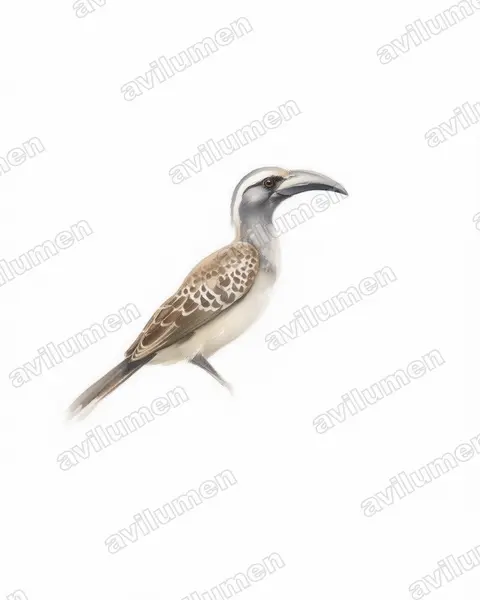
Watercolor 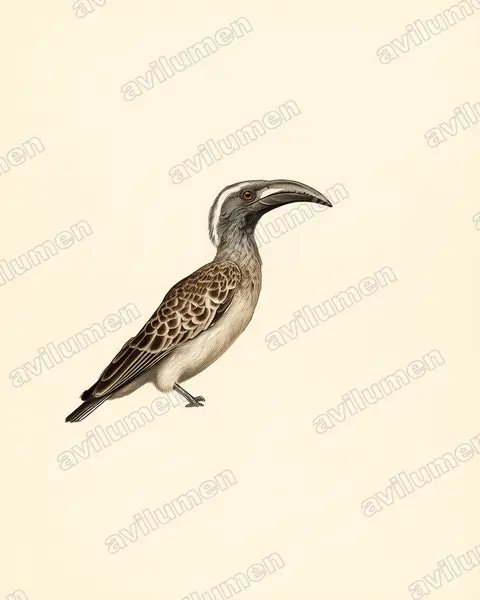
Vintage plate 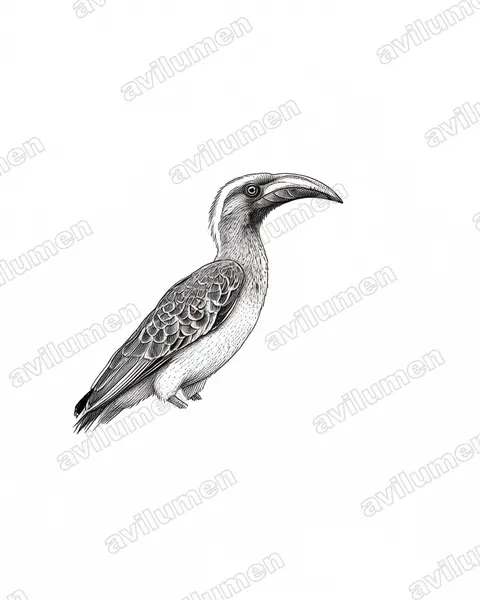
Ink 
Oil 
Realistic 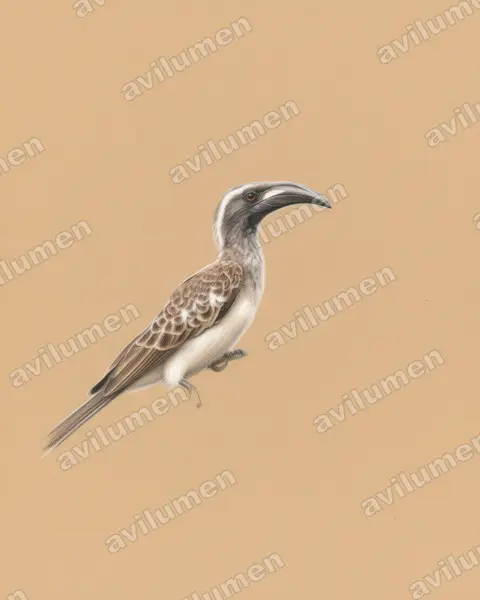
Colored pencil
Illustrations based on the photograph by Charles J. Sharp (CC BY-SA 4.0), from Wikimedia Commons.
Digital editions
HD Digital Art Pack — African Grey Hornbill
Digital download: 6 high-resolution illustrations of the African Grey Hornbill (Lophoceros nasutus), print-ready. This is a digital file; no animal or physical item is included.
AI Avatar — African Grey Hornbill
Generate an avatar fusing your face with the African Grey Hornbill (Lophoceros nasutus). Delivered digitally in 8K, watermark-free. Digital product; no animals are sold or brokered.
Instant download. No live birds are sold.
Frequently asked questions
- Is Lophoceros nasutus (African Grey Hornbill) endangered?
- The IUCN Red List places Lophoceros nasutus, commonly known as the African Grey Hornbill, in the «Least concern» category. «Least concern» means it is not currently threatened.
- Where does Lophoceros nasutus (African Grey Hornbill) live?
- Lophoceros nasutus (African Grey Hornbill) is found in Africa.
- What family does Lophoceros nasutus (African Grey Hornbill) belong to?
- Lophoceros nasutus (African Grey Hornbill) belongs to the family Bucerotidae, in the order Bucerotiformes.
- What colour is Lophoceros nasutus (African Grey Hornbill)?
- The plumage of Lophoceros nasutus (African Grey Hornbill) combines these colours: Grey and White.
More from the same family
 Vulnerable
Rufous-necked Hornbill
Aceros nipalensis
The rufous-necked hornbill is a species of hornbill in Bhutan, northeastern India, especially in Arunachal Pradesh, Indian subcontinent and Southeast Asia. It is locally extinct in Nepal due to hunting and significant loss of habitat. There are less than 10,000 adults left in the wild. With a length of about 117 cm (46 in), it is among the largest Bucerotine hornbills.
from $1.99
 Near threatened
Austen's Brown Hornbill
Anorrhinus austeni
Austen's brown hornbill, also known as the white-throated brown hornbill or brown hornbill, is a medium-sized species of hornbill found in forests from northeastern India to Vietnam and northern Thailand. It is rare throughout its range and is threatened by habitat loss and fragmentation.
from $1.99
 Near threatened
Bushy-crested Hornbill
Anorrhinus galeritus
The bushy-crested hornbill is a bird in the hornbill family. It is found in Brunei, Indonesia, Malaysia, Myanmar, and Thailand. Its natural habitat is subtropical or tropical moist lowland forests.
from $1.99
 Near threatened
Austen's Brwon Hornbill
Anorrhinus tickelli
Tickell's brown hornbill, also known as the rusty-cheeked hornbill, is a species of hornbill found in forests in Burma and adjacent western Thailand. Austen's brown hornbill is sometimes considered as a subspecies of Tickell's brown hornbill.
from $1.99