Tufted coquette
Lophornis ornatus
Avilumen editorial team ·

The tufted coquette is a tiny hummingbird that breeds in eastern Venezuela, Trinidad, Guiana, and northern Brazil. It is an uncommon but widespread species, and appears to be a local or seasonal migrant, although its movements are not well understood.
The tufted coquette (Lophornis ornatus) is a tiny hummingbird that breeds in eastern Venezuela, Trinidad, Guiana, and northern Brazil. It is an uncommon but widespread species, and appears to be a local or seasonal migrant, although its movements are not well understood.
This small bird inhabits open country, gardens, and cultivated areas.
Taxonomy
The tufted coquette was described by the French polymath Georges-Louis Leclerc, Comte de Buffon in 1781 in his Histoire Naturelle des Oiseaux. The bird was also illustrated in a hand-coloured plate engraved by François-Nicolas Martinet in the Planches Enluminées D'Histoire Naturelle which was produced under the supervision of Edme-Louis Daubenton to accompany Buffon's text. Neither the plate caption nor Buffon's description included a scientific name but in 1783 the Dutch naturalist Pieter Boddaert coined the binomial name Trochilus ornatus in his catalogue of the Planches Enluminées. The type locality is Cayenne in French Guiana. The tufted coquette is now placed in the genus Lophornis that was introduced by the French naturalist René Lesson in 1829. The species is monotypic. The generic name combines the Ancient Greek lophos meaning "crest" or "tuft" with ornis meaning "bird". The specific epithet ornatus is Latin for "ornate" or "adorned".
Description
The tufted coquette is 6.6 centimetres (2.6 in) long and weighs 2.3 grams (0.081 oz). The black-tipped red bill is short and straight. The male has a rufous head crest and a coppery green back with a whitish rump band that is prominent in flight. The forehead and underparts are green, and black-spotted rufous plumes project from the neck sides. The tail is golden rufous. The female lacks the crest and plumes. She has green upperparts (dorsal), except for the whitish tail band, and rufous underparts (ventral) that become much paler on the belly. The tail is mostly bronze green with a dusky band and whitish tips to the feathers. Immature males resemble the female, but their throats are whitish with fine dark spotting.
The female tufted coquette lays two eggs in a small cup nest made of plant down and placed on a branch.
Tufted coquettes are tame and approachable. The call of this species while feeding is a light chik.
Their food is nectar, taken from a variety of flowers, and some small invertebrates. With their small size and steady flight, these birds often resemble a large bee as it moves from flower to flower.
Text adapted from Wikipedia · CC BY-SA 4.0
Where it lives
Plumage colours
Distribution

Taxonomy
- Order
- Apodiformes
- Family
- Trochilidae
- Genus
- Lophornis
- Conservation status
- Least concern
Listen to its call
No recording yet
Illustration gallery
6 illustrations of Lophornis ornatus (Tufted coquette) in different styles, true to its real plumage. Shown watermarked; the art pack includes the high-resolution originals, ready to print.
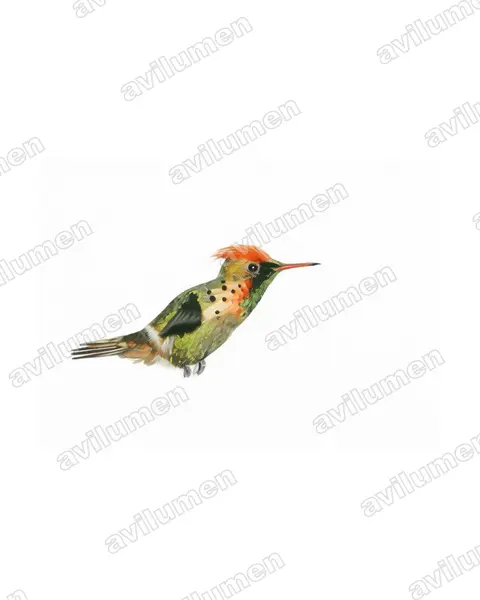
Watercolor 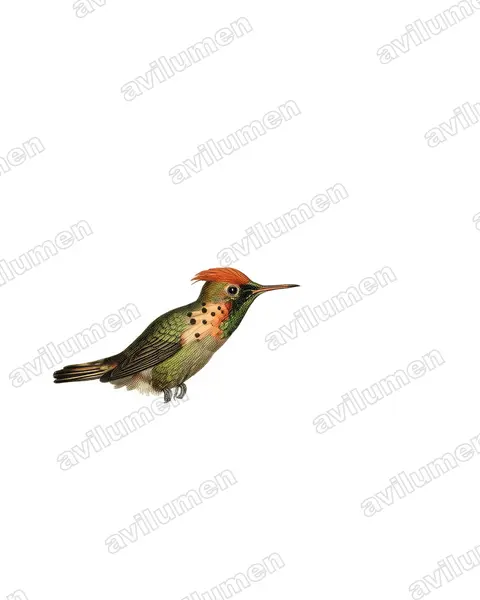
Vintage plate 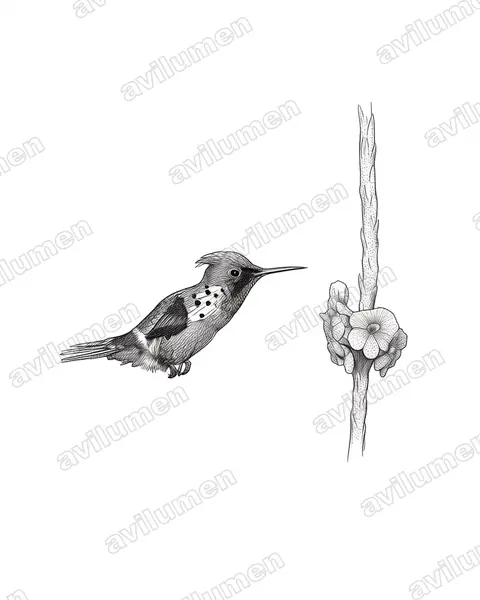
Ink 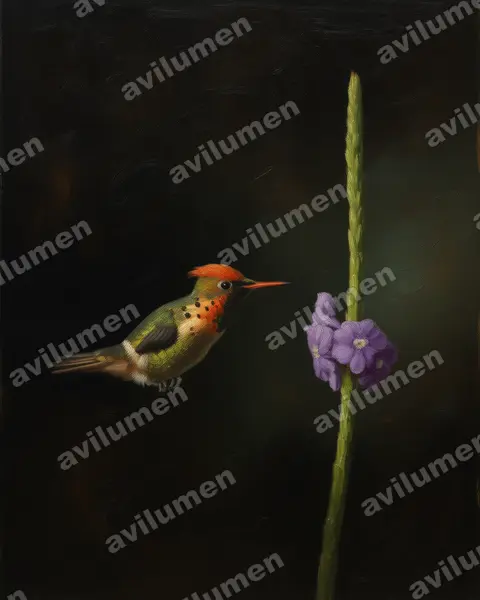
Oil 
Realistic 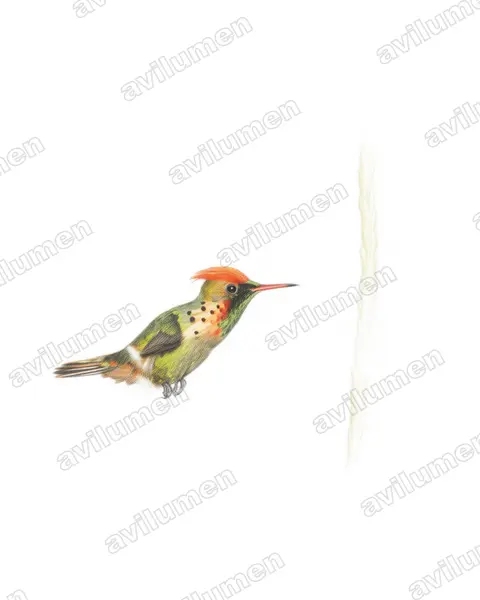
Colored pencil
Illustrations based on the photograph by Steve Garvie from Dunfermline, Fife, Scotland (CC BY-SA 2.0), from Wikimedia Commons.
Digital editions
HD Digital Art Pack — Tufted coquette
Digital download: 6 high-resolution illustrations of the Tufted coquette (Lophornis ornatus), print-ready. This is a digital file; no animal or physical item is included.
AI Avatar — Tufted coquette
Generate an avatar fusing your face with the Tufted coquette (Lophornis ornatus). Delivered digitally in 8K, watermark-free. Digital product; no animals are sold or brokered.
Instant download. No live birds are sold.
Frequently asked questions
- Is Lophornis ornatus (Tufted coquette) endangered?
- The IUCN Red List places Lophornis ornatus, commonly known as the Tufted coquette, in the «Least concern» category. «Least concern» means it is not currently threatened.
- Where does Lophornis ornatus (Tufted coquette) live?
- Lophornis ornatus (Tufted coquette) is found in Brazil and South America.
- What family does Lophornis ornatus (Tufted coquette) belong to?
- Lophornis ornatus (Tufted coquette) belongs to the family Trochilidae, in the order Apodiformes.
- What colour is Lophornis ornatus (Tufted coquette)?
- The plumage of Lophornis ornatus (Tufted coquette) combines these colours: Green.
More from the same family
 Least concern
Emerald-chinned Hummingbird
Abeillia abeillei
The emerald-chinned hummingbird is a species of hummingbird in the "emeralds", tribe Trochilini of subfamily Trochilinae.
from $1.99
 Least concern
Speckled hummingbird
Adelomyia melanogenys
The speckled hummingbird is a species of hummingbird. It is the only member of the genus Adelomyia. It inhabits Neotropical montane cloud forests at elevations of 1,000–2,500 meters and is confined to the Andes of Argentina, Bolivia, Peru, Ecuador, Colombia and Venezuela; as well as to some isolated montane forests in western Ecuador and Venezuela.
from $1.99
 Vulnerable
Purple-backed sunbeam
Aglaeactis aliciae
The purple-backed sunbeam is a bird species in the family Trochilidae. It is found only in Peru.
from $1.99
 Near threatened
White-tufted sunbeam
Aglaeactis castelnaudii
The white-tufted sunbeam is a species of hummingbird in the family Trochilidae. It is found only in Peru. Its natural habitats are subtropical or tropical moist montane forest and subtropical or tropical high-altitude shrubland.
from $1.99