Peacock coquette
Lophornis pavoninus
Avilumen editorial team ·

The peacock coquette is a species of hummingbird in the "coquettes", tribe Lesbiini of subfamily Lesbiinae. It is found in Brazil, Guyana, and Venezuela.
The peacock coquette (Lophornis pavoninus) is a species of hummingbird in the "coquettes", tribe Lesbiini of subfamily Lesbiinae. It is found in Brazil, Guyana, and Venezuela.
Taxonomy and systematics
The peacock coquette and the festive coquette (Lophornis chalybeus) were for a time placed in genus Polemistria. (During that period and after, what is now the butterfly coquette (L. verreauxii) was treated as a subspecies of festive coquette.) The peacock coquette has two subspecies, the nominate L. p. pavoninus and L. p. duidae.
Description
The peacock coquette is about 9.7 cm (3.8 in) long. The male of the nominate subspecies has a glittering golden green head with a black line through its middle. Its upperparts are shiny dark green with a white band across the rump. The tail is purplish bronzy and slightly forked. It has long shiny green cheek tufts with large blackish blue spots at the ends and a rufous patch with a white dot near the eye. Its underparts are grayish green. The female does not have the cheek tufts. Its upperparts are golden bronzy with a buffy white band across the rump. Its tail is grayish; the feathers have a wide purplish bronzy band near the end and the outermost pair have white tips. The throat is white with black streaks and the rest of the underparts are mottled black, white, and green. Subspecies L. p. duidae is similar to the nominate but its black crown line and the rufous patch on the cheek are smaller.
Distribution and habitat
The nominate subspecies of peacock coquette is found on Cerro Ptari-tepui and in Sierra de Lema in southeastern Venezuela's Bolívar state; on Mount Roraima where Venezuela, Brazil, and Guyana meet; and in the Merumé Mountains of Guyana. Subspecies L. p. duidae is found on Cerro Duida and nearby smaller tepuis in southeastern Venezuela's Amazonas state. The species inhabits the interior, clearings, and edges of rainforest and cloud forest at elevations between 500 and 2,000 m (1,600 and 6,600 ft).
Movement
The peacock coquette is thought to be mainly sedentary but appears to make migratory or nomadic movements in Sierra de Lema.
Feeding
The peacock coquette forages for nectar in the forest canopy, usually alone but sometimes in small groups. Its diet also includes small arthropods that it apparently gleans from foliage.
Breeding
The peacock coquette's nesting season is unknown. The female builds a cup nest suspended from a horizontal branch about 2 m (7 ft) above the ground. The clutch size is two; incubation lasts 13 to 14 days and fledging occurs about 20 days after hatch.
Vocalization
The peacock coquette's vocalizations have not been described, and as of February 2022 no recordings are available at Xeno-canto or Cornell University's Macaulay Library.
Status
The IUCN has assessed the peacock coquette as being of Least Concern, though its population size and trend are not known. Its habitat atop tepuis is generally intact and little visited by humans, and "so far no immediate threat has been detected."
Text adapted from Wikipedia · CC BY-SA 4.0
Where it lives
Plumage colours
Distribution

Taxonomy
- Order
- Apodiformes
- Family
- Trochilidae
- Genus
- Lophornis
- Conservation status
- Least concern
Listen to its call
No recording yet
Illustration gallery
6 illustrations of Lophornis pavoninus (Peacock coquette) in different styles, true to its real plumage. Shown watermarked; the art pack includes the high-resolution originals, ready to print.
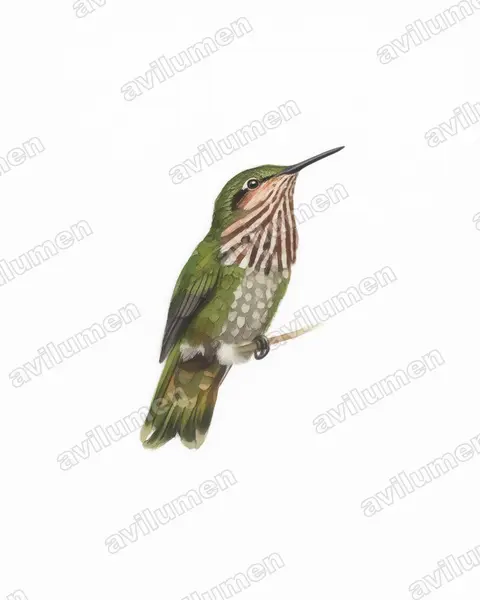
Watercolor 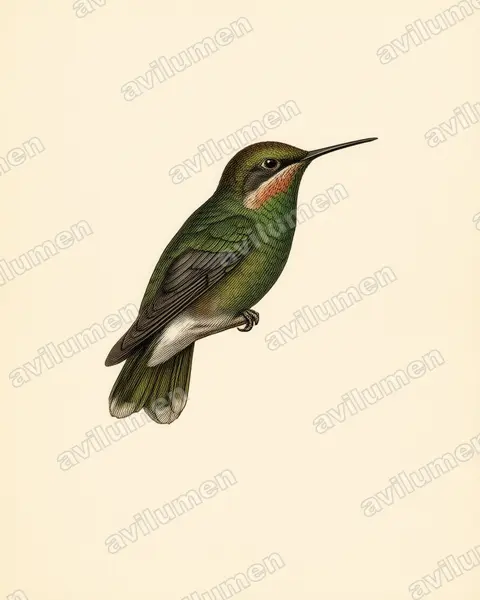
Vintage plate 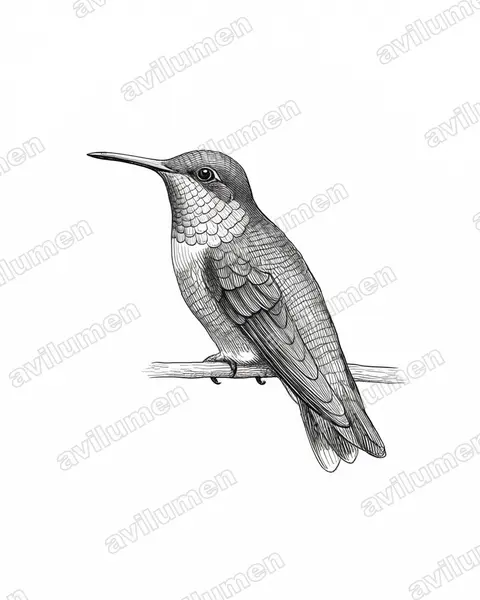
Ink 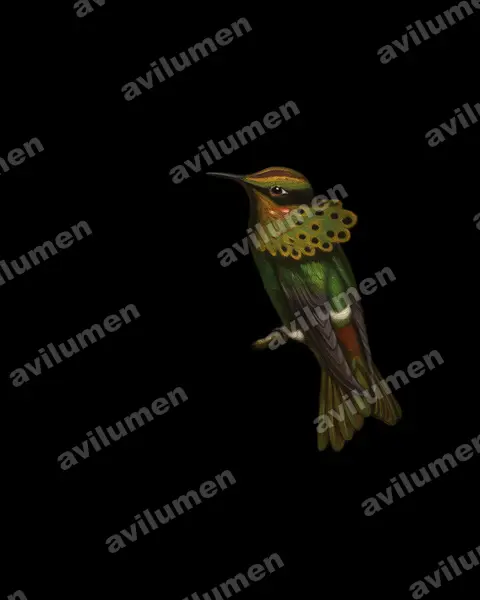
Oil 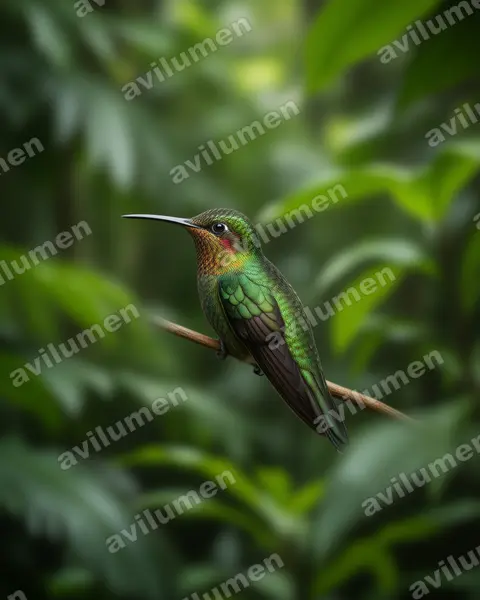
Realistic 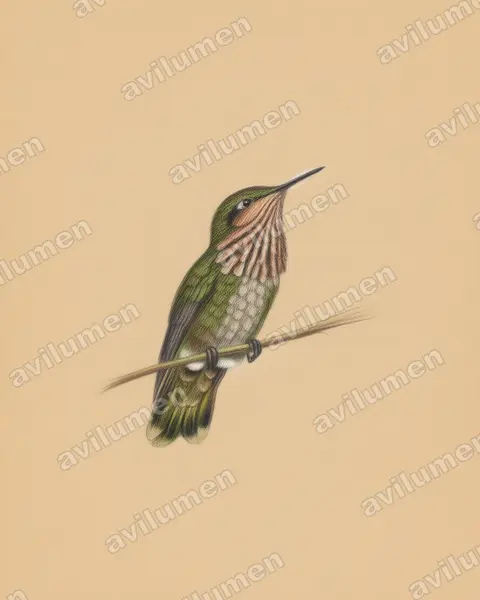
Colored pencil
Illustrations based on the photograph by John Gould / William Matthew Hart (Public domain), from Wikimedia Commons.
Digital editions
HD Digital Art Pack — Peacock coquette
Digital download: 6 high-resolution illustrations of the Peacock coquette (Lophornis pavoninus), print-ready. This is a digital file; no animal or physical item is included.
AI Avatar — Peacock coquette
Generate an avatar fusing your face with the Peacock coquette (Lophornis pavoninus). Delivered digitally in 8K, watermark-free. Digital product; no animals are sold or brokered.
Instant download. No live birds are sold.
Frequently asked questions
- Is Lophornis pavoninus (Peacock coquette) endangered?
- The IUCN Red List places Lophornis pavoninus, commonly known as the Peacock coquette, in the «Least concern» category. «Least concern» means it is not currently threatened.
- Where does Lophornis pavoninus (Peacock coquette) live?
- Lophornis pavoninus (Peacock coquette) is found in Brazil and South America.
- What family does Lophornis pavoninus (Peacock coquette) belong to?
- Lophornis pavoninus (Peacock coquette) belongs to the family Trochilidae, in the order Apodiformes.
- What colour is Lophornis pavoninus (Peacock coquette)?
- The plumage of Lophornis pavoninus (Peacock coquette) combines these colours: Green.
More from the same family
 Least concern
Emerald-chinned Hummingbird
Abeillia abeillei
The emerald-chinned hummingbird is a species of hummingbird in the "emeralds", tribe Trochilini of subfamily Trochilinae.
from $1.99
 Least concern
Speckled hummingbird
Adelomyia melanogenys
The speckled hummingbird is a species of hummingbird. It is the only member of the genus Adelomyia. It inhabits Neotropical montane cloud forests at elevations of 1,000–2,500 meters and is confined to the Andes of Argentina, Bolivia, Peru, Ecuador, Colombia and Venezuela; as well as to some isolated montane forests in western Ecuador and Venezuela.
from $1.99
 Vulnerable
Purple-backed sunbeam
Aglaeactis aliciae
The purple-backed sunbeam is a bird species in the family Trochilidae. It is found only in Peru.
from $1.99
 Near threatened
White-tufted sunbeam
Aglaeactis castelnaudii
The white-tufted sunbeam is a species of hummingbird in the family Trochilidae. It is found only in Peru. Its natural habitats are subtropical or tropical moist montane forest and subtropical or tropical high-altitude shrubland.
from $1.99