Paradise crow
Lycocorax pyrrhopterus
Avilumen editorial team ·

The Halmahera paradise-crow also known as the silky crow, is a medium-sized crow-like bird-of-paradise.
The Halmahera paradise-crow (Lycocorax pyrrhopterus) also known as the silky crow, is a medium-sized crow-like bird-of-paradise.
One of the few monogamous birds-of-paradise, this paradise-crow is endemic to lowland forests of Northern Maluku in Indonesia. The diet consists mainly of fruits and arthropods. It is a restricted-range forest dweller from Halmahera and Morotai, in the northern Maluku of Indonesia.
A common species throughout its habitat range, the Halmahera paradise-crow is evaluated as being of least concern on the IUCN Red List of Threatened Species. It is listed on Appendix II of CITES.
Description
The Halmahera paradise-crow is a medium-sized bird-of-paradise, reaching a body length of up to 42 cm, with a dark, soft and silky plumage that may appear all black, but is in fact a very dark brown. Both sexes are similar; the female is slightly smaller than the male. The nominate subspecies has the least or no white patch on the inner flight feathers.
The head is slightly glossy black-brown and the upper parts are lighter than the head. The upper plumage shines slightly, with a blue-gray shimmer that is most pronounced on the coat, with cinnamon-brown wings. It has a black bill, crimson eyes, and a call reminiscent of a dog's bark.
It was originally thought to be a crow (Corvidae), and was then reassigned to the birds of paradise, where it is the earliest known offshoot from the paradisaeid family tree, dating back approximately 17 million years in the Miocene period. Lycocorax is derived from the Greek lycos, a jackdaw, and korax, a raven. Pyrrhopterus means red-winged.
Distribution and subspecies
The Halmahera paradise-crow occurs on the Northern Maluku islands of Halmahera, Bacan (Batjan), Kasiruta, Morotai and Rau. There are two subspecies, which occur in the following regions of Maluku.
Lycocorax pyrrhopterus pyrrhopterus — Halmahera, Kasiruta, and Bacan
Lycocorax pyrrhopterus morotensis — Morotai, and Rao Island
Previously, the Obi paradise-crow (Lycocorax obiensis) was treated as a subspecies of the Halmahera paradise-crow. However, due to its distinctiveness and potential for separation, it was split from L. pyrrhopterus in 2016, with the International Ornithological Congress also following through in 2021.
Ecology and behaviour
The nominate form is a forest dweller, also found in gardens and forest edges. It prefers the taller trees of the forest interior and is not typically seen in the more open agricultural areas. Seldom found in swamp forest or mangroves, it sometimes occurs in Coconut plantations and orchards, and frequents the mid-level to lhe canopy of the vegetation. The diet of the paradise-crow is composed mainly by fruit, with some supplement from arthropods, both of which are foraged mainly from dense canopy and middle foliage.
The breeding season is approximately December to June, with eggs laid over the same period. As the sexes are similar, it is likely that the species is monogamous, but breeding behaviour is almost unknown. Halmahera nests are described as a large basin-shaped structure made of roots and moss and lined with soft chips of wood, and the clutch appears to consist of just a single egg.
Text adapted from Wikipedia · CC BY-SA 4.0
Taxonomy
- Order
- Passeriformes
- Family
- Paradisaeidae
- Genus
- Lycocorax
- Conservation status
- Least concern
Listen to its call
No recording yet
Illustration gallery
6 illustrations of Lycocorax pyrrhopterus (Paradise crow) in different styles, true to its real plumage. Shown watermarked; the art pack includes the high-resolution originals, ready to print.
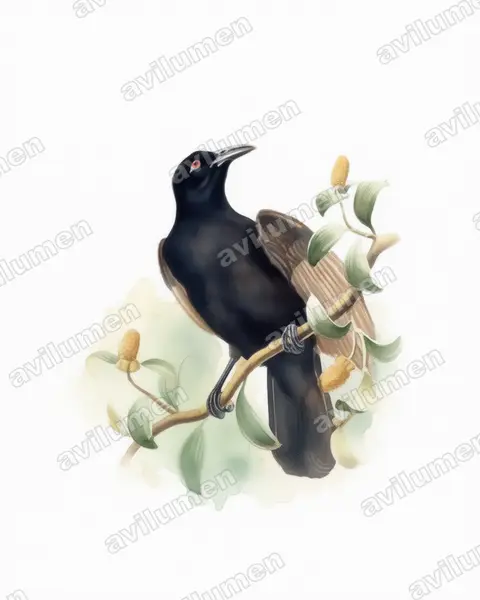
Watercolor 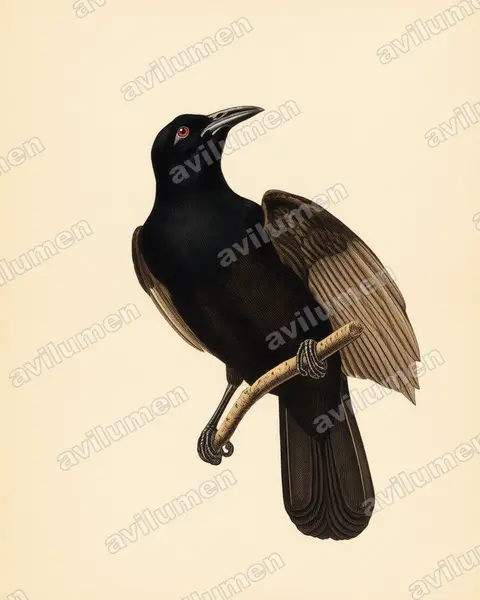
Vintage plate 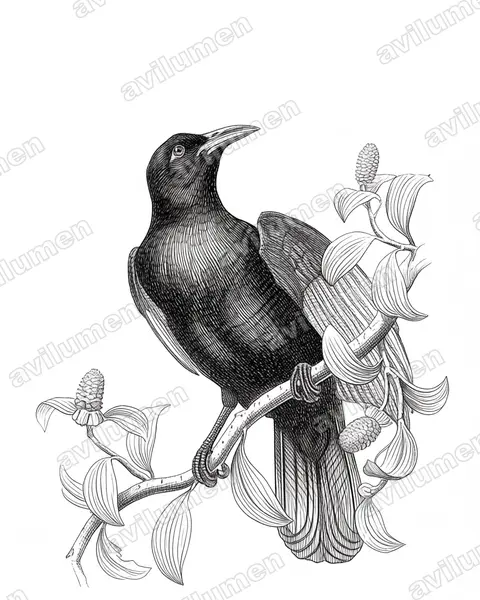
Ink 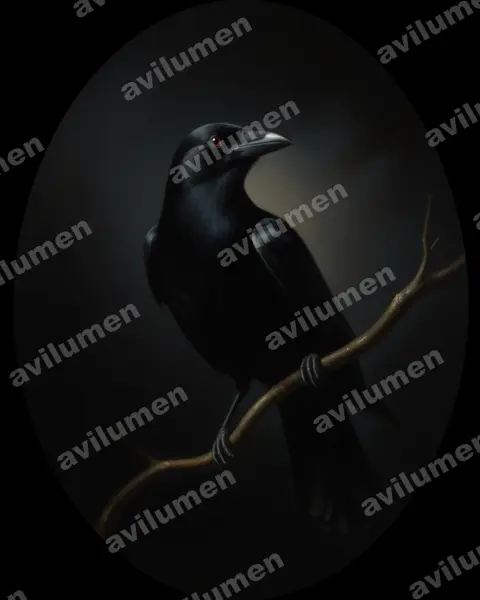
Oil 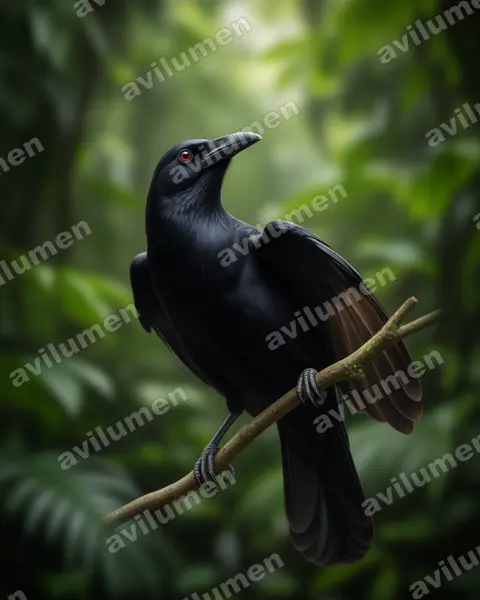
Realistic 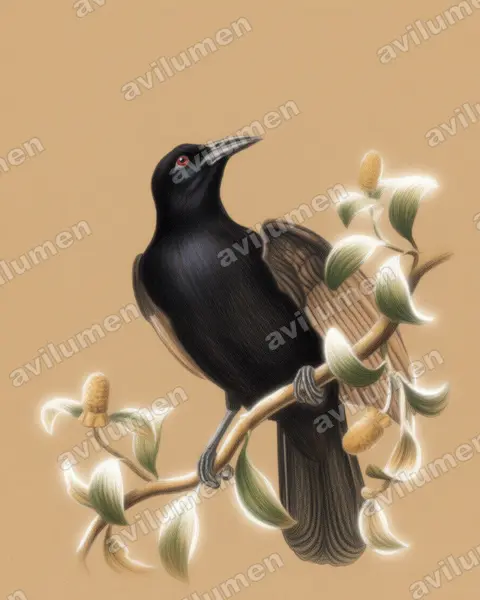
Colored pencil
Illustrations based on the photograph by Richard Bowdler Sharpe (Public domain), from Wikimedia Commons.
Digital editions
HD Digital Art Pack — Paradise crow
Digital download: 6 high-resolution illustrations of the Paradise crow (Lycocorax pyrrhopterus), print-ready. This is a digital file; no animal or physical item is included.
AI Avatar — Paradise crow
Generate an avatar fusing your face with the Paradise crow (Lycocorax pyrrhopterus). Delivered digitally in 8K, watermark-free. Digital product; no animals are sold or brokered.
Instant download. No live birds are sold.
Frequently asked questions
- Is Lycocorax pyrrhopterus (Paradise crow) endangered?
- The IUCN Red List places Lycocorax pyrrhopterus, commonly known as the Paradise crow, in the «Least concern» category. «Least concern» means it is not currently threatened.
- Where does Lycocorax pyrrhopterus (Paradise crow) live?
- Lycocorax pyrrhopterus (Paradise crow) is found in Indonesia.
- What family does Lycocorax pyrrhopterus (Paradise crow) belong to?
- Lycocorax pyrrhopterus (Paradise crow) belongs to the family Paradisaeidae, in the order Passeriformes.
- What colour is Lycocorax pyrrhopterus (Paradise crow)?
- The plumage of Lycocorax pyrrhopterus (Paradise crow) combines these colours: Black.
More from the same family
 Least concern
Ribbon-tailed Astrapia
Astrapia mayeri
The ribbon-tailed astrapia, also known as Shaw Mayer's astrapia, is a species of bird-of-paradise.
from $1.99
 Least concern
Arfak astrapia
Astrapia nigra
The Arfak astrapia is a species of astrapia, a group of birds found in the birds-of-paradise family Paradiseidae.
from $1.99
 Least concern
Huon Astrapia
Astrapia rothschildi
The Huon astrapia, also known as Rothschild's astrapia, Huon bird-of-paradise, or Lord Rothschild's bird-of-paradise, is a species of bird-of-paradise belonging to the genus Astrapia. Like most of its congeners, A. rothschildi is a rather elusive member of its genus and family.
from $1.99
 Least concern
Splendid Astrapia
Astrapia splendidissima
The splendid astrapia is a species of bird in the family Paradisaeidae, native to the montane forests of New Guinea. Males are known for their iridescent plumage and elaborate courtship displays, including branch-hopping, tail-flicking, and frog-like calls; they may also display in leks.
from $1.99