Ringed Kingfisher
Megaceryle torquata
Avilumen editorial team ·

The ringed kingfisher is a large, conspicuous, and noisy kingfisher bird commonly found along the lower Rio Grande Valley in southeasternmost Texas in the United States through Central America to Tierra del Fuego in South America.
The ringed kingfisher (Megaceryle torquata) is a large, conspicuous, and noisy kingfisher bird commonly found along the lower Rio Grande Valley in southeasternmost Texas in the United States through Central America to Tierra del Fuego in South America.
Description
Megaceryle torquata is a Neotropical kingfisher that lives in habitats ranging between the US and Mexico. In 1888, the species was first discovered in the US, while the first ringed kingfisher nest was found in 1970. They are commonly seen along the Rio Grande and in water bodies in southern Texas. Their distribution is increasing and expanding northwards.
Measurement
The wings of adult males range between 184.9 and 211.1 mm (7.28 and 8.31 in), with an average of 196.3 mm (7.73 in). Their tails range from 110.0–129.0 mm (4.33–5.08 in), and their bills measure 74.9–94 mm (2.95–3.70 in). Female wings are from 185.0-210.1 mm, and their tails measure 111.5–132.1 mm (4.39–5.20 in) and possess bills measuring 75.9–90.9 mm (2.99–3.58 in). Individuals can weigh between 305 and 341 g (10.8 and 12.0 oz). Such measurements prove that the species do not differ sexually in terms of size.
Identification
Ringed kingfishers have dark-brown irises that are consistent among all age groups. They have straight bills that are longer than their heads, along with curved culmens and tomial serrations. The lower mandible appears to have some yellowish colorations. They possess syndactyl feet with olive-green or yellowish toes and black claws. A large crest appears between the base of their bills and necks. Several individuals have a white collar located around the neck.
Plumage
Each ringed kingfisher possesses 10 primary wings, 15 secondaries, three tertials, and 12 rectrices. They are rounded, and the tail is squared. Subspecies can be found in Texas, Mexico, Central America, and South America, due to slight plumage differences. Individuals themselves vary slightly as a result of variable environmental constraints and day-length regimes.
Sexual dimorphism
Ringed kingfishers can be identified by sex due to differences in coloration. The males possess rusty-brown underparts with white undertail coverts and a white throat. Females have a bluish-gray band seen on the upper breast and a whitish band.
Eggs
A ringed kingfisher's clutch size is typically three to six eggs, which are incubated for about 22 days.
Taxonomy
The ringed kingfisher is from the family Alcedinidae in the order Coraciiformes. The ringed kingfisher is related to the belted kingfisher. Overall, the species appears much larger than its counterpart, while possessing a rufous belly, a massive bill, and a blue back.
Subspecies
Three subspecies are identified by size and color, as well as location.
M. t. torquata is found in regions of southern Texas and southern Sinaloa, Central America to South America, and throughout the Amazon basin, Argentina, and Uruguay, as well as Isla Margarita in Venezuela. Its undertail coverts are either fully white or spotted lightly with unmarked white underwing coverts for males, brown for females, and with a bill measuring more than 66 mm (2.6 in).
M. t. stictipennis is found in the Lesser Antilles, Dominica, and Martinique. Individuals have secondary feathers with white spots that reach the outer part of the feathers. The dorsum appears to be darker blue or gray.
M. t. stellate has breeding ranges and wintering grounds located in Chile and the southern part of Argentina. Its undertail coverts are spotted heavily with dark blue or gray coloration, with spotted or dusky underwing coverts, the dorm appears to be dark blue to gray, and the outer webs of its secondary wings do not appear to have white spots. Their bills measure less than 69 mm.
Habitat
Ringed kingfishers are seen in freshwater habitats, tropical and temperate marine shorelines, and several islands, such as Coiba Island. Breeding occurs in aquatic regions with the support of aquatic animals, including fish-populated areas for nesting burrows. Nests can be found farther away from water. Habitats are near waterbodies that include streams, rivers, ponds, lakes, estuaries, and marine habitats. Habitats with clear water and less vegetation are preferred to easily access prey.
Distribution
Ringed kingfishers are found in broad areas between Texas, USA and South America. The ranges of ringed and belted kingfishers overlap from Central America and above for 6–8 months. Ringed kingfishers also have ranges that overlap with other kingfisher species in Central and South America. Breeding ranges of ringed kingfishers vary in the Neotropics in Mexico, the Caribbean, and South America. Their preference for mangrove habitats has been observed in the tropics. Foraging occurs offshore as far as 1 km (.7 mi). Overwintering ringed kingfishers are indifferent to breeding ranges, but are able to forage farther than during their breeding periods. Large irrigation canals in Rio Grande, Texas, have been used as wintering grounds by such species. They are usually found in areas with high fish densities during the dry season.
Locomotion
The anatomy of ringed kingfishers prevents efficient terrestrial movements. Individuals shuffle into and out of nesting burrows, so displacing between branches is difficult for this species. They possess strong wings that beat very slowly as a result of their size. They are able to fly over land for long periods of time in comparison to other species of kingfishers.
#### Mating ritual
A mating ritual involves the male ringed kingfisher offering fish to the female before copulation. The pair performs, wherein the male creates calls circling above the water, while dropping into the water. This process lasts for a short time.
#### Parental behavior
Female and male ringed kingfishers incubate their eggs while performing other duties equally. Short foraging breaks are taken during late afternoon since incubation periods are long. Each individual takes turns during the morning. Incubating birds are capable of finding prey by regurgitating their undigested food to attract flies in their burrows.
Vocalization
Ringed kingfishers have louder and lower-pitched calls compared to the belted kingfishers. Captured Juveniles have been heard screaming, giving a klek or kek call. The same call is heard during human intervention or other disturbances. A softer klek is produced by the adult to signal its incubating partner. Its common vocalizations are described as rattles.
Foraging behavior
Ringed kingfishers can perch for several hours on trees while watching for prey in fresh water. Belted kingfishers perch for only a few moments. Ringed kingfishers have also been observed to forage in marine water. They catch their prey by diving from a perch.
Diet
The ringed kingfisher's diet is largely dependent on fish, but they sometimes target crabs and other crustaceans. Fish consumed include several species from the families Characidae and Cichlidae.
Diseases
A parasitic infection caused by Pulchrosopa pulchrosopa, a type of flatworm, causes internal damage in the respiratory system of ringed kingfishers. Infected individuals were examined, with the species found in their lungs, tracheae, and coelomic cavities. The parasite migrates to the lungs as the host experiences stressful or immunosuppressive periods. The parasite also causes significant damage to tissues due to its migration to the lungs.
Predation
Predators of ringed kingfishers include the white-tailed hawk, sharp-shinned hawk, bald eagle, golden eagle, and peregrine falcon.
Conservation status
The IUCN considers the ringed kingfisher to be of least concern. Increasing population trends indicate that the species is not vulnerable, as it is widespread and has a large habitat distribution and breeding ranges.
Text adapted from Wikipedia · CC BY-SA 4.0
Where it lives
Distribution

Taxonomy
- Order
- Coraciiformes
- Family
- Alcedinidae
- Genus
- Megaceryle
- Conservation status
- Least concern
Listen to its call
No recording yet
Illustration gallery
6 illustrations of Megaceryle torquata (Ringed Kingfisher) in different styles, true to its real plumage. Shown watermarked; the art pack includes the high-resolution originals, ready to print.

Watercolor 
Vintage plate 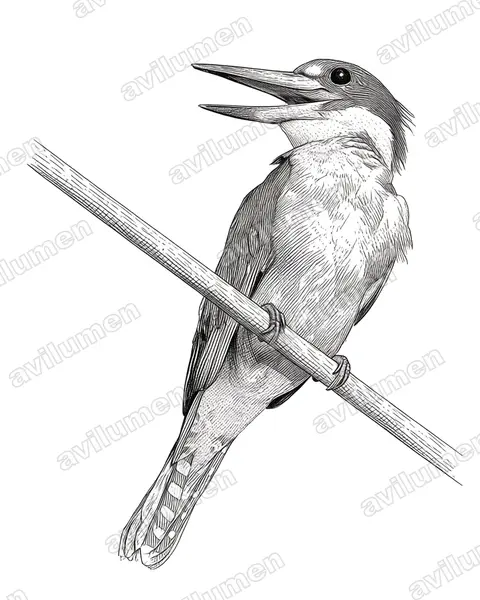
Ink 
Oil 
Realistic 
Colored pencil
Illustrations based on the photograph by Bernard DUPONT from FRANCE (CC BY-SA 2.0), from Wikimedia Commons.
Digital editions
HD Digital Art Pack — Ringed Kingfisher
Digital download: 6 high-resolution illustrations of the Ringed Kingfisher (Megaceryle torquata), print-ready. This is a digital file; no animal or physical item is included.
AI Avatar — Ringed Kingfisher
Generate an avatar fusing your face with the Ringed Kingfisher (Megaceryle torquata). Delivered digitally in 8K, watermark-free. Digital product; no animals are sold or brokered.
Instant download. No live birds are sold.
Frequently asked questions
- Is Megaceryle torquata (Ringed Kingfisher) endangered?
- The IUCN Red List places Megaceryle torquata, commonly known as the Ringed Kingfisher, in the «Least concern» category. «Least concern» means it is not currently threatened.
- Where does Megaceryle torquata (Ringed Kingfisher) live?
- Megaceryle torquata (Ringed Kingfisher) is found in Brazil and South America.
- What family does Megaceryle torquata (Ringed Kingfisher) belong to?
- Megaceryle torquata (Ringed Kingfisher) belongs to the family Alcedinidae, in the order Coraciiformes.
- What colour is Megaceryle torquata (Ringed Kingfisher)?
- The plumage of Megaceryle torquata (Ringed Kingfisher) combines these colours: Blue and Grey.
More from the same family
 Least concern
Moustached Kingfisher
Actenoides bougainvillei
The moustached kingfisher, also called Bougainville moustached kingfisher, is a species of bird in the family Alcedinidae. It is endemic to Bougainville Island in Papua New Guinea. An estimated 1,300–7,000 mature individuals are left.
from $1.99
 Near threatened
Rufous-collared Kingfisher
Actenoides concretus
The rufous-collared kingfisher is a species of bird in the family Alcedinidae. It is found in Brunei, Indonesia, Malaysia, Myanmar, and Thailand. Its natural habitats are subtropical or tropical moist lowland forest and subtropical or tropical moist montane forest. It is threatened by habitat loss.
from $1.99
 Least concern
Hombron's Kingfisher
Actenoides hombroni
The blue-capped kingfisher, also known as Hombron's kingfisher, is a species of bird in the family Alcedinidae endemic to the Philippines and found only on Mindanao. It is one of the most colorful kingfishers in the country having a dark blue cap and wings with rufous spots, a striped rufous belly, white chin and red bill.
from $1.99
 Least concern
Spotted Wood Kingfisher
Actenoides lindsayi
The spotted wood kingfisher or spotted kingfisher is a species of bird in the family Alcedinidae. It is endemic to the Philippines found on the islands of Luzon, Catanduanes, Marinduque, Negros and Panay where its natural habitat is tropical moist lowland forests.
from $1.99