European Bee-eater
Merops apiaster
Avilumen editorial team ·

The European bee-eater is a bird species in the bee-eater family, Meropidae. It has the largest range of any the bee-eater species. It breeds in southern and central Europe, northern and southern Africa, and western Asia. Except for the resident southern African population, the species is strongly migratory, wintering in tropical Africa.
The European bee-eater (Merops apiaster) is a bird species in the bee-eater family, Meropidae. It has the largest range of any the bee-eater species. It breeds in southern and central Europe, northern and southern Africa, and western Asia. Except for the resident southern African population, the species is strongly migratory, wintering in tropical Africa. This species occurs as a spring overshoot north of its usual range, with occasional breeding in northern Europe.
Taxonomy and systematics
The European bee-eater was formally described by the Swedish naturalist Carl Linnaeus in 1758 in the tenth edition of his Systema Naturae under its current binomial name Merops apiaster. The genus name Merops (μέροψ) is Ancient Greek for "bee-eater", and apiaster is Latin, also meaning "bee-eater", from apis, "bee".
Description
This species, like other bee-eaters, is a richly coloured, slender bird. It has brown and yellow upper parts, whilst the wings are green and the beak is black. It can reach a length of 27–29 cm (10.6–11.4 in), including the two elongated central tail feathers, and weigh 44–78 g (52 g on average). Sexes are alike. Female tends to have greener rather than gold feathers on shoulders. Non-breeding plumage is much duller and with a blue-green back and no elongated central tail feathers. Juvenile resembles a non-breeding adult, but with less variation in the feather colours. Adults begin to moult in June or July and complete the process by August or September. There is a further moult into breeding plumage in winter in Africa.
Breeding
These bee-eaters are gregarious, nesting colonially in sandy banks, preferably near river shores, usually at the beginning of May. They make a relatively long tunnel, in which they lay five to eight spherical white eggs around the beginning of June. Both male and female care for the eggs, which they brood for about three weeks. They also feed and roost communally.
During courtship, the male feeds large items to the female while eating the small ones himself. Most males are monogamous, but occasional bigamy has been encountered. Their typical call is a distinctive, mellow, liquid and burry prreee or prruup.
Feeding
This bird breeds in open country in warmer climates. As the name suggests, bee-eaters predominantly eat insects, especially bees, wasps, and hornets. They catch insects in flight, in sorties from an open perch. Before eating a bee, the European bee-eater removes the sting by repeatedly hitting the insect on a hard surface. It can eat around 250 bees a day.
The most important prey item in their diet is Hymenoptera, mostly the European honey bee. A study in Spain found that these comprise 69.4% to 82% of the European bee-eaters' diet. Their impact on bee populations, however, is small. They eat less than 1% of the worker bees in areas where they live.
A study found that European bee-eaters "convert food to body weight more efficiently if they are fed a mixture of bees and dragonflies than if they eat only bees or only dragonflies."
Predation of honey bees
If an apiary is set up close to a bee-eater colony, a larger number of honey bees are eaten because they are more abundant. However, studies show the bee-eaters do not intentionally fly into the apiary, rather they feed on the insects caught on pastures and meadows within a radius of 12 km (7.5 mi) from the colony, this maximum distance being reached only when there is a lack of food. Observations show that the birds actually enter the apiary only in cold and rainy periods, when the bees do not leave the hive and other insect prey are harder for the bee-eaters to detect.
Many bee-keepers believe that the bee-eaters are the main obstacle causing worker bees not to forage, and instead stay inside the hives for much of the day between May and the end of August. However, a study carried out in eucalyptus forest in the Alalous region, 80 km (50 mi) east of Tripoli, Libya, showed that the bee-eaters were not the main obstacle of bee foraging, which is the opposite of what beekeepers think. The foraging rate was higher in presence of the birds than in their absence in some cases. The average bird meal consisted of 90.8% honey bees and 9.2% beetles.
Predation is more likely when the bees are queening or during peak migrations, from late March till mid-April, and in mid-September. Hives close to or under trees or overhead cables are also at increased risk as the birds pounce on flying insects from these perches.
In order to keep bee-eaters at bay, some apiarists utilize falcon kite scarecrows (fake falcons,) since bee-eaters are frightened of falcons, predators of bee-eaters. Another preventive measure is a bioacustic bird repeller, which releases the sound of different birds of prey which are predators of the bee-eater.
In culture
With the help of a Motifs Advisory Group, the Governing Council of the European Central Bank selected a "bee-eater colony in a sand wall on the side of a large, confined river valley along a riverbank" as a potential front motif for the 2020s redesign of the 20€ banknote, with the reverse featuring the building of the European Central Bank.
Text adapted from Wikipedia · CC BY-SA 4.0
Where it lives
- Afghanistan
- Africa
- Albania
- Algeria
- Andorra
- Angola
- Armenia
- Austria
- Azerbaijan
- Bosnia and Herzegovina
- Botswana
- Bulgaria
- Burkina Faso
- Burundi
- Cyprus
- Democratic Republic of the Congo
- Eswatini
- France
- Georgia
- Ghana
- Greece
- Hungary
- Iran
- Israel
- Italy
- Ivory Coast
- Jordan
- Kazakhstan
- Kosovo
- Kyrgyzstan
- Lebanon
- Lesotho
- Liberia
- Libya
- Moldova
- Mongolia
- Montenegro
- Morocco
- Mozambique
- Nigeria
- North Macedonia
- Oman
- Pakistan
- People's Republic of China
- Portugal
- Romania
- Russia
- Rwanda
- Serbia
- Slovakia
- South Africa
- Spain
- Switzerland
- Tanzania
- Togo
- Tunisia
- Turkey
- Turkmenistan
- Ukraine
- United Arab Emirates
- Uzbekistan
- Zambia
- Zimbabwe
Plumage colours
Distribution

Taxonomy
- Order
- Coraciiformes
- Family
- Meropidae
- Genus
- Merops
- Conservation status
- Least concern
Listen to its call
No recording yet
Illustration gallery
6 illustrations of Merops apiaster (European Bee-eater) in different styles, true to its real plumage. Shown watermarked; the art pack includes the high-resolution originals, ready to print.

Watercolor 
Vintage plate 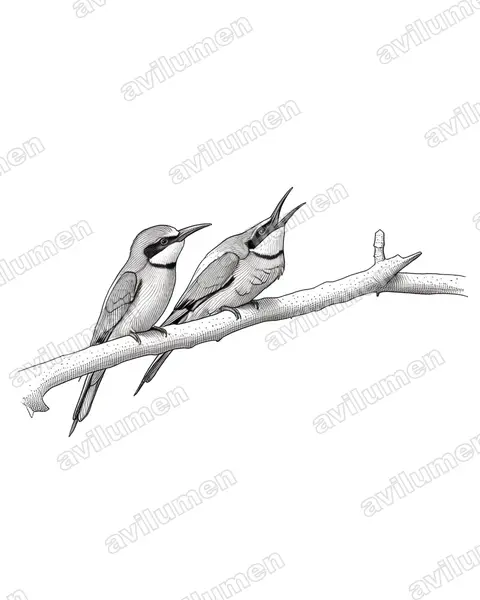
Ink 
Oil 
Realistic 
Colored pencil
Illustrations based on the photograph by Pierre Dalous (CC BY-SA 3.0), from Wikimedia Commons.
Digital editions
HD Digital Art Pack — European Bee-eater
Digital download: 6 high-resolution illustrations of the European Bee-eater (Merops apiaster), print-ready. This is a digital file; no animal or physical item is included.
AI Avatar — European Bee-eater
Generate an avatar fusing your face with the European Bee-eater (Merops apiaster). Delivered digitally in 8K, watermark-free. Digital product; no animals are sold or brokered.
Instant download. No live birds are sold.
Frequently asked questions
- Is Merops apiaster (European Bee-eater) endangered?
- The IUCN Red List places Merops apiaster, commonly known as the European Bee-eater, in the «Least concern» category. «Least concern» means it is not currently threatened.
- Where does Merops apiaster (European Bee-eater) live?
- Merops apiaster (European Bee-eater) is found in Afghanistan, Africa, Albania, Algeria, Andorra, Angola, Armenia, Austria, Azerbaijan, Bosnia and Herzegovina, Botswana, Bulgaria, Burkina Faso, Burundi, Cyprus, Democratic Republic of the Congo, Eswatini, France, Georgia, Ghana, Greece, Hungary, Iran, Israel, Italy, Ivory Coast, Jordan, Kazakhstan, Kosovo, Kyrgyzstan, Lebanon, Lesotho, Liberia, Libya, Moldova, Mongolia, Montenegro, Morocco, Mozambique, Nigeria, North Macedonia, Oman, Pakistan, People's Republic of China, Portugal, Romania, Russia, Rwanda, Serbia, Slovakia, South Africa, Spain, Switzerland, Tanzania, Togo, Tunisia, Turkey, Turkmenistan, Ukraine, United Arab Emirates, Uzbekistan, Zambia, and Zimbabwe.
- What family does Merops apiaster (European Bee-eater) belong to?
- Merops apiaster (European Bee-eater) belongs to the family Meropidae, in the order Coraciiformes.
- What colour is Merops apiaster (European Bee-eater)?
- The plumage of Merops apiaster (European Bee-eater) combines these colours: Multicoloured.
More from the same family
 Least concern
Purple-bearded Bee-eater
Meropogon forsteni
The purple-bearded bee-eater or Celebes bee-eater is a species of bee-eater endemic to the island of Sulawesi, Indonesia. This species is often seen in clearings inside dense forest.
from $1.99
 Least concern
White-throated Bee-eater
Merops albicollis
The white-throated bee-eater is a species of bee-eater that breeds in semi-desert along the southern edge of the Sahara. The white-throated bee-eater is migratory, wintering in a completely different habitat in the equatorial rain forests of Africa from southern Senegal to Uganda.
from $1.99
 Least concern
Böhm's Bee-eater
Merops boehmi
Böhm's bee-eater is a species of bird in the family Meropidae. It is found in Democratic Republic of the Congo, Malawi, Mozambique, Tanzania, and Zambia.
from $1.99
 Least concern
Black-headed Bee-eater
Merops breweri
The black-headed bee-eater is a species of bird in the family Meropidae. It is found in forests in tropical Central and West Africa, its range including Angola, Central African Republic, Republic of the Congo, Democratic Republic of the Congo, Ivory Coast, Gabon, Ghana, Nigeria, and South Sudan.
from $1.99