White-fronted Bee-eater
Merops bullockoides
Avilumen editorial team ·

The white-fronted bee-eater is a species of bee-eater widely distributed in sub-equatorial Africa.
The white-fronted bee-eater (Merops bullockoides) is a species of bee-eater widely distributed in sub-equatorial Africa.
The species has a distinctive white forehead, a square tail, and a bright red patch on its throat. It nests in small colonies, digging holes in cliffs or earthen banks, and can usually be seen in low trees, waiting to hunt passing insects by making quick hawking flights or gliding down before hovering briefly to catch the prey.
Description
This species, like other bee-eaters, is a richly coloured, slender bird, but with a distinctive black mask, white forehead, square tail and a bright red throat. The size is 23 cm (9 in.). The upperparts are green, with cinnamon underparts. The call is a deep squeak.
Distribution
White-fronted bee-eaters are found in the vast savannah regions of sub-equatorial Africa. The habitat commonly consists of open country, often near gullies, where bees, their prey, live.
Nesting and reproduction
White-fronted bee-eaters nest in colonies averaging 200 individuals, digging, roosting, and nesting holes in cliffs or banks of earth. A population of bee-eaters may range across many square kilometres of savannah, but will come to the same colony to roost, socialize, and to breed. White-fronted bee-eaters have one of the most complex family-based social systems found in birds.
Colonies comprise socially monogamous, extended family groups with overlapping generations, known as "clans", which exhibit cooperative breeding. Non-breeding individuals become helpers to relatives and assist to raise their brood. In white-fronted bee-eaters, this helping behavior is particularly well developed, with helpers assisting in half of all nesting attempts. These helpers may contribute to all aspects of the reproductive attempt, from digging the roosting or nesting chamber, to allofeeding the female, incubating and feeding the young; and have a large effect on increasing the number of young produced.
Only 50% of non-breeders in a colony typically become helpers, and whether or not an individual becomes a helper and to whom it provides aid is heavily dependent on the degree of kinship involved. Non-breeders are most likely to become helpers when breeding pairs are genetically close relatives. When faced with a choice of potential recipient nests, helpers preferentially help the breeding pair to whom they are most closely related, suggesting that this behaviour may serve to increase the helper's inclusive fitness.
Female white-fronted bee-eaters leaving their nesting burrows must avoid pursuit by unmated males who may force them to the ground and rape them. Furthermore, their unwelcome attentions are preferentially against females who are laying eggs and who thus might lay the eggs of their rapist rather than their mate.
Feeding and diet
Their diet is made up primarily of bees, but they also take other flying insects depending on the season and availability of prey. Two hunting methods have been observed. They either make quick hawking flights from lower branches of shrubs and trees, or glide slowly down from their perch and hover briefly to catch insects.
Text adapted from Wikipedia · CC BY-SA 4.0
Taxonomy
- Order
- Coraciiformes
- Family
- Meropidae
- Genus
- Merops
- Conservation status
- Least concern
Listen to its call
No recording yet
Illustration gallery
6 illustrations of Merops bullockoides (White-fronted Bee-eater) in different styles, true to its real plumage. Shown watermarked; the art pack includes the high-resolution originals, ready to print.
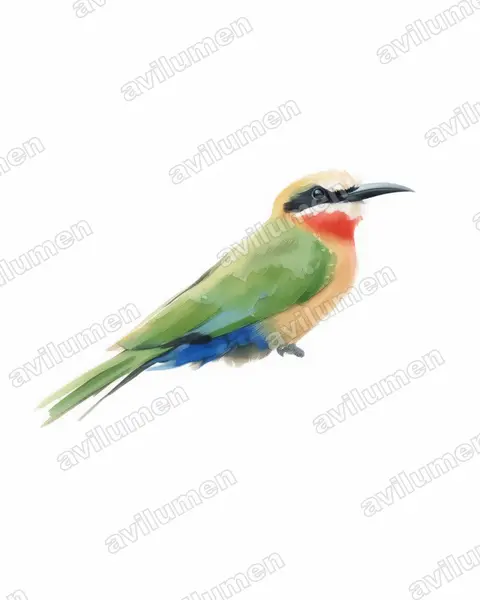
Watercolor 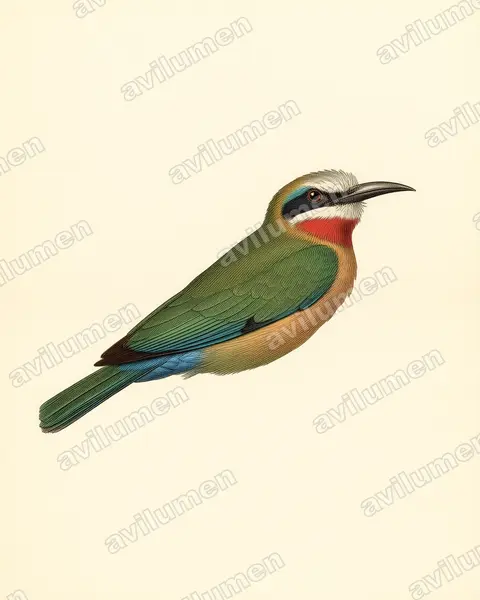
Vintage plate 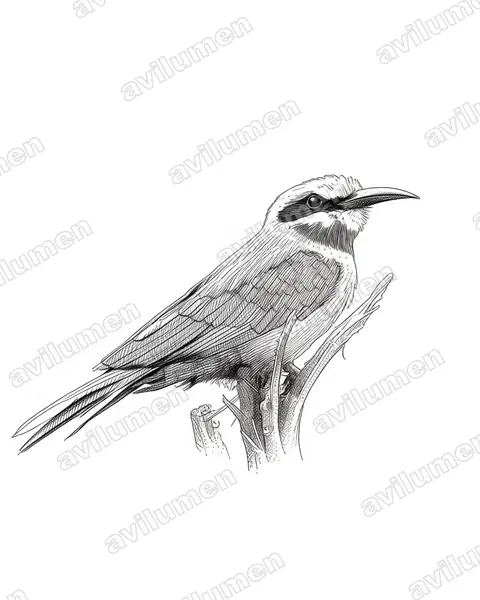
Ink 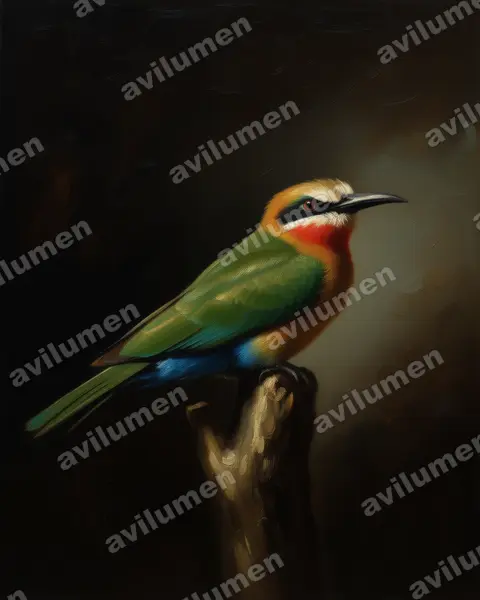
Oil 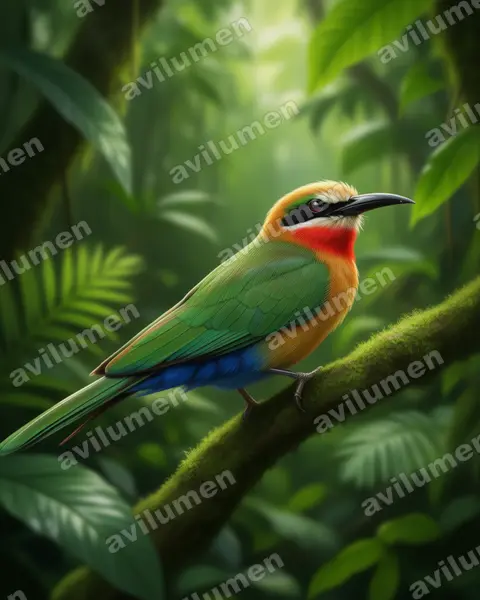
Realistic 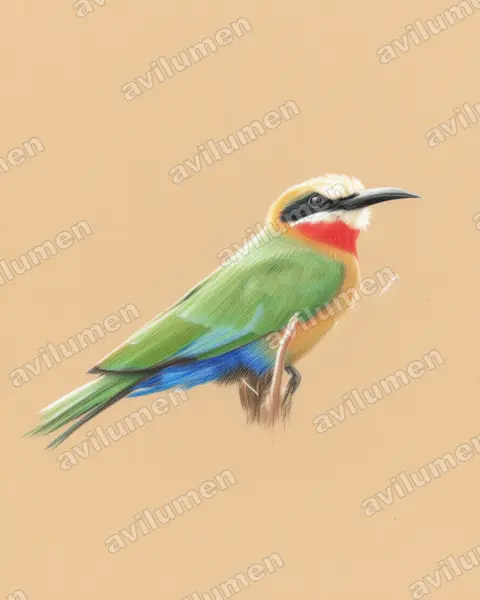
Colored pencil
Illustrations based on the photograph by Bernard DUPONT from FRANCE (CC BY-SA 2.0), from Wikimedia Commons.
Digital editions
HD Digital Art Pack — White-fronted Bee-eater
Digital download: 6 high-resolution illustrations of the White-fronted Bee-eater (Merops bullockoides), print-ready. This is a digital file; no animal or physical item is included.
AI Avatar — White-fronted Bee-eater
Generate an avatar fusing your face with the White-fronted Bee-eater (Merops bullockoides). Delivered digitally in 8K, watermark-free. Digital product; no animals are sold or brokered.
Instant download. No live birds are sold.
Frequently asked questions
- Is Merops bullockoides (White-fronted Bee-eater) endangered?
- The IUCN Red List places Merops bullockoides, commonly known as the White-fronted Bee-eater, in the «Least concern» category. «Least concern» means it is not currently threatened.
- Where does Merops bullockoides (White-fronted Bee-eater) live?
- Merops bullockoides (White-fronted Bee-eater) is found in Africa.
- What family does Merops bullockoides (White-fronted Bee-eater) belong to?
- Merops bullockoides (White-fronted Bee-eater) belongs to the family Meropidae, in the order Coraciiformes.
- What colour is Merops bullockoides (White-fronted Bee-eater)?
- The plumage of Merops bullockoides (White-fronted Bee-eater) combines these colours: Red and Green.
More from the same family
 Least concern
Purple-bearded Bee-eater
Meropogon forsteni
The purple-bearded bee-eater or Celebes bee-eater is a species of bee-eater endemic to the island of Sulawesi, Indonesia. This species is often seen in clearings inside dense forest.
from $1.99
 Least concern
White-throated Bee-eater
Merops albicollis
The white-throated bee-eater is a species of bee-eater that breeds in semi-desert along the southern edge of the Sahara. The white-throated bee-eater is migratory, wintering in a completely different habitat in the equatorial rain forests of Africa from southern Senegal to Uganda.
from $1.99
 Least concern
European Bee-eater
Merops apiaster
The European bee-eater is a bird species in the bee-eater family, Meropidae. It has the largest range of any the bee-eater species. It breeds in southern and central Europe, northern and southern Africa, and western Asia. Except for the resident southern African population, the species is strongly migratory, wintering in tropical Africa.
from $1.99
 Least concern
Böhm's Bee-eater
Merops boehmi
Böhm's bee-eater is a species of bird in the family Meropidae. It is found in Democratic Republic of the Congo, Malawi, Mozambique, Tanzania, and Zambia.
from $1.99