Blue-cheeked Bee-eater
Merops persicus
Avilumen editorial team ·

The blue-cheeked bee-eater is a species of bee-eater that breeds in Northern Africa and the Middle East from eastern Turkey to Kazakhstan and India. It is generally strongly migratory, wintering in tropical Africa, although some populations are resident year-round in the Sahel. This species occurs as a rare vagrant north of its breeding range, with most vagrants occurring in Italy and Greece.
The blue-cheeked bee-eater (Merops persicus) is a species of bee-eater that breeds in Northern Africa and the Middle East from eastern Turkey to Kazakhstan and India. It is generally strongly migratory, wintering in tropical Africa, although some populations are resident year-round in the Sahel. This species occurs as a rare vagrant north of its breeding range, with most vagrants occurring in Italy and Greece.
Taxonomy and systematics
The genus name Merops is Ancient Greek for "bee-eater", and persicus is Latin for "Persian".
Two subspecies of blue-cheeked bee-eater are accepted:
Merops persicus persicus - Breeds in Asia, winters in East and Southern Africa.
Merops persicus chrysocercus - Breeds in North Africa, winters in West Africa.
This species is closely related to the blue-tailed bee-eater, M. philippinus of East Asia, and the olive bee-eater of Africa, and has been treated as being the same species (conspecific).
Description
This species, like other bee-eaters, is a richly coloured, slender bird. It is predominantly green; its face has blue sides with a black eye stripe, and a yellow and brown throat; the beak is black. It can reach a length of 31 cm (12 in), with the two elongated central tail feathers adding another 7 cm (2.8 in). Sexes are mostly alike but the tail-streamers of the female are shorter.
This is a bird which breeds in sub-tropical semi-desert with a few trees, such as acacia. It winters in open woodland or grassland. As the name suggests, bee-eaters predominantly eat insects, especially bees, wasps and hornets, which are caught in the air by sorties from an open perch. However, this species probably takes more dragonflies than any other food item. It also enjoys damselflies and lacewings. Its preferred hunting perch is telephone wires if available.
Blue-cheeked bee-eaters may nest solitarily or in loose colonies of up to ten birds. They may also nest in colonies with European bee-eaters. The nests are located in sandy banks, embankments, low cliffs or on the shore of the Caspian Sea. They make a relatively long tunnel of 1 to 3 m (3–10 ft) in length in which the four to eight (usually six or seven), spherical white eggs are laid. Both the male and the female take care of the eggs, although the female alone incubates them at night. Incubation takes 23–26 days.
The call sounds 'flatter' and less 'fluty' than the European bee-eater.
Text adapted from Wikipedia · CC BY-SA 4.0
Taxonomy
- Order
- Coraciiformes
- Family
- Meropidae
- Genus
- Merops
- Conservation status
- Least concern
Listen to its call
No recording yet
Illustration gallery
6 illustrations of Merops persicus (Blue-cheeked Bee-eater) in different styles, true to its real plumage. Shown watermarked; the art pack includes the high-resolution originals, ready to print.
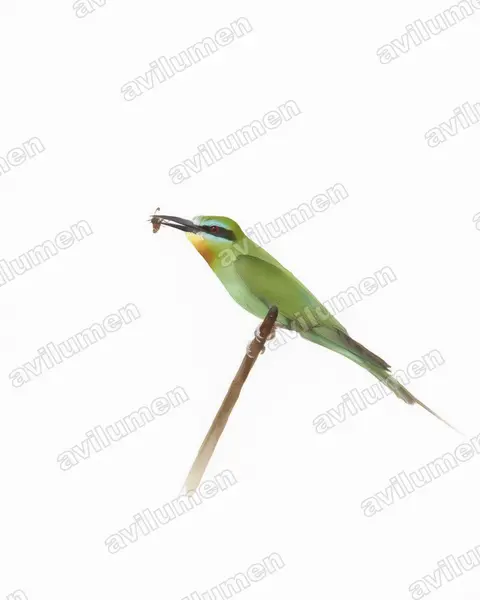
Watercolor 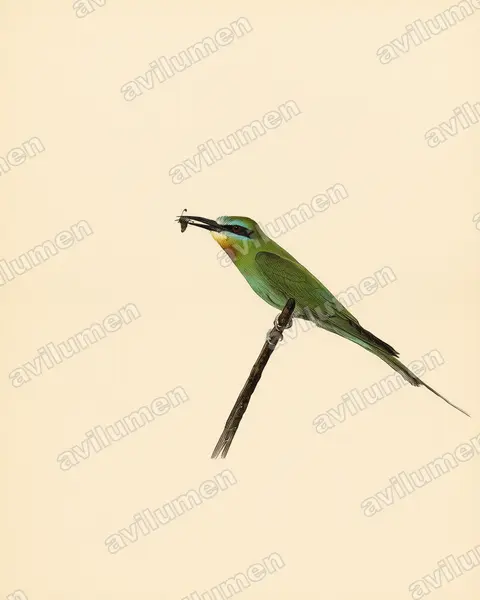
Vintage plate 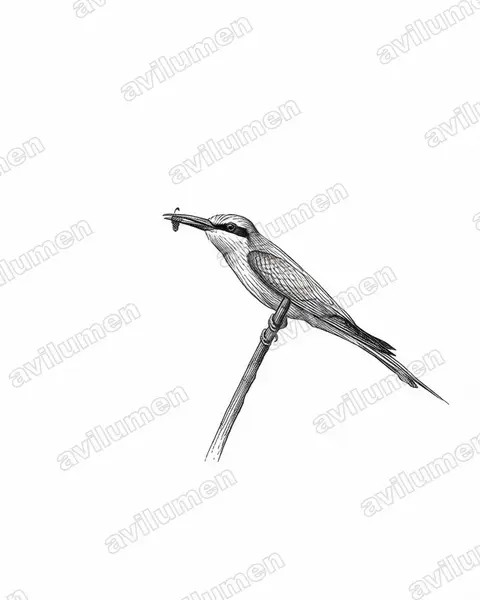
Ink 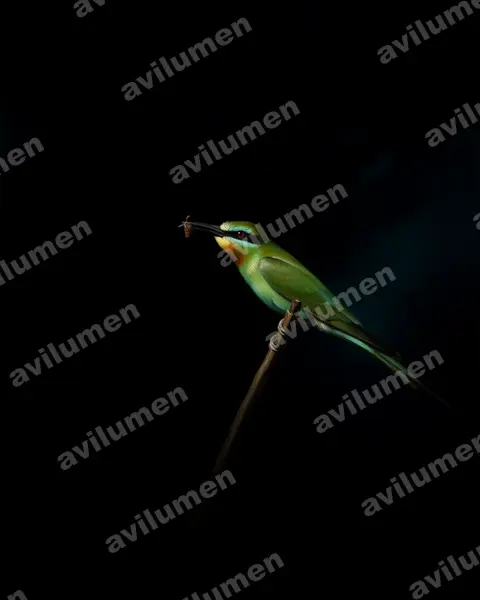
Oil 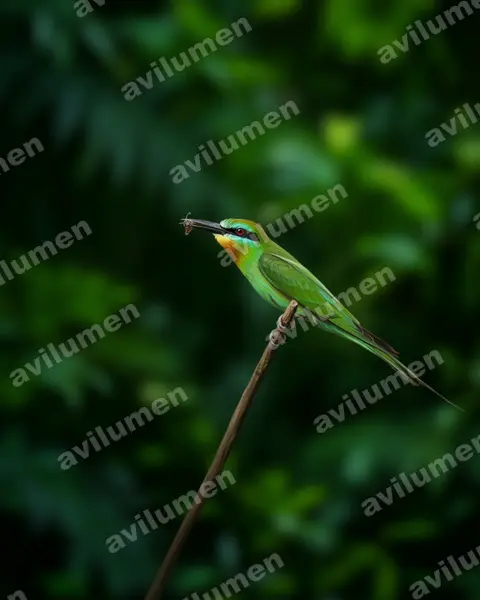
Realistic 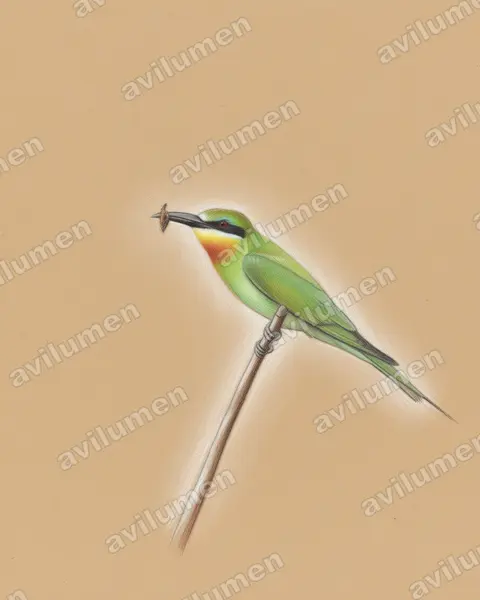
Colored pencil
Illustrations based on the photograph by El Golli Mohamed (CC BY-SA 4.0), from Wikimedia Commons.
Digital editions
HD Digital Art Pack — Blue-cheeked Bee-eater
Digital download: 6 high-resolution illustrations of the Blue-cheeked Bee-eater (Merops persicus), print-ready. This is a digital file; no animal or physical item is included.
AI Avatar — Blue-cheeked Bee-eater
Generate an avatar fusing your face with the Blue-cheeked Bee-eater (Merops persicus). Delivered digitally in 8K, watermark-free. Digital product; no animals are sold or brokered.
Instant download. No live birds are sold.
Frequently asked questions
- Is Merops persicus (Blue-cheeked Bee-eater) endangered?
- The IUCN Red List places Merops persicus, commonly known as the Blue-cheeked Bee-eater, in the «Least concern» category. «Least concern» means it is not currently threatened.
- Where does Merops persicus (Blue-cheeked Bee-eater) live?
- Merops persicus (Blue-cheeked Bee-eater) is found in Africa.
- What family does Merops persicus (Blue-cheeked Bee-eater) belong to?
- Merops persicus (Blue-cheeked Bee-eater) belongs to the family Meropidae, in the order Coraciiformes.
- What colour is Merops persicus (Blue-cheeked Bee-eater)?
- The plumage of Merops persicus (Blue-cheeked Bee-eater) combines these colours: Green and Blue.
More from the same family
 Least concern
Purple-bearded Bee-eater
Meropogon forsteni
The purple-bearded bee-eater or Celebes bee-eater is a species of bee-eater endemic to the island of Sulawesi, Indonesia. This species is often seen in clearings inside dense forest.
from $1.99
 Least concern
White-throated Bee-eater
Merops albicollis
The white-throated bee-eater is a species of bee-eater that breeds in semi-desert along the southern edge of the Sahara. The white-throated bee-eater is migratory, wintering in a completely different habitat in the equatorial rain forests of Africa from southern Senegal to Uganda.
from $1.99
 Least concern
European Bee-eater
Merops apiaster
The European bee-eater is a bird species in the bee-eater family, Meropidae. It has the largest range of any the bee-eater species. It breeds in southern and central Europe, northern and southern Africa, and western Asia. Except for the resident southern African population, the species is strongly migratory, wintering in tropical Africa.
from $1.99
 Least concern
Böhm's Bee-eater
Merops boehmi
Böhm's bee-eater is a species of bird in the family Meropidae. It is found in Democratic Republic of the Congo, Malawi, Mozambique, Tanzania, and Zambia.
from $1.99