Violet-throated metaltail
Metallura baroni
Avilumen editorial team ·

The violet-throated metaltail, locally called metalura gorjivioleta, is an Endangered species of hummingbird in the "coquettes", tribe Lesbiini of subfamily Lesbiinae. It is endemic to Ecuador.
The violet-throated metaltail (Metallura baroni), locally called metalura gorjivioleta, is an Endangered species of hummingbird in the "coquettes", tribe Lesbiini of subfamily Lesbiinae. It is endemic to Ecuador.
Taxonomy and systematics
The violet-throated metaltail is monotypic. At one time it was treated as a subspecies of what is now the fiery-throated metaltail (Metallura odomae). The species name commemorates the collector Oscar Theodor Brown.
Description
The violet-throated metaltail is 10 to 11 cm (3.9 to 4.3 in) long. Males weigh 4.3 to 4.5 g (0.15 to 0.16 oz) and females 3.9 to 5 g (0.14 to 0.18 oz). It has a medium length, straight, black bill. The adult male has dark olive green upper- and underparts. Its gorget is purple-violet. Its slightly forked tail is iridescent violaceous sky blue on its upper side and glittering yellow-green on its underside. The adult female's upperparts are also dark olive green. Its throat is a duller version of the male's and its breast, and belly are whitish gray spotted with olive green. Its outer tail feathers have whitish tips on their underside. Juveniles are similar to adult females.
Distribution and habitat
The violet-throated metaltail is found only on the Cajas Plateau west of the city of Cuenca, Ecuador. The plateau straddles the border of Azuay and Cañar provinces. It inhabits the edges of elfin forest and Polylepis woodlands and adjacent páramo grasslands. Its favored landscape is characterized by boulders with a cover of bromeliads, Ericaceae, and ferns and mosses. In elevation it normally ranges between 3,000 and 3,900 m (9,800 and 12,800 ft) but was once reported as low as 1,900 m (6,200 ft).
Movement
The violet-throated metaltail's movements, if any, have not been documented, but some seasonal elevational movement is thought possible.
Feeding
The violet-throated metaltail forages for nectar by hovering; it feeds on a variety of flowering vegetation at any level of its habitat. Males defend feeding territories.
Breeding
The violet-throated metaltail is thought to nest between November and February. One nest was described as resembling a slipper without a heel; it was made of moss, twigs, and wool. The female incubates the clutch of two white eggs; the incubation and nestling periods are not known.
Vocalization
A violet-throated metaltail vocalization has been described as "a descending series of 3–5 squeaky notes, followed by several jumbled ones, 'trsee-seee-seee-sew..trr-tsee-tse-tsew..trr-tsee-tse-tsew'." It is thought to be either a song or a chasing call.
Status
The IUCN originally assessed the violet-throated metaltail as Threatened. The assessment was changed to Vulnerable in 1994 and to Endangered in 2000. As of 2023, it has been downlisted to Vulnerable again. Its population is estimated at between 1,000 – 2,500 mature individuals and is believed to be decreasing. Its range includes El Cajas National Park and the small adjoining Río Mazán reserve. However, outside those areas and even within the national park its habitat is under threat by burning to create pasture.
Text adapted from Wikipedia · CC BY-SA 4.0
Where it lives
Distribution

Taxonomy
- Order
- Apodiformes
- Family
- Trochilidae
- Genus
- Metallura
- Conservation status
- Vulnerable
Listen to its call
No recording yet
Illustration gallery
6 illustrations of Metallura baroni (Violet-throated metaltail) in different styles, true to its real plumage. Shown watermarked; the art pack includes the high-resolution originals, ready to print.
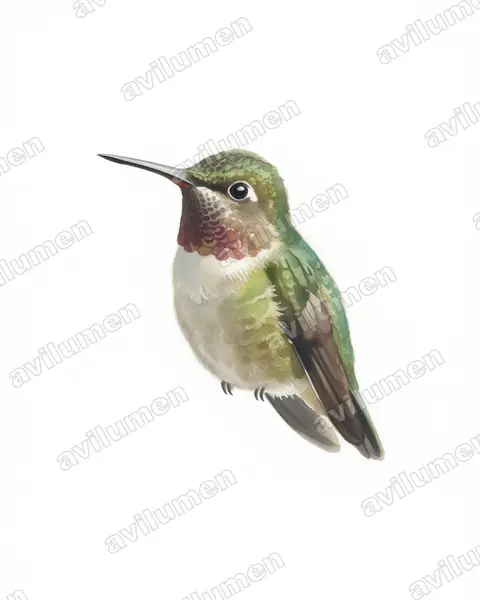
Watercolor 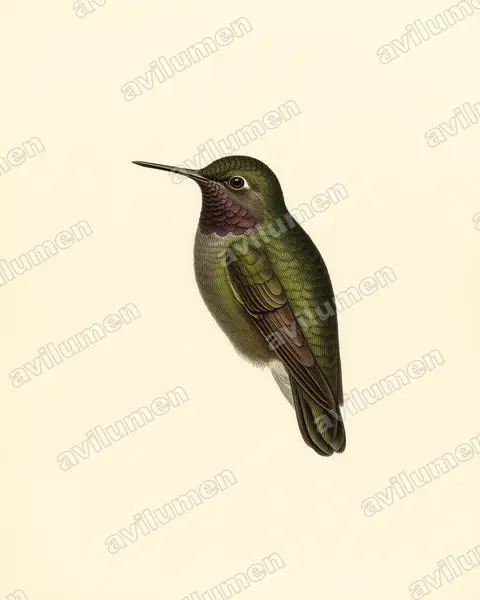
Vintage plate 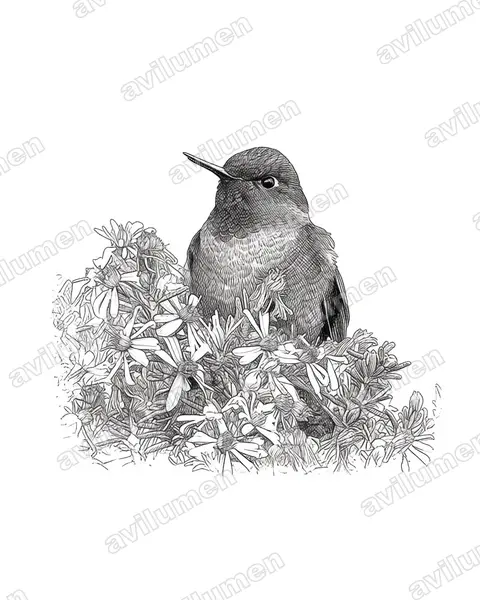
Ink 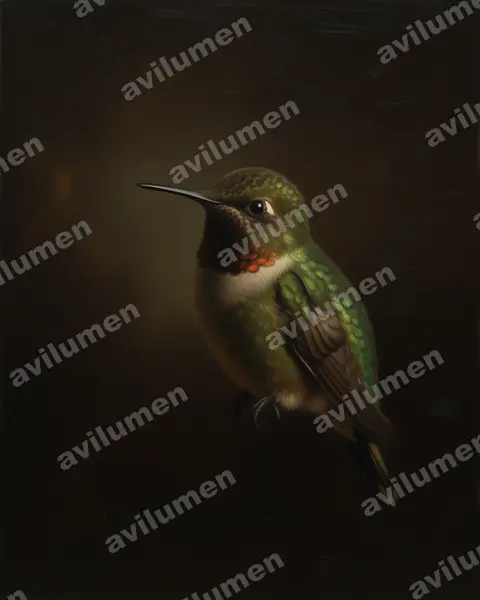
Oil 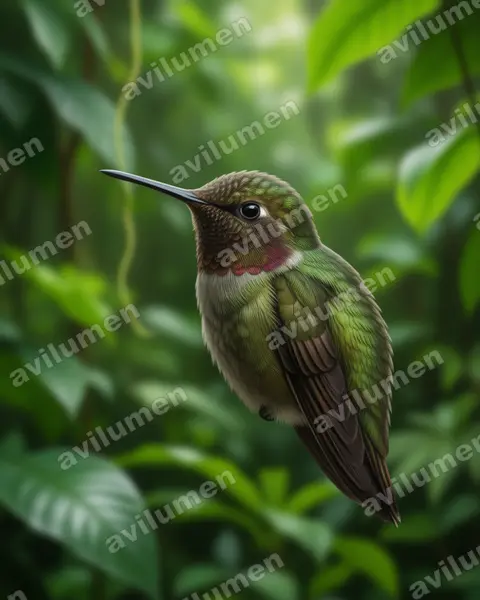
Realistic 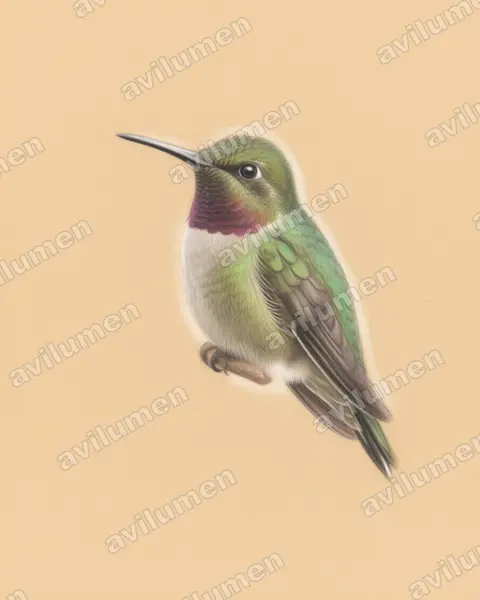
Colored pencil
Illustrations based on the photograph by Francesco Veronesi (CC BY-SA 2.0), from Wikimedia Commons.
Digital editions
HD Digital Art Pack — Violet-throated metaltail
Digital download: 6 high-resolution illustrations of the Violet-throated metaltail (Metallura baroni), print-ready. This is a digital file; no animal or physical item is included.
AI Avatar — Violet-throated metaltail
Generate an avatar fusing your face with the Violet-throated metaltail (Metallura baroni). Delivered digitally in 8K, watermark-free. Digital product; no animals are sold or brokered.
Instant download. No live birds are sold.
Frequently asked questions
- Is Metallura baroni (Violet-throated metaltail) endangered?
- The IUCN Red List places Metallura baroni, commonly known as the Violet-throated metaltail, in the «Vulnerable» category. «Vulnerable» means it faces a high risk of extinction in the medium term.
- Where does Metallura baroni (Violet-throated metaltail) live?
- Metallura baroni (Violet-throated metaltail) is found in Ecuador and South America.
- What family does Metallura baroni (Violet-throated metaltail) belong to?
- Metallura baroni (Violet-throated metaltail) belongs to the family Trochilidae, in the order Apodiformes.
- What colour is Metallura baroni (Violet-throated metaltail)?
- The plumage of Metallura baroni (Violet-throated metaltail) combines these colours: Violet and Green.
More from the same family
 Least concern
Emerald-chinned Hummingbird
Abeillia abeillei
The emerald-chinned hummingbird is a species of hummingbird in the "emeralds", tribe Trochilini of subfamily Trochilinae.
from $1.99
 Least concern
Speckled hummingbird
Adelomyia melanogenys
The speckled hummingbird is a species of hummingbird. It is the only member of the genus Adelomyia. It inhabits Neotropical montane cloud forests at elevations of 1,000–2,500 meters and is confined to the Andes of Argentina, Bolivia, Peru, Ecuador, Colombia and Venezuela; as well as to some isolated montane forests in western Ecuador and Venezuela.
from $1.99
 Vulnerable
Purple-backed sunbeam
Aglaeactis aliciae
The purple-backed sunbeam is a bird species in the family Trochilidae. It is found only in Peru.
from $1.99
 Near threatened
White-tufted sunbeam
Aglaeactis castelnaudii
The white-tufted sunbeam is a species of hummingbird in the family Trochilidae. It is found only in Peru. Its natural habitats are subtropical or tropical moist montane forest and subtropical or tropical high-altitude shrubland.
from $1.99