Tyrian metaltail
Metallura tyrianthina
Avilumen editorial team ·

The Tyrian metaltail is a species of hummingbird in the subfamily Lesbiinae, the brilliants and coquettes. It is found in Bolivia, Colombia, Ecuador, Peru, and Venezuela.
The Tyrian metaltail (Metallura tyrianthina) is a species of hummingbird in the subfamily Lesbiinae, the brilliants and coquettes. It is found in Bolivia, Colombia, Ecuador, Peru, and Venezuela.
Taxonomy and systematics
The Tyrian metaltail has these seven subspecies:
M. t. districta Bangs (1899)
M. t. chloropogon Cabanis & Heine (1860)
M. t. oreopola Todd (1913)
M. t. tyrianthina Loddiges (1832)
M. t. quitensis Gould (1861)
M. t. septentrionalis Hartert, E. (1899)
M. t. smaragdinicollis d'Orbigny & Lafresnaye (1838)
In the early twentieth century some authors treated M. t. chloropogon and M. t. smaragdinicollis as full species but that treatment has not been widely accepted.
Description
The Tyrian metaltail is 9 to 10 cm (3.5 to 3.9 in) long and weighs 2.7 to 5.1 g (0.10 to 0.18 oz). Both sexes of all subspecies have a short, straight, black bill. The male of the nominate subspecies has bottle green upperparts and gray underparts with pale fringes on the feathers. It has an emerald green throat and a slightly forked glistening bronze tail. The female is also bottle green above. Its throat and upper breast are ochre-orange with olive green spots and the lower breast and belly are whitish with green spots. Its outer tail feathers have whitish tips.
The plumage of the Tyrian metaltail's other subspecies differ from those of the nominate in some significant ways. M. t. districta has a violet tail and the female's underparts are not spotted. Both sexes of M. t. chloropogon have a coppery red tail; the male is otherwise almost completely black and the female has only a few spots on the throat and upper breast. M. t. oreopola's tail is golden red. The male's upperpart feathers have coppery bars near the ends and its underparts are green with pale fringes to the feathers. The female's throat and upper breast have few spots. M. t. quitensis has a longer bill than the nominate and a bronze-olive tail. M. t. septentrionalis's tail is purple-blue with green inclusions and the male's underparts are white with bronze-olive spots. M. t. smaragdinicollis has a violet tail like districta but the female's throat and upper breast are heavily spotted like those of the nominate.
Distribution and habitat
The subspecies of Tyrian metaltail are found thus:
M. t. districta, northern Colombia's Sierra Nevada de Santa Marta and northwestern Venezuela's Serranía del Perijá
M. t. chloropogon, the Venezuelan Coastal Range between the states of Aragua and Miranda
M. t. oreopola, the Andes of Venezuela from southwestern Lara south to northern Táchira
M. t. tyrianthina, from southern Táchira south through all three Andean chains of Colombia and eastern and southern Ecuador into Piura department in extreme northern Peru
M. t. quitensis, northwestern Ecuador
M. t. septentrionalis, the west slope of the Peruvian Andes west of the Marañón River between the departments of Cajamarca and Lima
M. t. smaragdinicollis, the east slope of the Peruvian Andes from the department of Amazonas south and east across central Bolivia into Santa Cruz department
The Tyrian metaltail inhabits the interior of several humid open landscapes including secondary forest, cloudforest, mossy treeline scrub, and elfin forest. It also occurs at the edges or in brushy parts of páramo. In elevation it ranges from 1,500 to 4,200 m (4,900 to 13,800 ft) but in most areas is most common between 2,500 to 3,300 m (8,200 to 10,800 ft) and in the Venezuelan coastal mountains at about 1,000 m (3,300 ft).
Movement
The Tyrian metaltail makes significant elevational movements between the seasons, even occurring casually as low as 600 m (2,000 ft) in Venezuela.
Feeding
The Tyrian metaltail forages in the canopy of bushes and medium-sized trees, where males defend territories. It takes nectar from a variety of flowering plants, both by inserting its bill into the corolla while hovering or clinging to it and occasionally by piercing the base of the flower to "rob" nectar. It also feeds on small insects on the wing.
Breeding
The Tyrian metaltail's breeding seasons vary widely along its north-south distribution. The female alone builds the nest, incubates the eggs, and cares for the young. It first breeds in its second year. The nest is an open cup made of moss, lichens, liverwort, and other plant material. It may be unlined or lined with soft cottony seeds. It is placed in a rocky niche or suspended from roots on an earthen or rocky bank. The clutch size is two eggs.
Vocalization
The Tyrian metaltail does not sing often; its song is "a repeated series of weak, high-pitched, lispy notes 'seek..sik..see..si..see..sip..see.......see..seek..see..see...'." It more often calls while chasing, "alternating stuttering trills and repeated phrases of squeaky notes 'trr..trr..trr..tsi-see-sew-sew...tsi-see-sew-sew...'". It also makes "a brief rattle and short 'tsit' or 'pit' notes.
Status
The IUCN has assessed the Tyrian metaltail as being of Least Concern. Though its population size is not known, it is believed to be stable. It is common throughout its large range and locally very abundant. It appears "less sensitive to man-induced environmental changes than other Metallura species" and occurs in many protected areas.
Text adapted from Wikipedia · CC BY-SA 4.0
Where it lives
Distribution

Taxonomy
- Order
- Apodiformes
- Family
- Trochilidae
- Genus
- Metallura
- Conservation status
- Least concern
Listen to its call
No recording yet
Illustration gallery
6 illustrations of Metallura tyrianthina (Tyrian metaltail) in different styles, true to its real plumage. Shown watermarked; the art pack includes the high-resolution originals, ready to print.
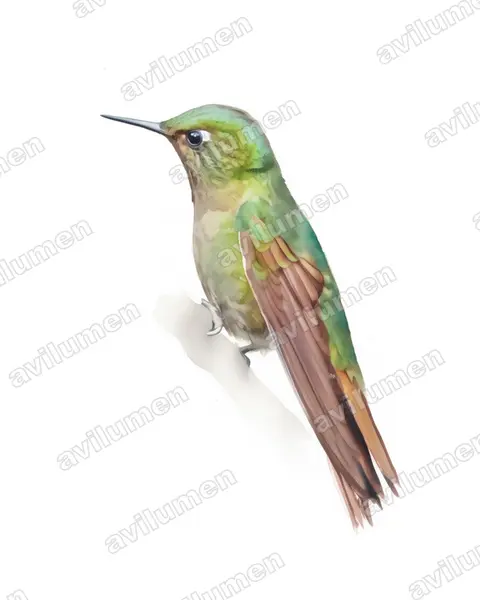
Watercolor 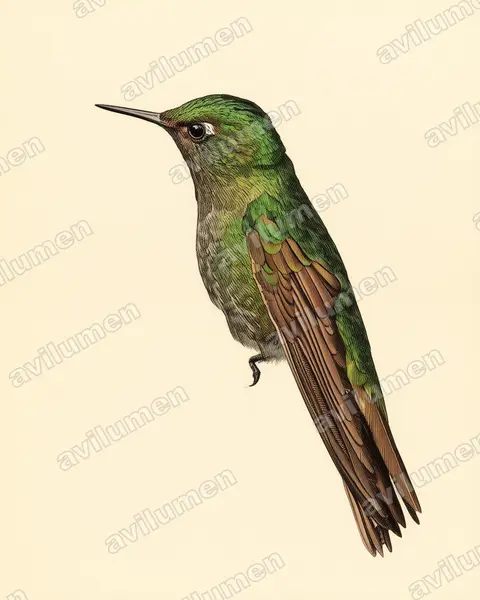
Vintage plate 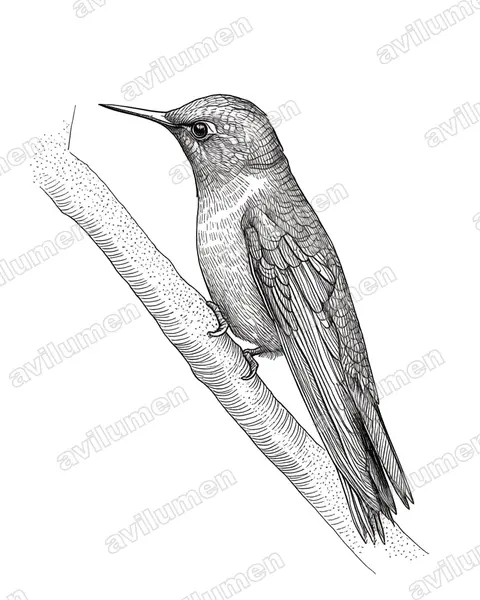
Ink 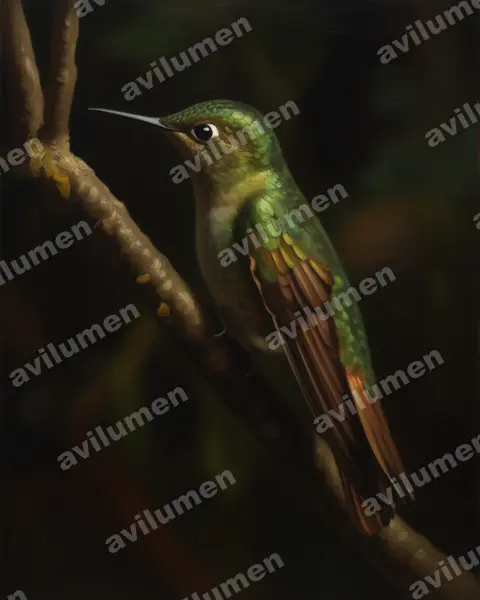
Oil 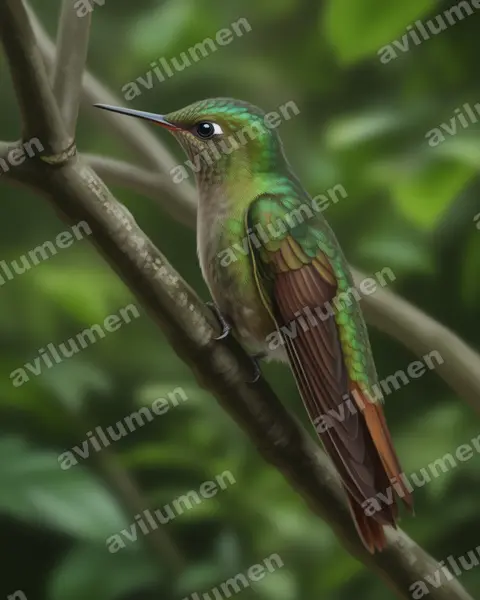
Realistic 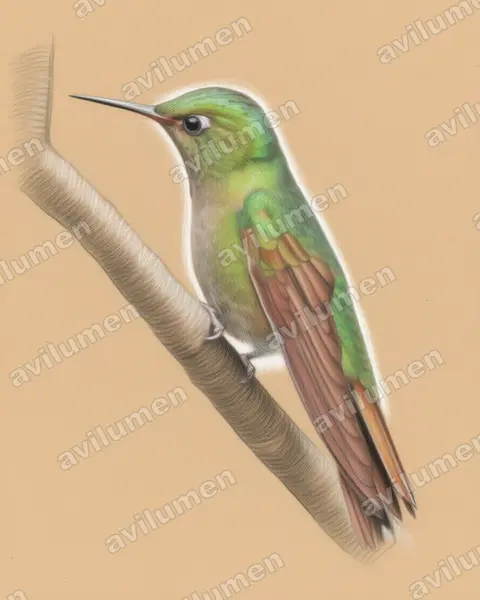
Colored pencil
Illustrations based on the photograph by Joseph C Boone (CC BY-SA 4.0), from Wikimedia Commons.
Digital editions
HD Digital Art Pack — Tyrian metaltail
Digital download: 6 high-resolution illustrations of the Tyrian metaltail (Metallura tyrianthina), print-ready. This is a digital file; no animal or physical item is included.
AI Avatar — Tyrian metaltail
Generate an avatar fusing your face with the Tyrian metaltail (Metallura tyrianthina). Delivered digitally in 8K, watermark-free. Digital product; no animals are sold or brokered.
Instant download. No live birds are sold.
Frequently asked questions
- Is Metallura tyrianthina (Tyrian metaltail) endangered?
- The IUCN Red List places Metallura tyrianthina, commonly known as the Tyrian metaltail, in the «Least concern» category. «Least concern» means it is not currently threatened.
- Where does Metallura tyrianthina (Tyrian metaltail) live?
- Metallura tyrianthina (Tyrian metaltail) is found in Peru and South America.
- What family does Metallura tyrianthina (Tyrian metaltail) belong to?
- Metallura tyrianthina (Tyrian metaltail) belongs to the family Trochilidae, in the order Apodiformes.
- What colour is Metallura tyrianthina (Tyrian metaltail)?
- The plumage of Metallura tyrianthina (Tyrian metaltail) combines these colours: Green and Yellow.
More from the same family
 Least concern
Emerald-chinned Hummingbird
Abeillia abeillei
The emerald-chinned hummingbird is a species of hummingbird in the "emeralds", tribe Trochilini of subfamily Trochilinae.
from $1.99
 Least concern
Speckled hummingbird
Adelomyia melanogenys
The speckled hummingbird is a species of hummingbird. It is the only member of the genus Adelomyia. It inhabits Neotropical montane cloud forests at elevations of 1,000–2,500 meters and is confined to the Andes of Argentina, Bolivia, Peru, Ecuador, Colombia and Venezuela; as well as to some isolated montane forests in western Ecuador and Venezuela.
from $1.99
 Vulnerable
Purple-backed sunbeam
Aglaeactis aliciae
The purple-backed sunbeam is a bird species in the family Trochilidae. It is found only in Peru.
from $1.99
 Near threatened
White-tufted sunbeam
Aglaeactis castelnaudii
The white-tufted sunbeam is a species of hummingbird in the family Trochilidae. It is found only in Peru. Its natural habitats are subtropical or tropical moist montane forest and subtropical or tropical high-altitude shrubland.
from $1.99