Kea
Nestor notabilis
Avilumen editorial team ·

The kea is a species of large parrot in the family Strigopidae that is endemic to the forested and alpine regions of the South Island of New Zealand. About 48 cm (19 in) long, it is mostly olive-green, with brilliant orange under its wings, and has a large, narrow, curved, grey-brown upper beak. Its omnivorous diet consists mainly of roots, leaves, berries, nectar, and insects, but also includes carrion.
The kea ( KEE-ə; Māori: [kɛ.a]; Nestor notabilis) is a species of large parrot in the family Strigopidae that is endemic to the forested and alpine regions of the South Island of New Zealand. About 48 cm (19 in) long, it is mostly olive-green, with brilliant orange under its wings, and has a large, narrow, curved, grey-brown upper beak. Its omnivorous diet consists mainly of roots, leaves, berries, nectar, and insects, but also includes carrion. It was once killed for bounty due to concern by sheep farmers that it attacked livestock, especially sheep. The kea is now uncommon, and received absolute protection under the Wildlife Act in 1986.
The kea nests in burrows or crevices among the roots of trees. Kea are known for their intelligence and curiosity, both vital to their survival in a harsh mountain environment. Kea can solve logical puzzles, such as pushing and pulling things in a certain order to get to food, and will work together to achieve a certain objective. They have been filmed preparing and using tools.
Taxonomy and naming
The kea was described by ornithologist John Gould in 1856, from two specimens shown to him by Walter Mantell, who obtained the birds in Murihiku. Eight years earlier, some elderly Māori had told Mantell about the bird, and how it used to visit the coast in winter but had not been seen in recent times. Mantell subsequently investigated and obtained the birds.
The kea's Latin binomial specific epithet, notabilis, means 'noteworthy'. The common name kea is from Māori, probably an onomatopoeic representation of their in-flight call – 'keee aaa'. In New Zealand English, the word 'kea' is both singular and plural. The collective noun is a circus or conspiracy of kea.
The genus Nestor contains four species: the New Zealand kākā (Nestor meridionalis), the kea (N. notabilis), the extinct Norfolk kākā (N. productus), and the extinct Chatham kākā (N. chathamensis). All four are thought to stem from a "proto-kākā", dwelling in the forests of New Zealand five million years ago. Their closest relative is the flightless kākāpō (Strigops habroptilus). Together, they form the parrot superfamily Strigopoidea, an ancient group that split off from all other Psittacidae before their radiation.
Description
The kea is a large parrot measuring 46 to 50 cm (18 to 20 in) in length, with some specimens possibly reaching 55 cm (22 in). The male is about 5% longer than the female. Adult kea weigh between 750 and 1,000 g (1.65 and 2.20 lb), with males averaging 956 g (2.108 lb) and females averaging 779 g (1.717 lb). The mean adult weight is 922 g (2.033 lb).
It has mostly olive-green plumage: the feathers on the sides of its face are dark olive-brown, the back and rump feathers are orange-red, and some of the outer wing feathers are dull blue. The kea has orange feathers on the undersides of its wings, and a short, broad, bluish-green tail with a black tip. Feather shafts project at the tip of the tail and the undersides of the inner tail feathers have yellow-orange transverse stripes.
The adult has dark-brown irises, and the cere, eye-rings, and legs are grey. The kea has a grey beak with a long, narrow, curved upper beak.The male's upper beak is 12–14% longer than that of the female.
Juveniles generally resemble adults, but have yellow eye-rings and cere, an orange-yellow lower beak, and grey-yellow legs.
Distribution and habitat
The kea is one of nine living endemic parrot species in New Zealand.
The kea's range is from lowland river valleys and coastal forests of the South Island's west coast up to alpine regions of the South Island such as Arthur's Pass and Aoraki / Mount Cook National Park. It is closely associated throughout its range with the southern beech (Nothofagus) forests on alpine ridges.
Apart from occasional vagrants, kea today are not found in the North Island. Subfossil kea bones have been found in sand dunes at Mataikona in the eastern Wairarapa, Poukawa near Hastings, and Waitomo, indicating that they ranged through lowland forest over much of the North Island until the arrival of Polynesian settlers about 750 years ago. Kea subfossils are not restricted to alpine areas, being commonly found in lowland or coastal sites in the South Island. The current distribution of kea reflects the effects of mammalian predators, including humans, which have driven them out of lowland forests into the mountains.
Breeding
At least one observer has reported that the kea is polygynous, with one male attached to multiple females. The same source also noted that there was a surplus of females.
Kea are social and live in groups of up to 13 birds. Isolated individuals do badly in captivity, but respond well to seeing themselves in a mirror.
In one study, nest sites occurred at a density of one per 4.4 square kilometres (1.7 sq mi). The breeding areas are most commonly in southern beech (Nothofagus) forests, located on steep mountainsides. Breeding at heights of 1,600 metres (5,200 ft) above sea level and higher, it is one of the few parrot species in the world to regularly spend time above the tree line. Nest sites are usually positioned on the ground underneath large beech trees, in rock crevices, or burrows dug between roots. They are accessed by tunnels leading back 1 to 6 metres (3.3 to 19.7 ft) into a larger chamber, which is furnished with lichens, moss, ferns, and rotting wood. The laying period starts in July and reaches into January. Two to five white eggs are laid, with an incubation time of around 21 days, and a brooding period of 94 days.
Mortality is high among young kea, with less than 40% surviving their first year. The median lifespan of a wild subadult kea has been estimated at five years, based on the proportion of kea seen again in successive seasons in Arthur's Pass, and allowing for some emigration to surrounding areas. Around 10% of the local kea population was expected to be over 20 years of age. The oldest known captive kea was 50 years old in 2008.
Cognitive abilities
Kea parrots have strong cognitive abilities. According to recent studies, kea have a sense of impulse control and forward planning. Kea can wait up to 160 seconds for a more preferred reward. In addition, kea also use trial-and-error tactics and use observational learning to solve difficult problems and when faced with puzzles and locks. These decision-making abilities are similar to primates and other intelligent bird species such as the African grey parrot.
Diet and feeding
An omnivore, the kea feeds on more than 40 plant species, beetle larvae, grasshoppers, land snails, other birds (including shearwater chicks), and mammals (including sheep, rabbits and mice). It has been observed breaking open shearwater nests to feed on the chicks after hearing the chicks in their nests. It enjoys the flesh and bone marrow from carcasses. The kea has also taken advantage of human rubbish and "gifts" of food.
Tool use behaviour has been observed in this species. A bird named Bruce, who has a broken upper beak, wedged pebbles between his tongue and lower mandible and then utilised this arrangement to aid with his preening habits.
#### Sheep
The controversy about whether the kea preys on sheep is long-running. Sheep suffering from unusual wounds on their sides or loins were noticed by the mid-1860s, within a decade of sheep farmers moving into the high country. Although some supposed the cause was a new disease, suspicion soon fell on the kea. James MacDonald, head shepherd at Wanaka Station, witnessed a kea attacking a sheep in 1868, and similar accounts were widespread. Prominent members of the scientific community accepted that kea attacked sheep, with Alfred Wallace citing this as an example of behavioural change in his 1889 book Darwinism. Thomas Potts noted that attacks were most frequent during winter and snow-bound sheep with two years growth in their fleece were the most vulnerable, while newly-shorn sheep in warm weather were rarely molested.
Despite substantial anecdotal evidence of sheep attacks, others remained unconvinced, especially in later years. For instance, in 1962, animal specialist J.R. Jackson concluded that while the bird may attack sick or injured sheep, especially if it mistakes them for dead, it is not a significant predator. In August 1992, however, its nocturnal assaults were captured on video, proving that at least some kea will attack and feed on healthy sheep. The video confirmed what many scientists had long suspected: that the kea uses its powerful, curved beak and claws to rip through the layer of wool and eat the fat from the back of the animal. Though the bird does not directly kill the sheep, death can result from infections or accidents suffered by animals when trying to escape.
Since kea are now a protected species, their depredations are generally tolerated by sheep farmers, though why some kea attack sheep, and others do not, remains unclear. Various theories, including similarities with existing food sources, curiosity, entertainment, hunger, maggots as well as a progression from scavenging dead sheep and hides have all been put forward as to how the behaviour was first acquired. Anecdotal evidence also suggests that only particular birds have learned the behaviour, with identification and removal of those individuals being sufficient to control the problem.
There are also anecdotal reports of kea attacking rabbits, dogs, and even horses. There are also suggestions that kea used to feed on moa in a similar way.
Relationship with humans
Kea, which are social, have a high level of cognitive ability and the capacity to solve complex tasks. This curiosity and urge to explore and investigate make the bird both a pest for residents and an attraction for tourists. In 2017 the kea was voted New Zealand Bird of the Year in a campaign to raise awareness about the country's endangered wildlife.
Called "the clown of the mountains", it will investigate backpacks, boots, skis, snowboards, and even cars, often causing damage or flying off with smaller items. Kea have been kept as pets before they were protected, but rarely, since they were difficult to capture and destructive when in captivity.
People commonly encounter wild kea at South Island ski areas, where they are attracted by the prospect of food scraps. Their curiosity leads them to peck and carry away unguarded items of clothing, or to pry apart rubber parts of cars, to the entertainment and annoyance of human observers. They are often described as "cheeky". A kea has even been reported to have made off with the passport of a tourist who was visiting Fiordland National Park.
The Department of Conservation suggested that the time savings resulting from a human-assisted, more calorie-rich diet gives kea more free time to investigate and damage things at campsites and car parks.
The bird's naturally trusting behaviour around humans has also been indicated as a contributing factor in a number of incidents at popular tourist spots where kea have been purposely killed.
Kea were eaten by Māori. They were believed by the Waitaha tribe to be kaitiaki (guardians).
Cultural references
The kea featured on the reverse side of the New Zealand $10 note between 1967 and 1992, when it was replaced by the blue duck (whio).
Kea are the protagonists in New Zealand author Philip Temple's novels Beak of the Moon (1981) and Dark of the Moon (1993), recounting respectively the first encounters of a group of kea with humans at the time of the colonisation of the South Island by Māori, and their life in present-day, human-dominated New Zealand. Sentient kea also feature as prominent characters in the Orson Scott Card novel The Last Shadow.
The youngest section of Scouts New Zealand (known as Beavers in the United Kingdom and Joeys in Australia) is named after the bird.
In the video game Dwarf Fortress, kea are one of many species of animals that will steal the player's items.
Text adapted from Wikipedia · CC BY-SA 4.0
Where it lives
Distribution

Taxonomy
- Order
- Psittaciformes
- Family
- Nestoridae
- Genus
- Nestor
- Conservation status
- Endangered
Listen to its call
No recording yet
Illustration gallery
6 illustrations of Nestor notabilis (Kea) in different styles, true to its real plumage. Shown watermarked; the art pack includes the high-resolution originals, ready to print.
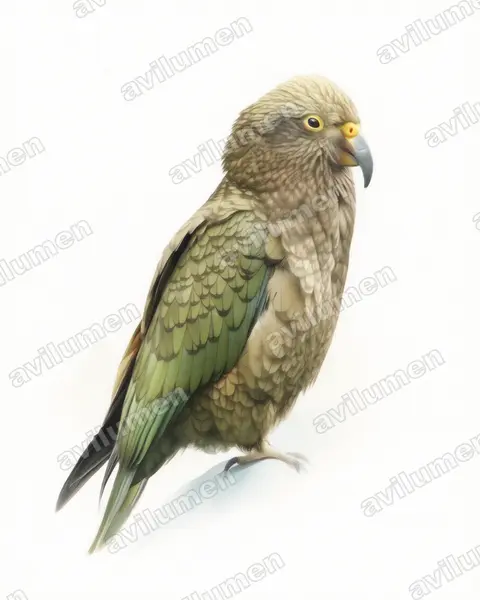
Watercolor 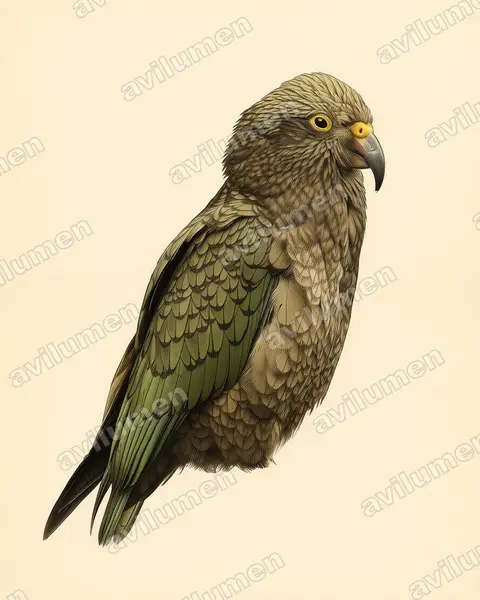
Vintage plate 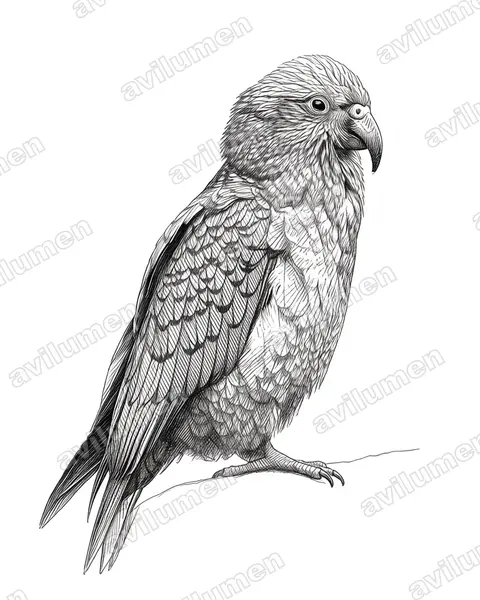
Ink 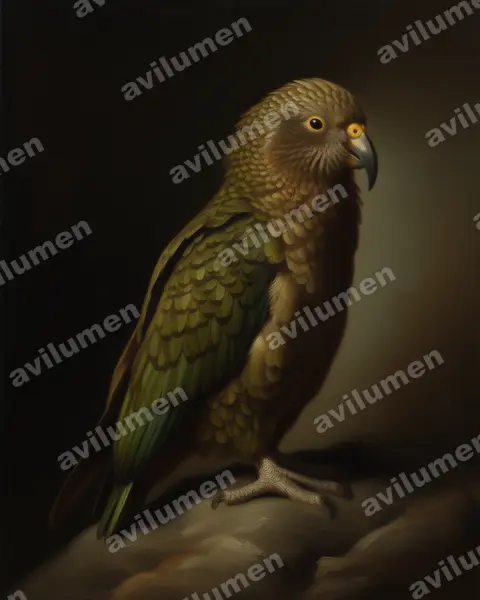
Oil 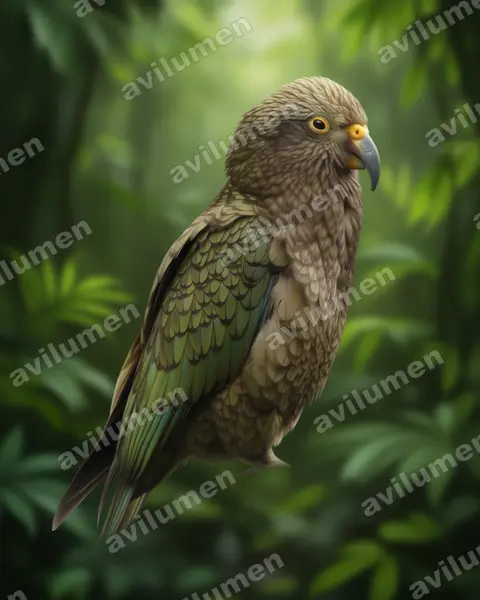
Realistic 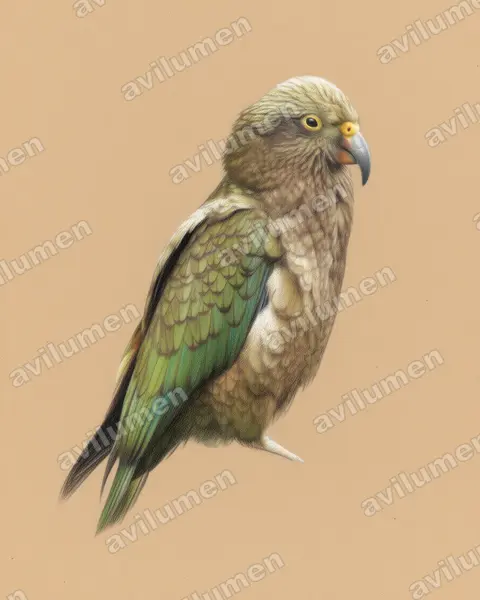
Colored pencil
Illustrations based on the photograph by Markus Koljonen (Dilaudid) (CC BY-SA 3.0), from Wikimedia Commons.
Digital editions
HD Digital Art Pack — Kea
Digital download: 6 high-resolution illustrations of the Kea (Nestor notabilis), print-ready. This is a digital file; no animal or physical item is included.
AI Avatar — Kea
Generate an avatar fusing your face with the Kea (Nestor notabilis). Delivered digitally in 8K, watermark-free. Digital product; no animals are sold or brokered.
Instant download. No live birds are sold.
Frequently asked questions
- Is Nestor notabilis (Kea) endangered?
- The IUCN Red List places Nestor notabilis, commonly known as the Kea, in the «Endangered» category. «Endangered» means it faces a very high risk of disappearing in the wild.
- Where does Nestor notabilis (Kea) live?
- Nestor notabilis (Kea) is found in New Zealand.
- What family does Nestor notabilis (Kea) belong to?
- Nestor notabilis (Kea) belongs to the family Nestoridae, in the order Psittaciformes.
- What colour is Nestor notabilis (Kea)?
- The plumage of Nestor notabilis (Kea) combines these colours: Green and Orange.
More from the same family
 Extinct
Chatham kākā
Nestor chathamensis
The Chatham kākā or Chatham Island kākā is an extinct parrot species previously found on the Chatham Islands, New Zealand. The first individuals were thought to belong to the New Zealand kākā, but detailed examination of the subfossil bones showed that they actually belong to a separate endemic species.
from $1.99
 Vulnerable
Kākā
Nestor meridionalis
The New Zealand kākā is a large species of parrot of the family Strigopidae found in native forests of New Zealand. The species is often known by the abbreviated name kākā, although it shares this name with the Norfolk kākā and Chatham kākā, both recently extinct. Two subspecies of New Zealand kākā are recognised.
from $1.99
 Extinct
Norfolk Kaka
Nestor productus
The Norfolk kākā is an extinct species of large parrot, belonging to the parrot family Nestoridae. The birds were about 38 cm long, with mostly olive-brown upperparts, reddish-orange cheeks and throat, straw-coloured breast, thighs, rump and lower abdomen dark orange and a prominent beak. It inhabited the rocks and treetops of Norfolk Island and adjacent Phillip Island. It was a relative of the New Zealand kākā.
from $1.99