Ecuadorian Hillstar
Oreotrochilus chimborazo
Avilumen editorial team ·

The Ecuadorian hillstar or Chimborazo hillstar is a species of hummingbird. It is native to the Andes of Ecuador and extreme southern Colombia. Its main habitat type is high-altitude mountain grassland between 3500 and 5200 meters.
The Ecuadorian hillstar or Chimborazo hillstar (Oreotrochilus chimborazo) is a species of hummingbird. It is native to the Andes of Ecuador and extreme southern Colombia. Its main habitat type is high-altitude mountain grassland between 3500 and 5200 meters.
Description and range
The length of this species is about 12 cm, and it weighs approximately 8.0 g. It has a black bill that is slightly decurved and is about 2 cm long. The male has a glittering violet purple hood bordered below by a horizontal black chest stripe. It is dark olive green above and white below with a dark line down the center of the belly. The central tail feathers are blue-green and the rest are mostly white with black tips and edges. Females are duller dusty olive green above with a whitish throat speckled with brown spots. Its tail is dark and the rest of its underparts are pale grayish.
There are two subspecies and the males can be distinguished by their throat. The entire throat of the O. c. jamesonii subspecies is glittering violet purple, but the O. c. chimborazo subspecies has a violet-purple upper throat and a glittering aquamarine patch on its lower throat. Both have the black chest stripe bordering the throat.
O. c. chimborazo is found around the Chimborazo and Quilotoa volcanoes and the intervening paramo, but O. c. jamesonii is more widespread. It occurs in favorable habitats from southern Columbia to the mountains of Azuay Province, especially around the volcanoes of Cotacachi, Pichincha, Antisana, Iliniza, and Cotopaxi.
A third subspecies, O. c. soderstromi, is thought to be endemic to the volcano Quilotoa in Ecuador. This subspecies, however, has not been recorded since the time of its description. Moreover, the description fits that of an intergrade between the other two subspecies. Both O. c. chimborazo and O. c. jamesonii have been recorded at the type locality of O. c. soderstromi. This third subspecies, thus, may not be a valid one.
Behavior and nesting
Nectar is a very important food for the Ecuadorian hillstar and their main source is the orange flowers of the Chuquiraga shrub. For a hummingbird, its feet are relatively large and instead of hovering while feeding, they usually land and feed while clinging to the plant. This behavior saves energy in the cold environment where they live. Insects are another important food source, many of which are caught in the air or foraged in the vegetation and along the cliffs. At night or when the weather is bad they seek shelter in caves or crevices in ravines. During the night they go into a torpid state to conserve energy.
To protect from the weather, nests are often built in caves or on the walls of steep ravines, usually with an overhang for added protection from hail, rain, and the midday Sun. Some nests are built in protective bushes. The nests are very large for a hummingbird and are built out of warm material like grass, moss, feathers, plant down, horse hair, and rabbit fur. In highly desirable locations, several nests may be found in close proximity. The clutch size is two, and the male does not participate in the nest building, incubation of the eggs, or feeding of the young.
Possible evolutionary importance
Despite its small range, the Ecuadorian hillstar comprises two subspecies. This remarkable case of geographic differentiation has caught the attention of many prominent biologists, among which was Alfred Russel Wallace. In Island Life, Wallace wrote that the ranges of these subspecies were among the most wonderful cases of restricted ranges of any bird.
The presence of the two subspecies is presumed to be related to the complex topography of the Andes, which may have presented numerous opportunities for geographic isolation. Any geographic barrier between both subspecies, however, seems to be absent in the present. Past isolation tied to the varying climate of the Pleistocene may have promoted differentiation within the range of the Ecuadorian Hillstar. Such isolation may not have occurred a long time ago, because no notable differences between the subspecies have been found in mitochondrial DNA.
Text adapted from Wikipedia · CC BY-SA 4.0
Where it lives
Plumage colours
Distribution

Taxonomy
- Order
- Apodiformes
- Family
- Trochilidae
- Genus
- Oreotrochilus
- Conservation status
- Least concern
Listen to its call
No recording yet
Illustration gallery
6 illustrations of Oreotrochilus chimborazo (Ecuadorian Hillstar) in different styles, true to its real plumage. Shown watermarked; the art pack includes the high-resolution originals, ready to print.
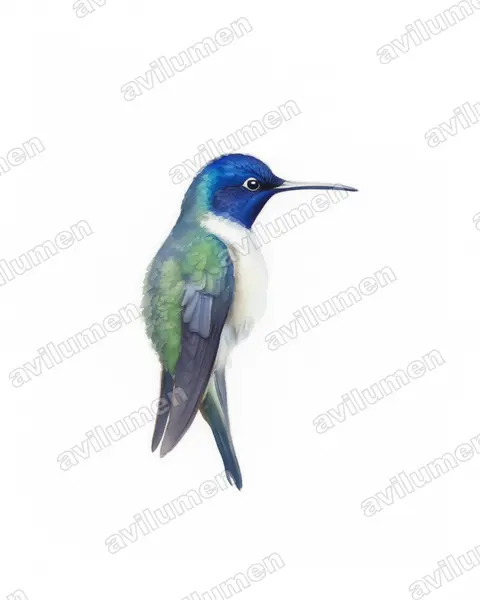
Watercolor 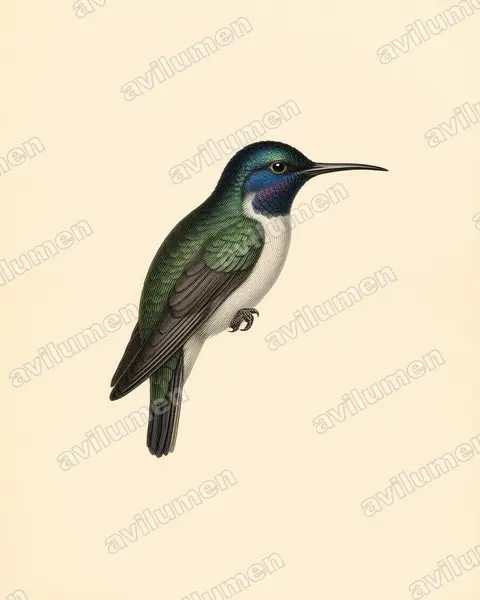
Vintage plate 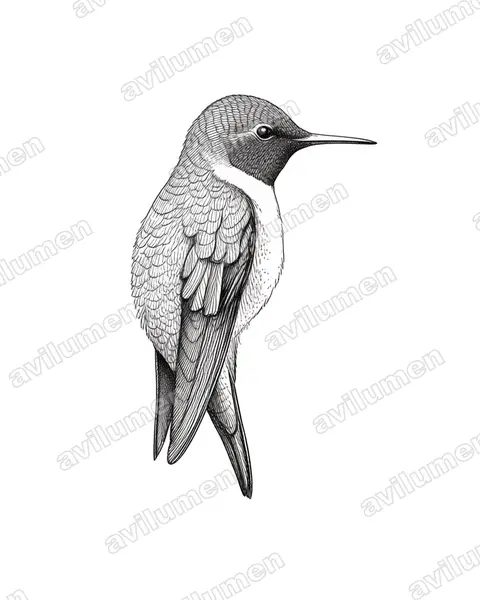
Ink 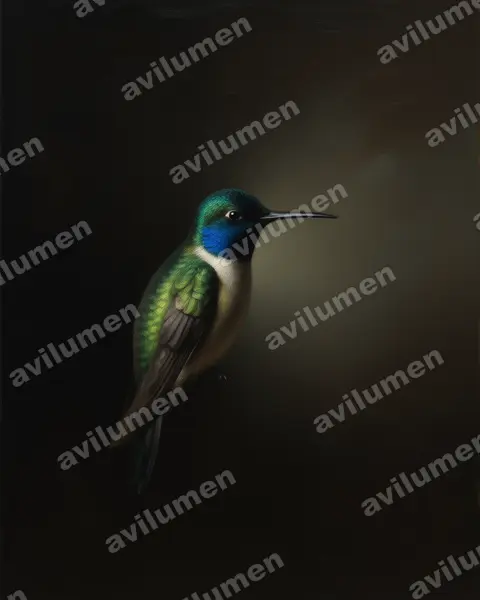
Oil 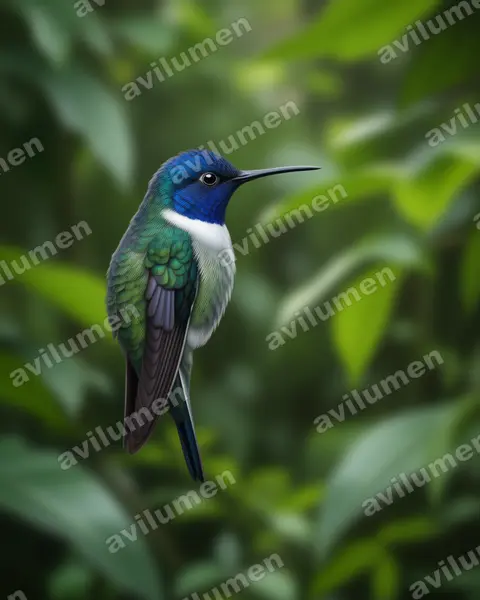
Realistic 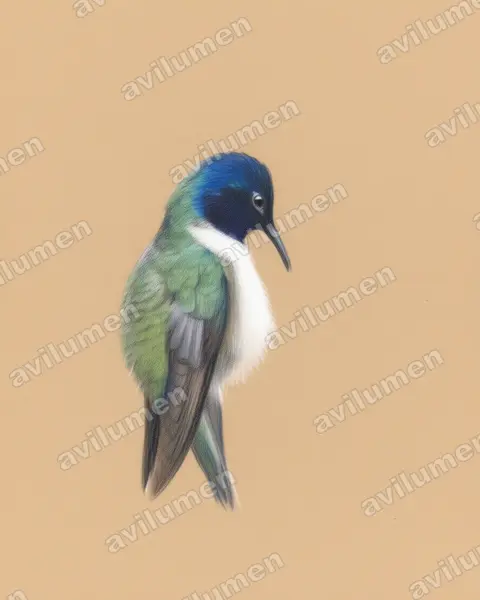
Colored pencil
Illustrations based on the photograph by Joseph C Boone (CC BY-SA 3.0), from Wikimedia Commons.
Digital editions
HD Digital Art Pack — Ecuadorian Hillstar
Digital download: 6 high-resolution illustrations of the Ecuadorian Hillstar (Oreotrochilus chimborazo), print-ready. This is a digital file; no animal or physical item is included.
AI Avatar — Ecuadorian Hillstar
Generate an avatar fusing your face with the Ecuadorian Hillstar (Oreotrochilus chimborazo). Delivered digitally in 8K, watermark-free. Digital product; no animals are sold or brokered.
Instant download. No live birds are sold.
Frequently asked questions
- Is Oreotrochilus chimborazo (Ecuadorian Hillstar) endangered?
- The IUCN Red List places Oreotrochilus chimborazo, commonly known as the Ecuadorian Hillstar, in the «Least concern» category. «Least concern» means it is not currently threatened.
- Where does Oreotrochilus chimborazo (Ecuadorian Hillstar) live?
- Oreotrochilus chimborazo (Ecuadorian Hillstar) is found in South America.
- What family does Oreotrochilus chimborazo (Ecuadorian Hillstar) belong to?
- Oreotrochilus chimborazo (Ecuadorian Hillstar) belongs to the family Trochilidae, in the order Apodiformes.
- What colour is Oreotrochilus chimborazo (Ecuadorian Hillstar)?
- The plumage of Oreotrochilus chimborazo (Ecuadorian Hillstar) combines these colours: Black.
More from the same family
 Least concern
Emerald-chinned Hummingbird
Abeillia abeillei
The emerald-chinned hummingbird is a species of hummingbird in the "emeralds", tribe Trochilini of subfamily Trochilinae.
from $1.99
 Least concern
Speckled hummingbird
Adelomyia melanogenys
The speckled hummingbird is a species of hummingbird. It is the only member of the genus Adelomyia. It inhabits Neotropical montane cloud forests at elevations of 1,000–2,500 meters and is confined to the Andes of Argentina, Bolivia, Peru, Ecuador, Colombia and Venezuela; as well as to some isolated montane forests in western Ecuador and Venezuela.
from $1.99
 Vulnerable
Purple-backed sunbeam
Aglaeactis aliciae
The purple-backed sunbeam is a bird species in the family Trochilidae. It is found only in Peru.
from $1.99
 Near threatened
White-tufted sunbeam
Aglaeactis castelnaudii
The white-tufted sunbeam is a species of hummingbird in the family Trochilidae. It is found only in Peru. Its natural habitats are subtropical or tropical moist montane forest and subtropical or tropical high-altitude shrubland.
from $1.99