Fiery-throated hummingbird
Panterpe insignis
Avilumen editorial team ·

The fiery-throated hummingbird is a species of hummingbird in the "mountain gems" tribe Lampornithini in subfamily Trochilinae. It is found in Costa Rica and Panama.
The fiery-throated hummingbird (Panterpe insignis) is a species of hummingbird in the "mountain gems" tribe Lampornithini in subfamily Trochilinae. It is found in Costa Rica and Panama.
Taxonomy and systematics
The fiery-throated hummingbird is the only member of genus Panterpe. It has two subspecies, the nominate P. i. insignis and P. i. eisenmanni.
Description
The fiery-throated hummingbird is 10.5 to 11 cm (4.1 to 4.3 in) long. Males weigh 5.9 to 6.2 g (0.21 to 0.22 oz) and females 4.9 to 5.2 g (0.17 to 0.18 oz). Within each subspecies the male and female are alike. All have a mostly black bill with a pink base to the mandible and a small white spot behind the eye. The nominate P. i. insignis has a glittering royal blue crown and the rest of the face and nape are black. The back is bright metallic green that becomes bluish green on the uppertail coverts. The tail is blue-black. The center of the throat is brilliant rosy coppery orange and the sides are golden green. It has a violet-blue patch on the center of the breast and the rest of the underparts are bright green to blue-green. Subspecies P. i. eisenmanni is slightly smaller than the nominate but has a much shorter bill. The black of the neck extends onto the upper back and the blue-violet of the chest extends into the belly. The uppertail coverts are mostly blue.
Distribution and habitat
The nominate subspecies of fiery-throated hummingbird is found from the Cordillera de Tilarán in north-central Costa Rica southeast to Bocas del Toro and Chiriquí provinces of far western Panama. P. i. eisenmanni is restricted to the Cordillera de Guanacaste in northwestern Costa Rica. The species inhabits a variety of wooded landscapes including montane forest, cloudforest and elfin forest. It also occurs in more open landscapes like the lower edge of páramo, secondary forest, and pastures with many trees. It mostly remains in the forest canopy but occurs in shrubs low down at the forest edge and in clearings. In northern and north-central Costa Rica it occurs at elevations from 1,600 m (5,250 ft) to summits at up to 2,000 m (6,560 ft); further south in higher mountains it ranges between 2,200 and 3,200 m (7,220 and 10,500 ft).
Movement
In at least parts of its range, the fiery-throated hummingbird moves to lower elevations after breeding, though rarely below 1,400 m (4,590 ft).
Feeding
The fiery-throated hummingbird feeds on nectar taken from a variety of small flowers, including those of epiphytic Ericaceae, bromeliads, shrubs, and small trees. At flowers too deep for its bill it will take nectar from holes made by itself, bumblebees, and flowerpiercers. The species is aggressive and dominant over most other hummingbirds. Males defend feeding territories during the breeding season but allow females to feed; both sexes defend territories post-breeding. In addition to nectar, the species captures small arthropods on the wing and sometimes by gleaning from foliage.
Breeding
The fiery-throated hummingbird's breeding season in Costa Rica spans from August to January. The female is entirely responsible for nest building and incubation. She lays two white eggs in a bulky cup nest of plant fibers whose outside is covered with moss and lichen. The nest is typically placed 2 to 4 m (7 to 10 ft) high at the end of a descending bamboo stem or on a rootlet under a bank. The incubation length and time to fledging have not been documented.
Vocalization
The fiery-throated hummingbird does not appear to have a true song. One call is "a repeated nasal, squeaky 'kek...kek...', given in [a] fast series". Another is "a complex fast liquid twittering with sudden squeaky rises in pitch".
Status
The IUCN has assessed the fiery-throated hummingbird as being of Least Concern. Though it has a small range, its population is estimated to be between 50,000 and 500,000 mature individuals and the number is believed to be stable. Much of its range is protected in preserves and national parks, and it is considered common to abundant throughout.
Text adapted from Wikipedia · CC BY-SA 4.0
Distribution

Taxonomy
- Order
- Apodiformes
- Family
- Trochilidae
- Genus
- Panterpe
- Conservation status
- Least concern
Listen to its call
No recording yet
Illustration gallery
6 illustrations of Panterpe insignis (Fiery-throated hummingbird) in different styles, true to its real plumage. Shown watermarked; the art pack includes the high-resolution originals, ready to print.
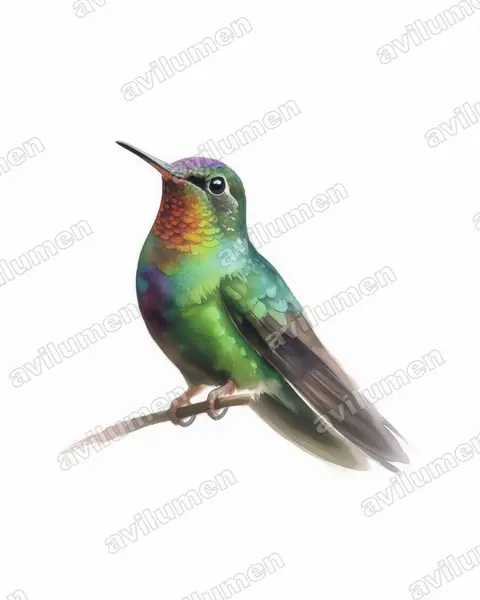
Watercolor 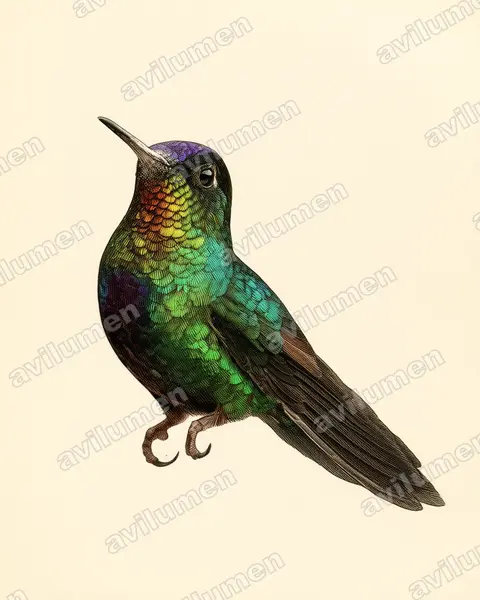
Vintage plate 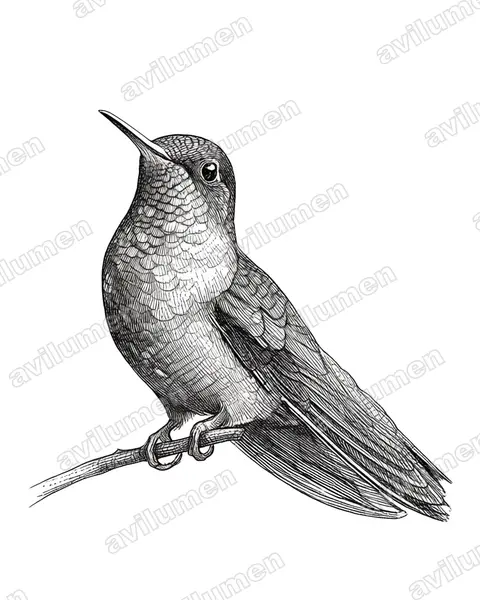
Ink 
Oil 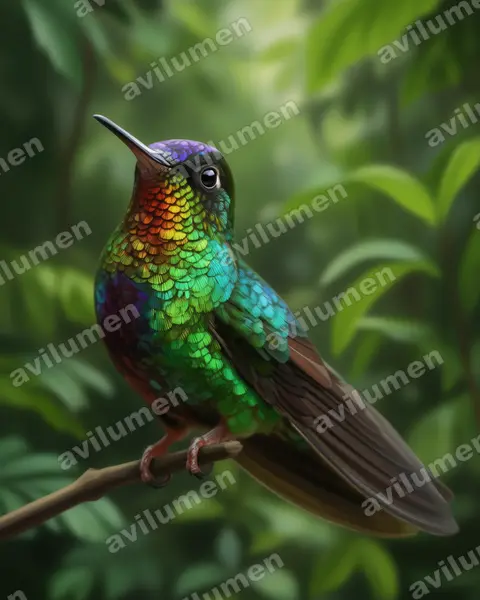
Realistic 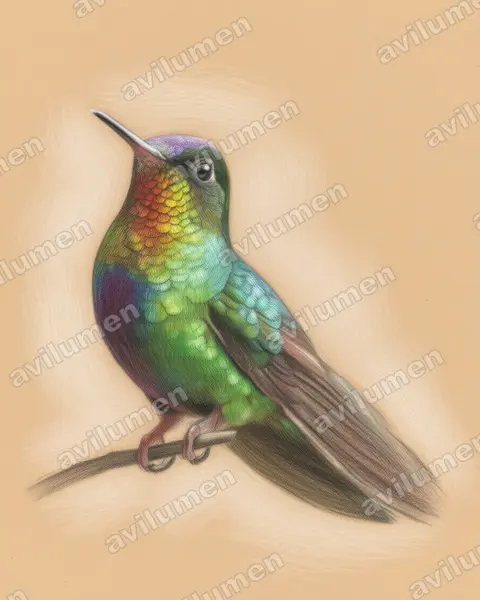
Colored pencil
Illustrations based on the photograph by Giles Laurent (CC BY-SA 4.0), from Wikimedia Commons.
Digital editions
HD Digital Art Pack — Fiery-throated hummingbird
Digital download: 6 high-resolution illustrations of the Fiery-throated hummingbird (Panterpe insignis), print-ready. This is a digital file; no animal or physical item is included.
AI Avatar — Fiery-throated hummingbird
Generate an avatar fusing your face with the Fiery-throated hummingbird (Panterpe insignis). Delivered digitally in 8K, watermark-free. Digital product; no animals are sold or brokered.
Instant download. No live birds are sold.
Frequently asked questions
- Is Panterpe insignis (Fiery-throated hummingbird) endangered?
- The IUCN Red List places Panterpe insignis, commonly known as the Fiery-throated hummingbird, in the «Least concern» category. «Least concern» means it is not currently threatened.
- What family does Panterpe insignis (Fiery-throated hummingbird) belong to?
- Panterpe insignis (Fiery-throated hummingbird) belongs to the family Trochilidae, in the order Apodiformes.
- What colour is Panterpe insignis (Fiery-throated hummingbird)?
- The plumage of Panterpe insignis (Fiery-throated hummingbird) combines these colours: Green and Red.
More from the same family
 Least concern
Emerald-chinned Hummingbird
Abeillia abeillei
The emerald-chinned hummingbird is a species of hummingbird in the "emeralds", tribe Trochilini of subfamily Trochilinae.
from $1.99
 Least concern
Speckled hummingbird
Adelomyia melanogenys
The speckled hummingbird is a species of hummingbird. It is the only member of the genus Adelomyia. It inhabits Neotropical montane cloud forests at elevations of 1,000–2,500 meters and is confined to the Andes of Argentina, Bolivia, Peru, Ecuador, Colombia and Venezuela; as well as to some isolated montane forests in western Ecuador and Venezuela.
from $1.99
 Vulnerable
Purple-backed sunbeam
Aglaeactis aliciae
The purple-backed sunbeam is a bird species in the family Trochilidae. It is found only in Peru.
from $1.99
 Near threatened
White-tufted sunbeam
Aglaeactis castelnaudii
The white-tufted sunbeam is a species of hummingbird in the family Trochilidae. It is found only in Peru. Its natural habitats are subtropical or tropical moist montane forest and subtropical or tropical high-altitude shrubland.
from $1.99