Blue bird-of-paradise
Paradisaea rudolphi
Avilumen editorial team ·

The blue bird-of-paradise is a large species of bird-of-paradise. It is the only species in the genus Paradisornis, but was previously included in the genus Paradisaea.
The blue bird-of-paradise (Paradisornis rudolphi) is a large species of bird-of-paradise. It is the only species in the genus Paradisornis, but was previously included in the genus Paradisaea.
It is often regarded as one of the most fabulous and extravagant of all birds of the world, with its glorified and fancy flank feathers present only in males and the two long wires also only found in the males.
Taxonomy
The blue bird-of-paradise was formally described in 1886 by the German naturalists Otto Finsch and Adolf Bernhard Meyer. They placed the bird in a new genus Paradisornis and coined the binomial name Paradisornis rudolphi. The genus name Paradisornis combines the Ancient Greek paradeisos meaning "paradise" with ornis meaning "bird". The specific epithet rudolphi was chosen to honour Archduke Rudolf Franz Karl Joseph, the Crown-Prince of Austria. This species was formerly placed in the genus Paradisaea.
Two subspecies are recognised:
P. r. margaritae (Mayr & Gilliard, 1951) – east central New Guinea
P. r. rudolphi Finsch & Meyer, AB, 1886 – southeast New Guinea
The blue bird-of-paradise is known to have hybridized with Lawes's parotia (Parotia lawesii), which is called "Schodde's bird-of-paradise", and also with the Raggiana bird-of-paradise (Paradisaea raggiana).
Description
The blue bird-of-paradise is around 30 cm (12 in) in length (excluding the long tail wires), rivaling some of the Paradisaea and Manucodia species. It typically weighs between 124 and 166 g (4.4 and 5.9 oz). Males tend to be larger than females. This species is sexually dimorphic, though maintains a lot of similarities between the two sexes. Males are glossy black from their heads to mantle with silver-white crescents surrounding the eyes. These feathers are iridescent, ranging from a red gloss on the neck to blues on the mantle. They have a blackish-blue underbelly. Their wings and tails are blue, commonly being a light blue, but can aqua or a sky-baby blue. Unique to the males are its two elongated central tail feathers which are blue-black with iridescent, whitish spatulate tips. These 'wires' are 64 cm (25 in) long. They also sport fine and silky elongated flank plumes that are a dull amber colour on the upper side, a light blue below, and are based by two dark crimson lines on each side of the lower belly. Females are similar in coloration to males; however, their plumage is less iridescent and their underbellies are a chestnut brown. Juvenile females have black barring on their underbelly. Both sexes have a very crow-like, light grey bill. They have purplish-grey legs and feet and greyer claws.
Diet
The blue bird-of-paradise is mainly a frugivorous species, feeding on a good variety of fruits like figs, drupes, and berries, but animal prey is also present in the diet; it not only includes insects, but also some vertebrates like reptiles. They typically feed alone, though females and juveniles are more likely to feed in trees in association with other birds or other species. They are shown to search high in the canopy when seeking fruits and apparently forage at lower altitudes when in search of their animal prey.
Breeding
The male is polygamous and performs a breathtaking courtship display. But unlike most other birds of paradise species, he performs solitary on a preferably thin branch, while an attending female observes nearby. In the display, the male hangs from a branch upside down. The black oval with a red margin at the center of his chest is rhythmically enlarged and contracted. His violet-blue plumes spread out in a fan, looking like an apron, swaying its body back and forth while the black wires form two impressive arches down to either side. During this display, he continuously makes a soft, insect-like buzzing noise, mixed with a chittering or chattering noise to rope the female back in if she moves away.
The nesting and parental duties are covered only by the females; she builds her nest with stems, twigs, palm leaves, vines, and other materials all by herself, usually in a flat cup-like shape. They mostly lay one egg, but two are less occasional, and the mother is very defensive of her brood. The eggs are described to be a salmon-type color, with the ends being ringed with flecks of cinnamon-rufous to tawny.
Status and conservation
Due to ongoing habitat loss, limited range, small population size, and, in some areas, hunting for its highly prized plumes, the rare blue bird-of-paradise is classified as Near Threatened on the IUCN Red List of Threatened Species. It is listed in Appendix II of CITES. Its population is thought to have a decreasing trend, estimated to be anywhere from 2,500 to 10,000 individuals.
Text adapted from Wikipedia · CC BY-SA 4.0
Distribution

Taxonomy
- Order
- Passeriformes
- Family
- Paradisaeidae
- Genus
- Paradisaea
- Conservation status
- Not evaluated
Listen to its call
No recording yet
Illustration gallery
6 illustrations of Paradisaea rudolphi (Blue bird-of-paradise) in different styles, true to its real plumage. Shown watermarked; the art pack includes the high-resolution originals, ready to print.
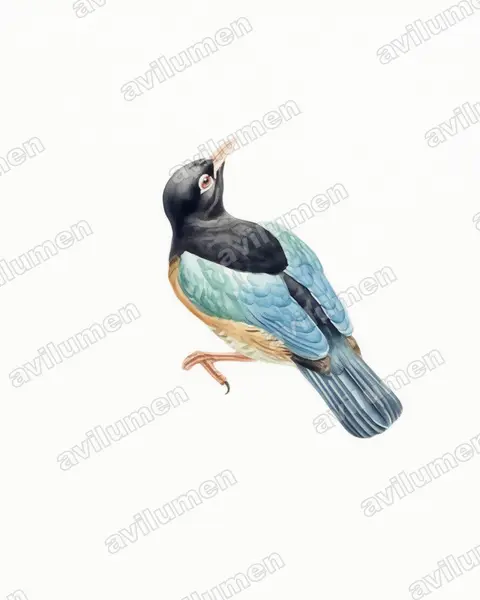
Watercolor 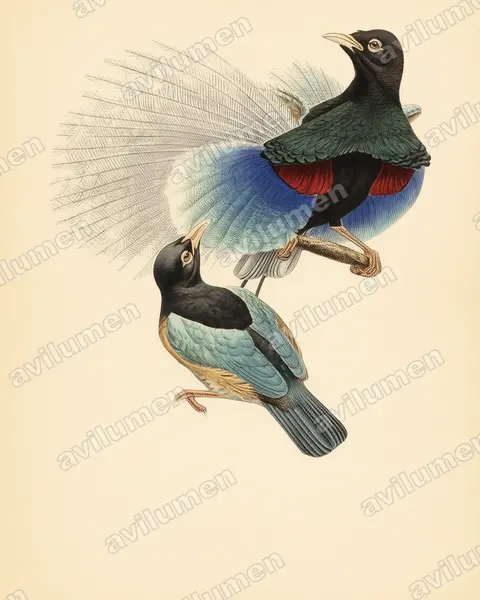
Vintage plate 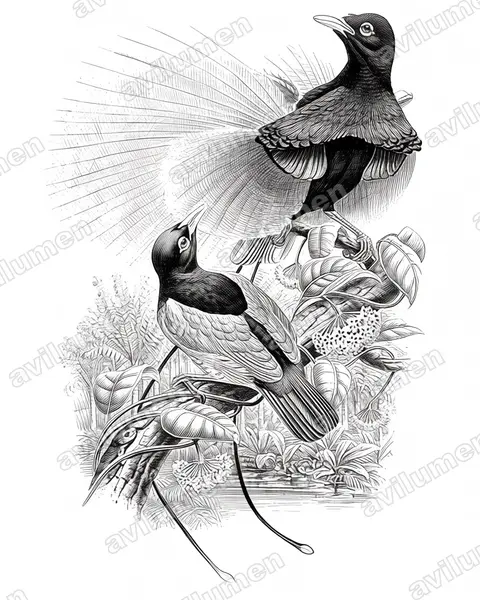
Ink 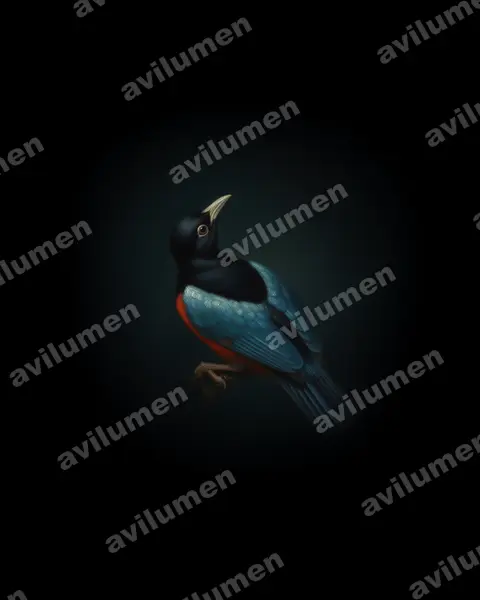
Oil 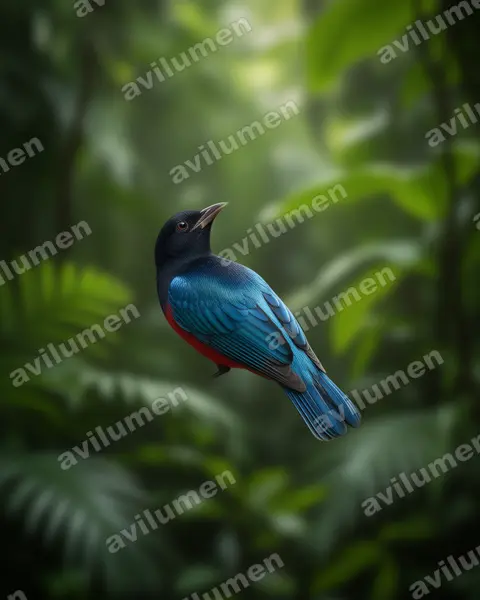
Realistic 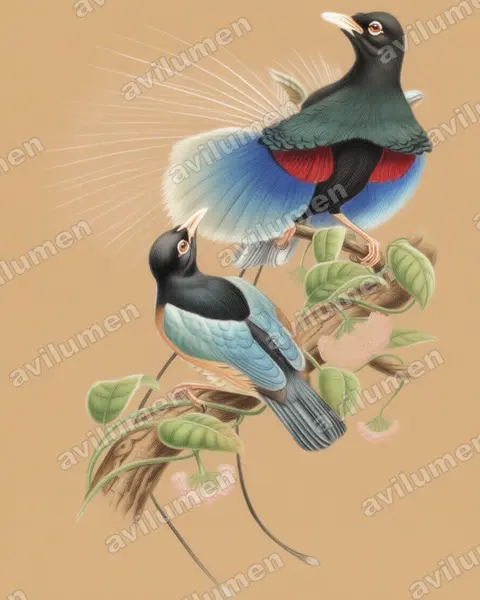
Colored pencil
Illustrations based on the photograph by Richard Bowdler Sharpe (Public domain), from Wikimedia Commons.
Digital editions
HD Digital Art Pack — Blue bird-of-paradise
Digital download: 6 high-resolution illustrations of the Blue bird-of-paradise (Paradisaea rudolphi), print-ready. This is a digital file; no animal or physical item is included.
AI Avatar — Blue bird-of-paradise
Generate an avatar fusing your face with the Blue bird-of-paradise (Paradisaea rudolphi). Delivered digitally in 8K, watermark-free. Digital product; no animals are sold or brokered.
Instant download. No live birds are sold.
Frequently asked questions
- Is Paradisaea rudolphi (Blue bird-of-paradise) endangered?
- The IUCN Red List places Paradisaea rudolphi, commonly known as the Blue bird-of-paradise, in the «Not evaluated» category. «Not evaluated» means the IUCN has not yet assessed this species.
- What family does Paradisaea rudolphi (Blue bird-of-paradise) belong to?
- Paradisaea rudolphi (Blue bird-of-paradise) belongs to the family Paradisaeidae, in the order Passeriformes.
- What colour is Paradisaea rudolphi (Blue bird-of-paradise)?
- The plumage of Paradisaea rudolphi (Blue bird-of-paradise) combines these colours: Blue and Black.
More from the same family
 Least concern
Ribbon-tailed Astrapia
Astrapia mayeri
The ribbon-tailed astrapia, also known as Shaw Mayer's astrapia, is a species of bird-of-paradise.
from $1.99
 Least concern
Arfak astrapia
Astrapia nigra
The Arfak astrapia is a species of astrapia, a group of birds found in the birds-of-paradise family Paradiseidae.
from $1.99
 Least concern
Huon Astrapia
Astrapia rothschildi
The Huon astrapia, also known as Rothschild's astrapia, Huon bird-of-paradise, or Lord Rothschild's bird-of-paradise, is a species of bird-of-paradise belonging to the genus Astrapia. Like most of its congeners, A. rothschildi is a rather elusive member of its genus and family.
from $1.99
 Least concern
Splendid Astrapia
Astrapia splendidissima
The splendid astrapia is a species of bird in the family Paradisaeidae, native to the montane forests of New Guinea. Males are known for their iridescent plumage and elaborate courtship displays, including branch-hopping, tail-flicking, and frog-like calls; they may also display in leks.
from $1.99