Indian Peafowl
Pavo cristatus
Avilumen editorial team ·

The Indian peafowl, also known as the common peafowl, or blue peafowl, is a species of peafowl native to the Indian subcontinent. While it originated in the Indian subcontinent, it has since been introduced to many other parts of the world. Male peafowl are referred to as peacocks, and female peafowl are referred to as peahens, although both sexes are often referred to colloquially as a "peacock".
The Indian peafowl (Pavo cristatus), also known as the common peafowl, or blue peafowl, is a species of peafowl native to the Indian subcontinent. While it originated in the Indian subcontinent, it has since been introduced to many other parts of the world. Male peafowl are referred to as peacocks, and female peafowl are referred to as peahens, although both sexes are often referred to colloquially as a "peacock".
The Indian peafowl displays a marked form of sexual dimorphism. The brightly coloured male has a blue coloured head with a fan-shaped crest and is best known for his long train. The train is made up of elongated upper-tail covert feathers with colourful eyespots. These stiff feathers are raised into a fan and quivered in a display during courtship. The peahen is predominantly brown in colour, with a white face and iridescent green lower neck, and lacks the elaborate train. There are several colour mutations of the Indian peafowl including the leucistic white peafowl.
Despite the length and size of the covert feathers, the peacock is still capable of flight. The peafowl lives mainly on the ground in open forests or on cultivable lands where it forages for berries and grains, and also preys on snakes, lizards and small rodents. It makes loud calls, which makes it easier to detect, and are often used to indicate the presence of a predator in the forest areas. It forages on the ground in small groups and usually escapes on foot through undergrowth and avoids flying, though it flies into tall trees to roost.
The function of the Indian peacock's elaborate train has been debated for more than a century. In the 19th century, Charles Darwin found it a puzzle, hard to explain through ordinary natural selection. His later explanation, sexual selection, is widely but not universally accepted. In the 20th century, Amotz Zahavi argued that the train was a handicap, and that males were honestly signalling their fitness in proportion to the splendour of their trains. Despite extensive study, opinions remain divided on the mechanisms involved.
The Indian peafowl is listed as Least Concern on the IUCN Red List. It is the national bird of India and venerated in Hindu and Greek mythology.
Taxonomy
The Indian peafowl was formally described in 1758 by the Swedish naturalist Carl Linnaeus in the tenth edition of his Systema Naturae under its current binomial name Pavo cristatus. The genus name Pavo is Latin for "peacock", which came from the Greek word taos derived from Persian tavus, which came from the Tamil word tokei. The specific epitet cristatus is Latin meaning "crested". The species is considered to be monotypic: no subspecies are recognised.
The earliest usage of the word peacock in written English was from the 14th century where Geoffrey Chaucer used the word in a simile "proud a pekok" in his poem Troilus and Criseyde. Various spelling variants included peacock, pacok, pecok, pekok, pokok, and pocok among others.
Description
The Indian peafowl's size, color and shape of the crest make them easily identifiable within their native distribution range. It displays a marked form of sexual dimorphism. A male peafowl or peacock is a larger sized bird with an average bill to tail length of 100–120 cm (40–46 in) and as much as 200–230 cm (78–90 in) to the end of a fully grown train. It weighs 4.1–5.2 kg (9–11.5 lb) and is amongst the heaviest birds in Phasianidae. The male has a metallic blue crown with short and curled, blue-greenish head feathers. It has a fan-shaped crest with bare black shafts and tipped with bluish-green webbing. A white stripe above the eye and a crescent shaped white patch below the eye are formed by bare white skin. The lore, chin and throat are covered with greenish feathers. It has a long blue neck with scaly bronze-green feathers with black and copper markings in the back. The scapular region and wings are made of chestnut colored primary feathers with black secondaries. The tail is dark brown with glossy green chest, buff thighs, and blackish-brown abdomen and tail coverts.
The male is best known for his elongated train, which extend from the rump. The train is made up of elongated upper tail coverts, which are bronze-green train with the outermost and longer feathers ending up with an elaborate eye-spot. The eye-spots consist of a purplish-black, heart-shaped nucleus, enclosed by blue and an outer copper rim, which is surrounded by alternating green and bronze. A few of the outer feathers lack the spot and end in a crescent shaped black tip. The feathers of the train do not have colored pigments and the colorization is a result of the micro-structure of the feathers and the optical phenomena involved. The male has a spur on the leg above the hind toe. The train feathers and the tarsal spur of the male start developing only in the second year of its life. The trains are not fully developed until the age of four. The train feathers of the male Indian peafowl are also moulted every year, usually starting at the end of the monsoon in August or September and are fully developed by February to March. The moult of the flight feathers may be spread out across the year.
The females or peahens, are smaller at around 97 cm (38 in) in length and weigh 2.7–4.1 kg (6–9 lb). The peahen has a rufous-brown head with a crest, whose tips are chestnut colored and edged with green. The upper body is brownish with pale mottling and the primaries, secondaries and tail are dark brown. The lower neck is metallic green with dark brown breast feathers glossed with green and whitish underparts. Both sexes have dark brown eyes, brown colored beak and legs. Young males also resemble the females with chestnut colored primaries.
Mutations and hybrids
There are several colour mutations of the Indian peafowl that have become common in captive birds through selective breeding. The black-shouldered mutation was initially considered as a subspecies or even a separate species of the Indian peafowl (P. nigripennis). Charles Darwin presented firm evidence for it being a variety under domestication, which is now well established and accepted. It was important for Darwin to prove that it was a colour variation rather than a wild species as it was contrary to his theory of slow modification by natural selection in the wild. In this genetic variation, the adult male is melanistic with black wings. The young birds are creamy white with fulvous-tipped wings. The gene which produces melanism in the male, causes a dilution of colour in females, which have creamy white and brown markings. Other forms of mutations include the pied and white mutations, which are the result of allelic variation at specific loci.
Crosses between a male green peafowl (Pavo muticus) and a female Indian peafowl (P. cristatus) produce a stable hybrid called a "Spalding", named after Keith Spalding, a bird fancier from California. There can be outbreeding depression if birds of unknown pedigree are released into the wild, as the viability of such hybrids and their offspring is often reduced as per Haldane's rule.
Distribution and habitat
The Indian peafowl is a resident breeder in the Indian subcontinent and is found across most of India and Sri Lanka. In India, it is found across the country from the Indus valley in the north-west to Assam in the north-east, and from Himalayas in the north to the southern tip, except for the marshlands of Sunderbans in East India. In India, it is found up to elevations of 5,000 ft (1,500 m) in the north and upto 6,000 ft (1,800 m) in the mountains of the south. In Sri Lanka, it largely inhabits the drier lowland areas. It is generally found in forests, small hills, and bushy areas near water sources. It also occupies cultivable lands and live in a semi-domesticated state in human habitations. The peafowl has since been introduced in many other parts of the world and has become feral in some areas. It was supposedly introduced into Europe by Alexander the Great, while the bird might have been introduced earlier and had reached Athens by 450 BCE.
The first whole-genome sequencing of the Indian peafowl identified 15,970 protein-coding sequences and was found to have less repetitive DNA (8.62%) than that of the chicken genome (9.45%). Studies have suggested that the population suffered at least two bottlenecks (four mya and 450,000 years ago), which resulted in a severe reduction in its effective population size.
Behaviour and ecology
The Indian peafowl forages on the ground in small groups, known as musters, that usually have a single peacock and three to five peahens. After the breeding season, the flocks tend to be made up only of females and young. It is found in the open early in the mornings and tends to rest under cover during the heat of the day. It is often sighted dust-bathing at dusk. It roosts on tall trees at night, but may sometimes make use of rocks or buildings. Birds usually arrive at their roosting sites during the dusk and call frequently before taking their positions. Despite its size, the Indian peafowl is capable of flight. However, it rarely flies and often escapes by running on foot through the undergrowth when perturbed or disturbed. When it takes off, it uses regular, slower flaps to maintain flight rather than gliding.
Diet
The Indian peafowl is found lazily feeding in the open early in the mornings, and might move to cultivated lands to feed during the mornings and the evenings. The groups often walk in single file to the nearby waterholes for a drink. The birds often congregate near human habitats and might be fed by humans. It is omnivorous and feeds on grass, seeds, flowerbuds, fruits, insects, and small reptiles. Around human settlements, it feeds on food scraps and even human excreta. Crops in its diet include peanut, tomato, paddy, chili pepper and bananas. In the Gir forest, its diet contains a large proportion of Zizyphus berries. Its diet in the Anaikatty Hills consists largely of vegetable matter and less than 9% of ants, termites, grasshoppers, beetles and earthworms.
Two Indian peafowl were observed pecking on and teasing a cobra, but they did not kill it.
Communication
The most common calls are a loud pia-ow or may-awe with the frequency of calling increasing before the monsoon season. It raises loud sounds when alarmed or disturbed and are often used to indicate the presence of a predators such as the tiger in the forests. It also makes other calls such as a rapid series of ka-aan..ka-aan or a rapid kok-kok. It often emits an explosive low-pitched honk! when agitated. It might even call at night when alarmed and neighboring birds may call in a relay like series. Nearly seven different call variants have been identified apart from six variants of alarm calls that are commonly produced by both the sexes.
Breeding
The Indian peacock is polygamous. The breeding season is associated with the onset of the monsoon rains.
Several often closely related cocks congregate at a lek site. They maintain small territories next to each other and allow females to visit them, but make no attempt to guard harems, and females do not favour specific males.
The peacock uses its ornate train in a courtship display, wherein it raises the tail feathers into an arched fan and quivers them. The wings are held half open and drooped and it periodically vibrates the long feathers, producing a ruffling sound. It faces the peahen initially and might turn around to display the tail. Display sites are usually open and elevated like fallen trees, large rocks and even roof tops.
The peacock also freezes over food to invite a peahen in a form of courtship feeding. When a peacock is displaying, peahens appear not to show any interest and usually continue foraging. Peacocks usually display in the presence of peahens, but sometimes also without them.
Cocks start shedding their train feathers between end of July in Bandipur National Park and end of October in eastern Tamil Nadu.
The Indian peafowl nests on crevices in buildings, and disused nests of vultures. Nests are usually shallow hollow scrapes on the ground lined with leaves, sticks and other debris. The female lays a clutch of three to eight oval shaped eggs. The eggs measure about 2.45–3 in (6.2–7.6 cm) in length and 1.42–2.2 in (3.6–5.6 cm) in width. They appear polished and have thick shells with pits and pores. The colour varies from pale white to buff or reddish-brown. The males take no part in hatching or rearing the young. However, isolated unusual instance of a male incubating a clutch of eggs has been reported. The eggs are incubated by the females for about 28 to 30 days.
The chicks are nidifugous and follow the mother around after hatching. Downy young may sometimes climb on their mothers' back and the female may carry them in flight to a safe tree branch.
Sexual selection
Text adapted from Wikipedia · CC BY-SA 4.0
Distribution

Taxonomy
- Order
- Galliformes
- Family
- Phasianidae
- Genus
- Pavo
- Conservation status
- Least concern
Listen to its call
No recording yet
Illustration gallery
6 illustrations of Pavo cristatus (Indian Peafowl) in different styles, true to its real plumage. Shown watermarked; the art pack includes the high-resolution originals, ready to print.
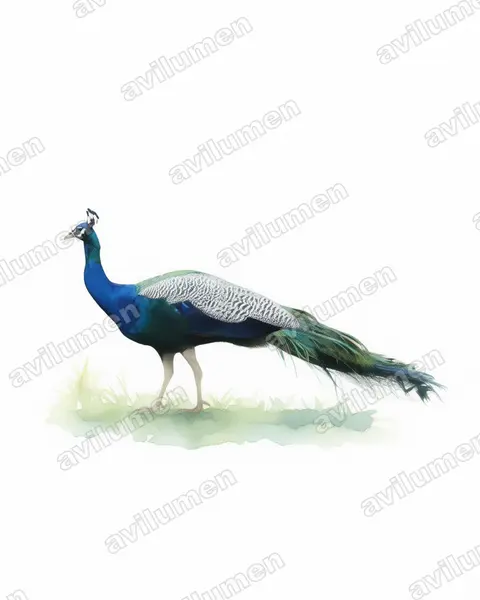
Watercolor 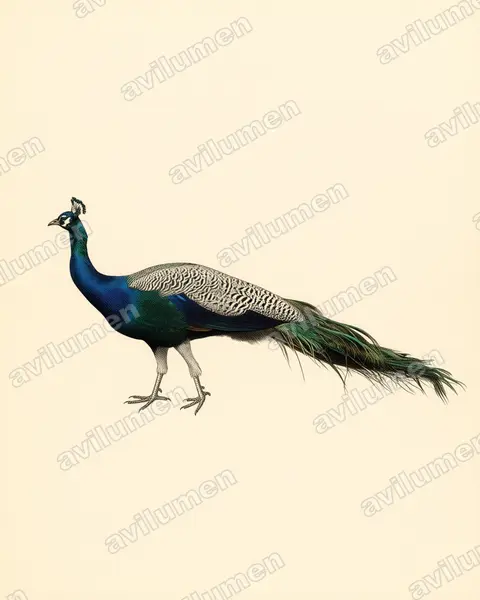
Vintage plate 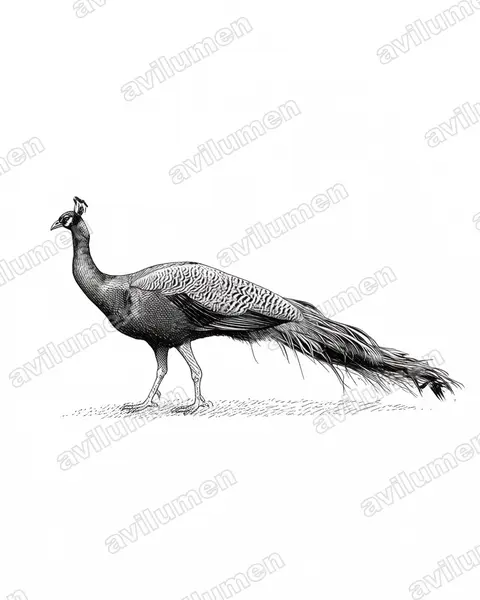
Ink 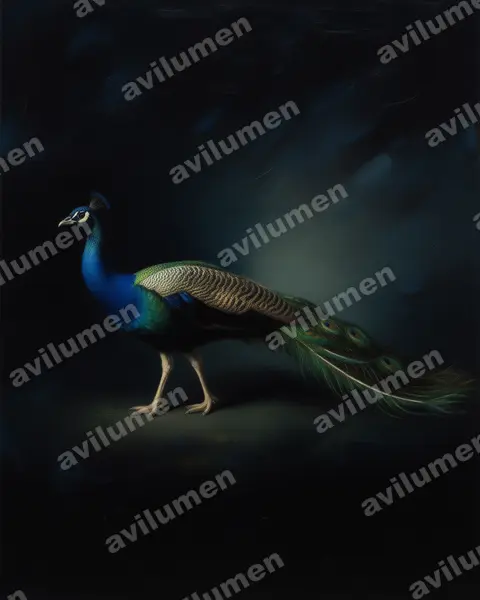
Oil 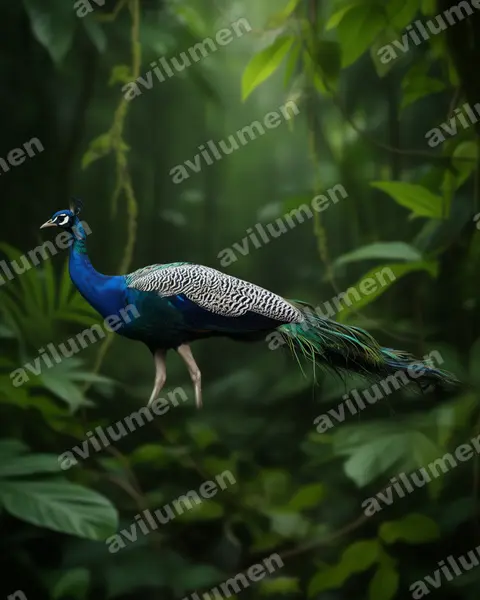
Realistic 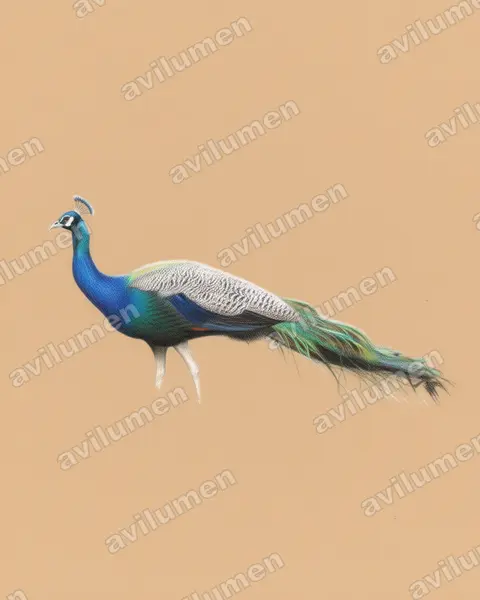
Colored pencil
Illustrations based on the photograph by Praveenp (CC BY-SA 4.0), from Wikimedia Commons.
Digital editions
HD Digital Art Pack — Indian Peafowl
Digital download: 6 high-resolution illustrations of the Indian Peafowl (Pavo cristatus), print-ready. This is a digital file; no animal or physical item is included.
AI Avatar — Indian Peafowl
Generate an avatar fusing your face with the Indian Peafowl (Pavo cristatus). Delivered digitally in 8K, watermark-free. Digital product; no animals are sold or brokered.
Instant download. No live birds are sold.
Frequently asked questions
- Is Pavo cristatus (Indian Peafowl) endangered?
- The IUCN Red List places Pavo cristatus, commonly known as the Indian Peafowl, in the «Least concern» category. «Least concern» means it is not currently threatened.
- Where does Pavo cristatus (Indian Peafowl) live?
- Pavo cristatus (Indian Peafowl) is found in Africa and Indonesia.
- What family does Pavo cristatus (Indian Peafowl) belong to?
- Pavo cristatus (Indian Peafowl) belongs to the family Phasianidae, in the order Galliformes.
- What colour is Pavo cristatus (Indian Peafowl)?
- The plumage of Pavo cristatus (Indian Peafowl) combines these colours: Blue and Green.
More from the same family
 Least concern
Lady Amherst’s Pheasant
Chrysolophus amherstiae
Lady Amherst's pheasant is a bird of the order Galliformes and the family Phasianidae. The genus name is from Ancient Greek khrusolophos, "with golden crest". The English name and amherstiae commemorates Sarah Amherst, who was responsible for sending the first specimen of the bird to London in 1828. It is also sometimes referred to as the Chinese copper pheasant.
from $1.99
 Least concern
Golden Pheasant
Chrysolophus pictus
The golden pheasant, also known as the Chinese pheasant, and rainbow pheasant, is a gamebird of the order Galliformes and the family Phasianidae (pheasants). The genus name is from Ancient Greek khrusolophos, "with golden crest", and pictus is Latin for "painted" from pingere, "to paint".
from $1.99