Band-tailed Guan
Penelope argyrotis
Avilumen editorial team ·

The band-tailed guan is a species of bird in the family Cracidae, the chachalacas, guans, and curassows. It is found in Colombia and Venezuela.
The band-tailed guan (Penelope argyrotis) is a species of bird in the family Cracidae, the chachalacas, guans, and curassows. It is found in Colombia and Venezuela.
Taxonomy and systematics
The band-tailed guan is closely related to bearded guan (Penelope barbata) and they at times have been considered conspecific. The band-tailed guan has three subspecies, the nominate P. a. argyrotis, P. a. albicauda, and P. a. colombiana. The last of these has sometimes been treated as a separate species, and two other subspecies split from albicauda and colombiana have been proposed, but these treatments have not gained support.
Description
The band-tailed guan is 50 to 61 cm (1.6 to 2.0 ft) long. Males weigh 686 to 981 g (1.5 to 2.2 lb) and females 625 to 900 g (1.4 to 2.0 lb). The nominate subspecies' upperparts are blackish-brown to dark rufous with conspicuous white streaks. Its breast is olive brown and belly is pale to medium brown. Its face is pale grey to white and it has a prominent red dewlap. It gets its name from the wide chestnut band across the end of the tail. P. a. albicauda differs from the nominate by having buffy tips on the tail feathers. P. a. colombiana has more white on the crown and less white on the face than the nominate.
Distribution and habitat
The nominate subspecies of band-tailed guan is found in the eastern Andes of Colombia and western Venezuela and also in the Venezuelan Coastal Range. P. a. albicauda is found in the Serranía del Perijá of northern Colombia and northwestern Venezuela. The nominate P. a. argyrotis is restricted to the Sierra Nevada de Santa Marta of northern Colombia. They mostly inhabit dense wet virgin forest, though they will sometimes be found in secondary forest, shade coffee plantations, and the upper reaches of drier forest. In the Sierra Nevada de Santa Marta they range in elevation from 550 to 2,000 m (1,800 to 6,560 ft) and in Venezuela usually from 800 to 2,400 m (2,600 to 7,900 ft), though locally much higher or lower.
Feeding
The band-tailed guan usually forages in groups of up to six, but more may feed in a fruit-laden tree. It feeds on fruit, usually in the mid-story, but will eat fallen fruit on the ground.
Breeding
The band-tailed guan's breeding season extends from January to May. It is territorial though several territories may be close to each other. The nest is a loose structure of plant matter placed up to 8 m (26 ft) high in a tree.
Vocal and non-vocal sounds
The band-tailed guan uses a wing-rattling display to announce territories; it sounds like "canvas ripping forward, then in reverse". Alarm calls are "soft, piping whistles" and in extreme alarm "a repeated shrieking 'GUEEA!' interspersed by various gruff notes".
Status
The IUCN has assessed the band-tailed guan as being of Least Concern. It is uncommon to fairly common in most of its range and in Venezuela occurs in several protected areas. However, it is threatened by deforestation and hunting.
Text adapted from Wikipedia · CC BY-SA 4.0
Where it lives
Plumage colours
Distribution

Taxonomy
- Order
- Galliformes
- Family
- Cracidae
- Genus
- Penelope
- Conservation status
- Least concern
Listen to its call
No recording yet
Illustration gallery
6 illustrations of Penelope argyrotis (Band-tailed Guan) in different styles, true to its real plumage. Shown watermarked; the art pack includes the high-resolution originals, ready to print.
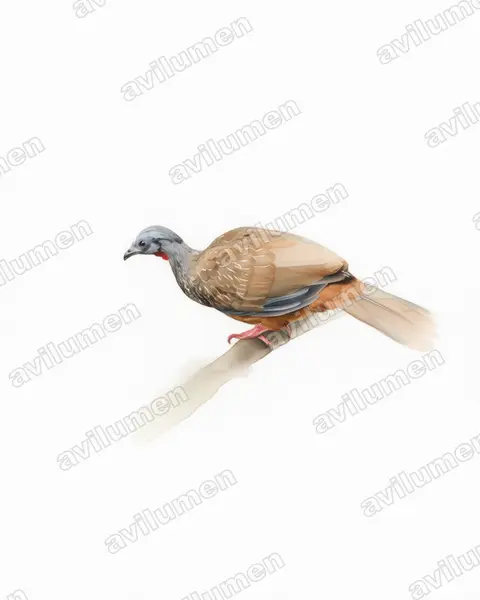
Watercolor 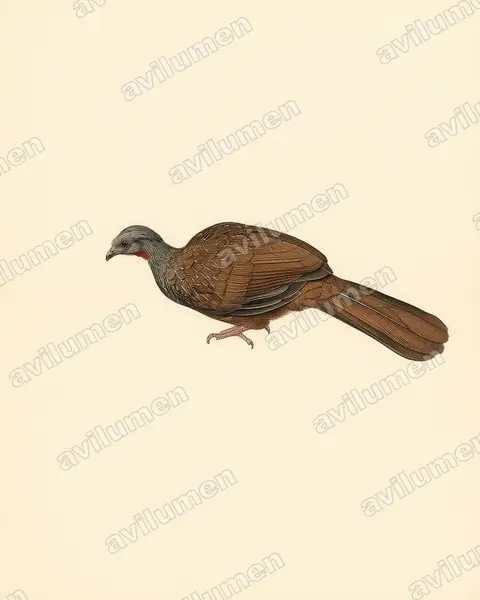
Vintage plate 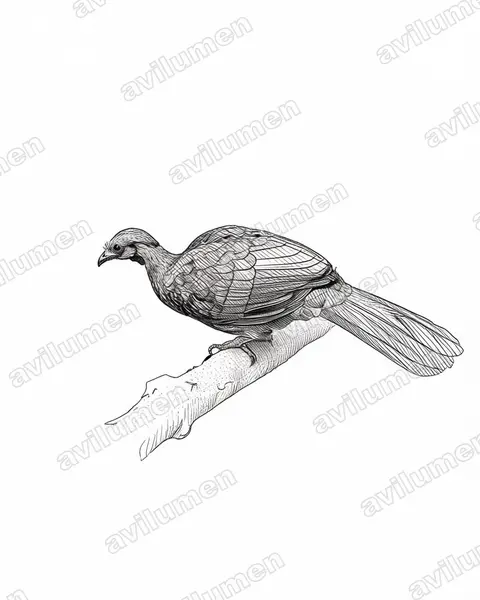
Ink 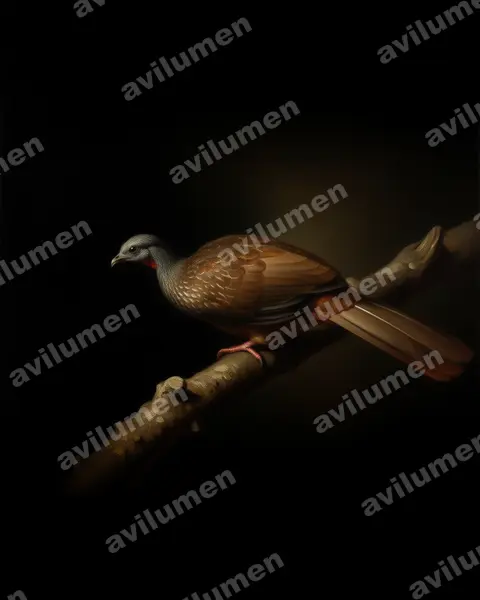
Oil 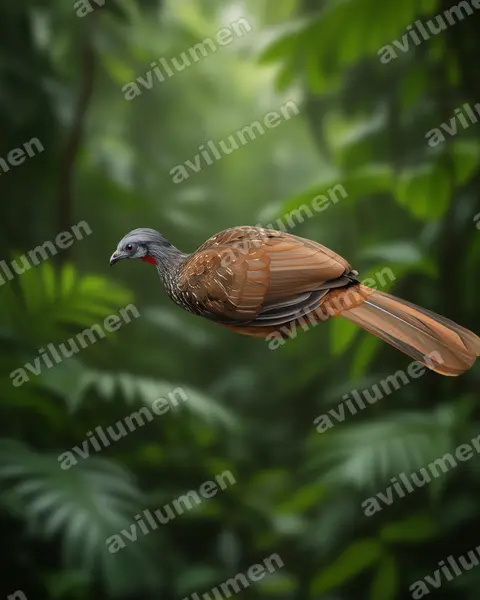
Realistic 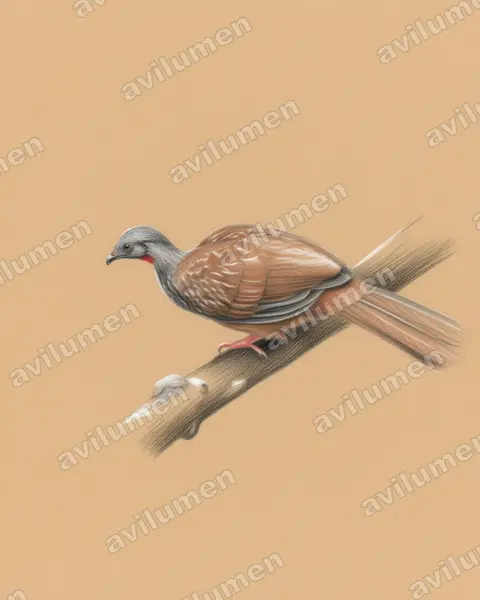
Colored pencil
Illustrations based on the photograph by Zieger M (CC BY-SA 4.0), from Wikimedia Commons.
Digital editions
HD Digital Art Pack — Band-tailed Guan
Digital download: 6 high-resolution illustrations of the Band-tailed Guan (Penelope argyrotis), print-ready. This is a digital file; no animal or physical item is included.
AI Avatar — Band-tailed Guan
Generate an avatar fusing your face with the Band-tailed Guan (Penelope argyrotis). Delivered digitally in 8K, watermark-free. Digital product; no animals are sold or brokered.
Instant download. No live birds are sold.
Frequently asked questions
- Is Penelope argyrotis (Band-tailed Guan) endangered?
- The IUCN Red List places Penelope argyrotis, commonly known as the Band-tailed Guan, in the «Least concern» category. «Least concern» means it is not currently threatened.
- Where does Penelope argyrotis (Band-tailed Guan) live?
- Penelope argyrotis (Band-tailed Guan) is found in South America.
- What family does Penelope argyrotis (Band-tailed Guan) belong to?
- Penelope argyrotis (Band-tailed Guan) belongs to the family Cracidae, in the order Galliformes.
- What colour is Penelope argyrotis (Band-tailed Guan)?
- The plumage of Penelope argyrotis (Band-tailed Guan) combines these colours: Brown.
More from the same family
 Least concern
Wattled Guan
Aburria aburri
The wattled guan is a species of bird in the family Cracidae. It is a fairly large black cracid with blue-based, black-tipped beak and a long, red-and-yellow wattle.
from $1.99
 Least concern
Sickle-winged Guan
Chamaepetes goudotii
The sickle-winged guan is a species of bird in the chachalaca, guan, and curassow family Cracidae. It is found in Bolivia, Colombia, Ecuador, and Peru.
from $1.99
 Least concern
Black Guan
Chamaepetes unicolor
The black guan is a species of bird in the chachalaca, guan, and curassow family Cracidae. It is found in Costa Rica and Panama.
from $1.99
 Critically endangered
Blue-billed Curassow
Crax alberti
The blue-billed curassow is a species of bird in the family Cracidae, the chachalacas, guans, and curassows. It is endemic to Colombia.
from $1.99