Long-billed Hermit
Phaethornis longirostris
Avilumen editorial team ·

The long-billed hermit is a bird in the family Trochilidae, the hummingbirds. It is found from central Mexico south through Central America, Colombia and Ecuador into Peru.
The long-billed hermit (Phaethornis longirostris) is a bird in the family Trochilidae, the hummingbirds. It is found from central Mexico south through Central America, Colombia and Ecuador into Peru.
Taxonomy and systematics
It has often been considered conspecific with what is now the long-tailed hermit, P. superciliosus, which is found east of the Andes. The two populations were called the western and eastern long-tailed hermits; the "eastern" was dropped after the split into two species and the renaming of the western population.
The South American Classification Committee (SACC) of the American Ornithological Society, the International Ornithological Committee (IOC), and the Clements taxonomy assign these four subspecies to the long-billed hermit:
P. l. longirostris Delattre (1843)
P. l. cephalus Bourcier & Mulsant (1848)
P. l. susurrus Bangs (1901)
P. l. baroni Hartert (1897)
However, BirdLife International's Handbook of the Birds of the World (HBW) treats P. l. baroni as a separate species, "Ecuadorian hermit". The SACC in 2006 had rejected that treatment. Other subspecies within longirostrus and cephalus have been proposed but have not been accepted.
Description
The long-billed hermit is 13 to 16 cm (5.1 to 6.3 in) long. Males weigh 5 to 7.5 g (0.18 to 0.26 oz) and females 4 to 6.5 g (0.14 to 0.23 oz). The nominate subspecies P. l. longirostris has greenish-brown upperparts and brownish to grayish underparts. Its uppertail coverts have dark and light ochre bands and the central tail feathers are long with long white tips. It has a long decurved bill, with the female's being shorter but more curved than the male's. P. l. cephalus is similar but its underparts become more ochraceous towards the southern part of its range. P. l. susurrus is larger than cephalus but similarly colored. P. l. baroni's upperparts are dull metallic green and its belly is whiter than those of the other subspecies.
Distribution and habitat
The subspecies of long-billed hermit are found thus:
P. l. longirostris, from Mexico's Oaxaca and Chiapas states south through Guatemala into northern Honduras
P. l. cephalus, from eastern Honduras through Nicaragua, Costa Rica, and Panama into northwestern Colombia as far south as Santander Department
P. l. susurrus, the isolated Sierra Nevada de Santa Marta in northeastern Colombia
P. l. baroni, from Ecuador's western Esmeraldas Province south into Peru's Tumbes and Piura departments.
The species inhabits the understory and edges of a variety of landscapes including rainforest, tall secondary forest, humid semi-deciduous forest, cloudforest, and gallery forest. It has been recorded from sea level to 1,000 m (3,300 ft) in Costa Rica, to 1,500 m (4,900 ft) in eastern Mexico, to 2,500 m (8,200 ft) in northern Colombia, to 400 m (1,300 ft) in Peru, and to at least 1,300 m (4,300 ft) and possibly to 1,700 m (5,600 ft) in Ecuador.
Movement
The long-billed hermit is not known to make large-scale movements but is thought to wander short distances.
Feeding
The long-billed hermit is a "trap-line" feeder like other hermit hummingbirds, visiting a circuit of a variety of flowering plants for nectar. Examples include Heliconia, Costus, Aphelandra, and Passiflora. It also consumes small arthropods.
Breeding
The long-billed hermit's breeding seasons vary considerably throughout its range, from April to July in Mexico, May to September in Panama, and January to April or May in Colombia. The nest is a cone-shaped cup made of plant fibers and spider silk suspended from the underside of a drooping leaf. The clutch size is two eggs; The incubation period is 17 to 18 days with fledging 22 to 23 days after hatch.
During the breeding season, male long-billed hermits sing in communal leks of up to 25 birds, and also wiggle their long tails in display. Competitive lek singing can occupy half of the daylight hours to attract females. In addition, mature males have a longer bill than females, and appear to use its dagger-like tip as a secondary sexual trait to defend against other males at the lek.
Vocalization
The songs of the three northern subspecies of long-billed hermit are "a continuous series of single, piercing, usually upslurred 'sweeup' notes". Their call is "a sharp, explosive 'week!'" that is often given in flight. The song of P. l. baroni is "a continuous series of single, sparrow-like, chipping notes...'tchee..tchee..tchee..'." Its call is "a thin 'seep'" also given in flight.
Status
The IUCN follows HBW taxonomy, and so has separately assessed the long-billed hermit and "Ecuadorian hermit" as being of Least Concern. The population sizes and trends of both are unknown. P. l. susurrus has a small range that potentially places it at risk. P. l. cephalus occurs in many protected areas in Costa Rica. P. l. baroni is considered fairly common throughout its range and occurs in some protected areas.
Text adapted from Wikipedia · CC BY-SA 4.0
Where it lives
Plumage colours
Distribution

Taxonomy
- Order
- Apodiformes
- Family
- Trochilidae
- Genus
- Phaethornis
- Conservation status
- Least concern
Listen to its call
No recording yet
Illustration gallery
6 illustrations of Phaethornis longirostris (Long-billed Hermit) in different styles, true to its real plumage. Shown watermarked; the art pack includes the high-resolution originals, ready to print.
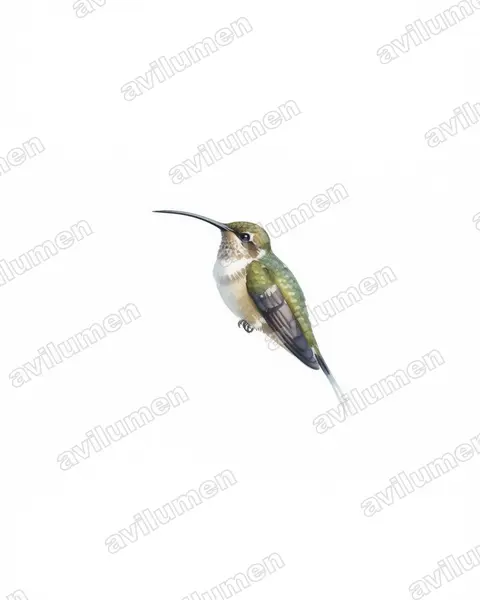
Watercolor 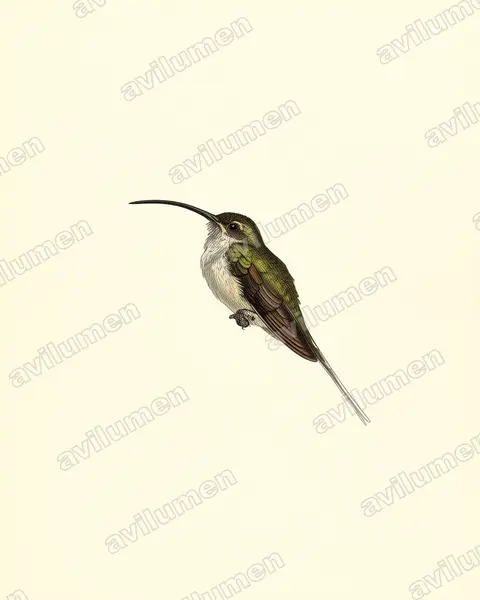
Vintage plate 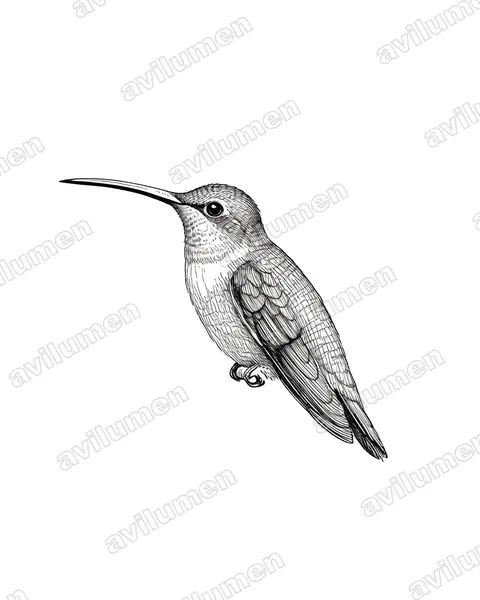
Ink 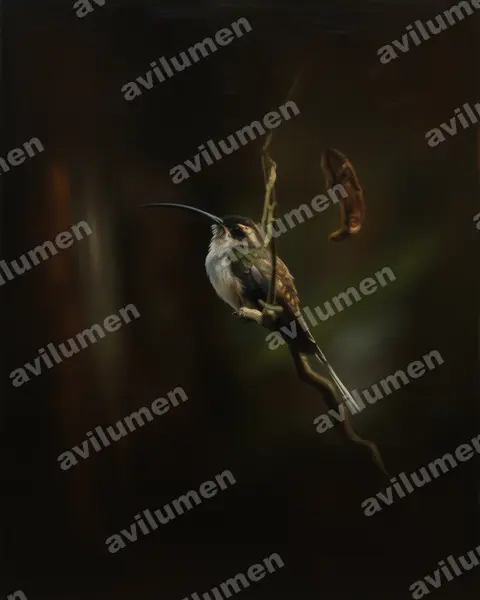
Oil 
Realistic 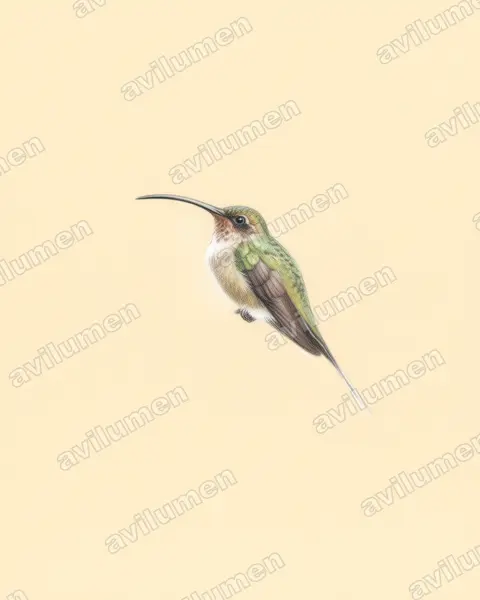
Colored pencil
Illustrations based on the photograph by Francesco Veronesi from Italy (CC BY-SA 2.0), from Wikimedia Commons.
Digital editions
HD Digital Art Pack — Long-billed Hermit
Digital download: 6 high-resolution illustrations of the Long-billed Hermit (Phaethornis longirostris), print-ready. This is a digital file; no animal or physical item is included.
AI Avatar — Long-billed Hermit
Generate an avatar fusing your face with the Long-billed Hermit (Phaethornis longirostris). Delivered digitally in 8K, watermark-free. Digital product; no animals are sold or brokered.
Instant download. No live birds are sold.
Frequently asked questions
- Is Phaethornis longirostris (Long-billed Hermit) endangered?
- The IUCN Red List places Phaethornis longirostris, commonly known as the Long-billed Hermit, in the «Least concern» category. «Least concern» means it is not currently threatened.
- Where does Phaethornis longirostris (Long-billed Hermit) live?
- Phaethornis longirostris (Long-billed Hermit) is found in South America.
- What family does Phaethornis longirostris (Long-billed Hermit) belong to?
- Phaethornis longirostris (Long-billed Hermit) belongs to the family Trochilidae, in the order Apodiformes.
- What colour is Phaethornis longirostris (Long-billed Hermit)?
- The plumage of Phaethornis longirostris (Long-billed Hermit) combines these colours: Brown.
More from the same family
 Least concern
Emerald-chinned Hummingbird
Abeillia abeillei
The emerald-chinned hummingbird is a species of hummingbird in the "emeralds", tribe Trochilini of subfamily Trochilinae.
from $1.99
 Least concern
Speckled hummingbird
Adelomyia melanogenys
The speckled hummingbird is a species of hummingbird. It is the only member of the genus Adelomyia. It inhabits Neotropical montane cloud forests at elevations of 1,000–2,500 meters and is confined to the Andes of Argentina, Bolivia, Peru, Ecuador, Colombia and Venezuela; as well as to some isolated montane forests in western Ecuador and Venezuela.
from $1.99
 Vulnerable
Purple-backed sunbeam
Aglaeactis aliciae
The purple-backed sunbeam is a bird species in the family Trochilidae. It is found only in Peru.
from $1.99
 Near threatened
White-tufted sunbeam
Aglaeactis castelnaudii
The white-tufted sunbeam is a species of hummingbird in the family Trochilidae. It is found only in Peru. Its natural habitats are subtropical or tropical moist montane forest and subtropical or tropical high-altitude shrubland.
from $1.99