Tawny-bellied Hermit
Phaethornis syrmatophorus
Avilumen editorial team ·

The tawny-bellied hermit is a species of hummingbird in the family Trochilidae. It is found in Colombia, Ecuador, and Peru.
The tawny-bellied hermit (Phaethornis syrmatophorus) is a species of hummingbird in the family Trochilidae. It is found in Colombia, Ecuador, and Peru.
Taxonomy and systematics
Two subspecies of the tawny-bellied hermit are recognised, the nominate P. s. syrmatophorus (Gould, 1852) and P. s. columbianus (Boucard, 1891). Two others have been proposed, P. s. berlepschi and P. s. huallagae. The former was based on a specimen of an immature nominate and the latter cannot be distinguished from the nominate.
Description
The tawny-bellied hermit is about 14 cm (5.5 in) long and weighs 5 to 7 g (0.18 to 0.25 oz). This medium-sized hermit's upperparts are olive green, and males have reddish-orange uppertail coverts. The central tail feathers of both sexes are long and white and the rest are dark with bright orange ends. The nominate subspecies has an orange throat, belly, and undertail coverts; the throat and chest of P. s. columbianus are dark brown. Both sexes have an obviously decurved bill with the female's being more curved than the male's.
Distribution and habitat
The nominate subspecies of tawny-bellied hermit is found in the Western Andes of Colombia (including the valleys of the Cauca and Patía rivers) and locally south on the western Andean slope through Ecuador to western Loja Province. P. s. columbianus is found in the Central and Eastern Andes of Colombia (including the southern Magdalena River valley) and south on the Andes' eastern slope through Ecuador to northern Peru's San Martín Department. It principally inhabits the understory of humid montane forest but is also found at forest edges and in dense secondary forest. In elevation it mostly ranges between 1,000 and 2,300 m (3,300 and 7,500 ft) though it has been recorded as low as 750 m (2,500 ft) and as high as 3,100 m (10,000 ft). The white-whiskered hermit (P. yaruqui) replaces it in similar habitats below 1,000 m (3,300 ft).
Movement
The tawny-bellied hermit is believed to be sedentary.
Feeding
The tawny-bellied hermit is a "trap-line" feeder like other hermit hummingbirds, visiting a circuit of a wide variety of flowering plants for nectar. It also consumes small arthropods.
Breeding
The tawny-bellied hermit's breeding seasons across its range have not been determined in detail but seem to be in the March to August window and possibly also in December. The nest is a cone-shaped cup constructed of leaves and vegetable fibers bound with spider silk and suspended from the underside tip of a drooping leaf. The clutch size is two eggs.
Vocalization
The tawny-bellied hermit's song is "a continuous series of single, high-pitched, almost insect-like 'tsi' calls". Several males often sing at a lek. The species also gives flight calls of "an upslurred 'peeet!'" and "a soft 'stip'".
Status
The IUCN has assessed the tawny-bellied hermit as being of Least Concern, though its population size is unknown and believed to be decreasing. It is found in some protected areas, but "habitat loss may be a severe threat in the future."
Text adapted from Wikipedia · CC BY-SA 4.0
Where it lives
Distribution

Taxonomy
- Order
- Apodiformes
- Family
- Trochilidae
- Genus
- Phaethornis
- Conservation status
- Least concern
Listen to its call
No recording yet
Illustration gallery
6 illustrations of Phaethornis syrmatophorus (Tawny-bellied Hermit) in different styles, true to its real plumage. Shown watermarked; the art pack includes the high-resolution originals, ready to print.
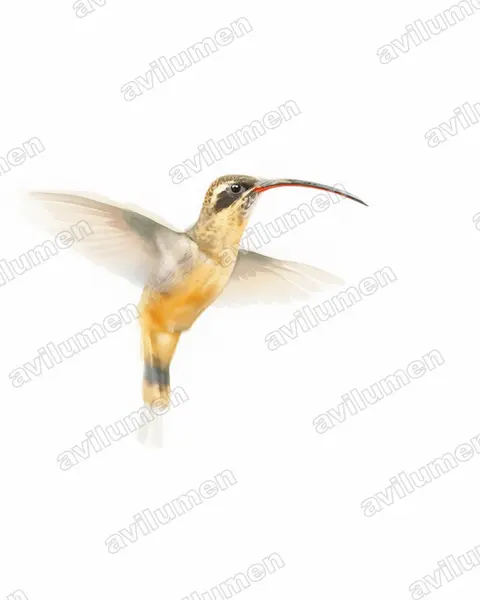
Watercolor 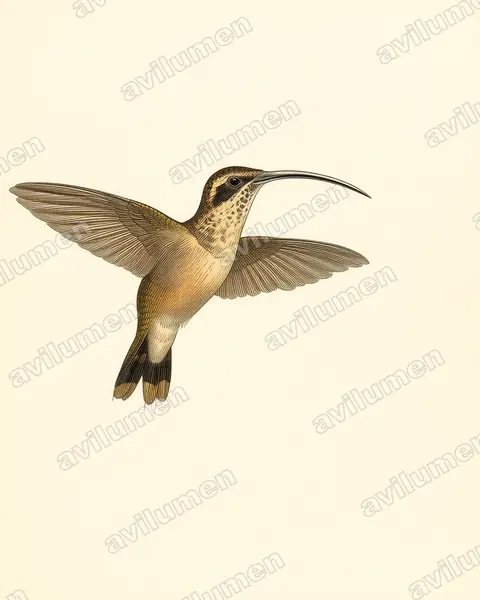
Vintage plate 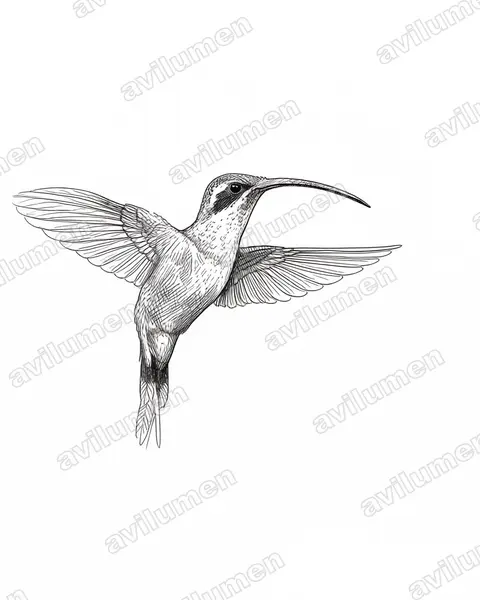
Ink 
Oil 
Realistic 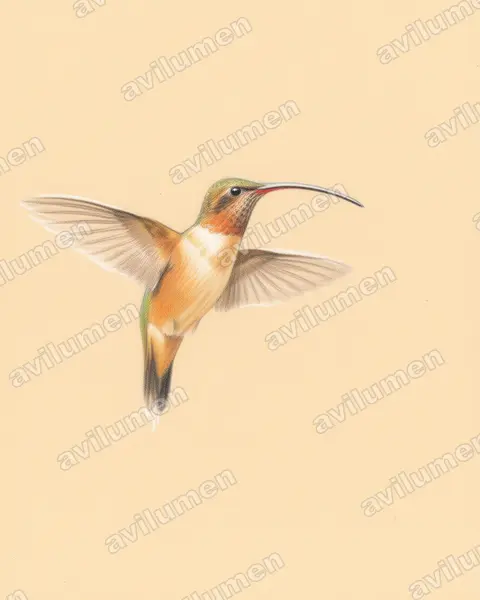
Colored pencil
Illustrations based on the photograph by Michael Woodruff from Spokane, Washington, USA (CC BY-SA 2.0), from Wikimedia Commons.
Digital editions
HD Digital Art Pack — Tawny-bellied Hermit
Digital download: 6 high-resolution illustrations of the Tawny-bellied Hermit (Phaethornis syrmatophorus), print-ready. This is a digital file; no animal or physical item is included.
AI Avatar — Tawny-bellied Hermit
Generate an avatar fusing your face with the Tawny-bellied Hermit (Phaethornis syrmatophorus). Delivered digitally in 8K, watermark-free. Digital product; no animals are sold or brokered.
Instant download. No live birds are sold.
Frequently asked questions
- Is Phaethornis syrmatophorus (Tawny-bellied Hermit) endangered?
- The IUCN Red List places Phaethornis syrmatophorus, commonly known as the Tawny-bellied Hermit, in the «Least concern» category. «Least concern» means it is not currently threatened.
- Where does Phaethornis syrmatophorus (Tawny-bellied Hermit) live?
- Phaethornis syrmatophorus (Tawny-bellied Hermit) is found in South America.
- What family does Phaethornis syrmatophorus (Tawny-bellied Hermit) belong to?
- Phaethornis syrmatophorus (Tawny-bellied Hermit) belongs to the family Trochilidae, in the order Apodiformes.
- What colour is Phaethornis syrmatophorus (Tawny-bellied Hermit)?
- The plumage of Phaethornis syrmatophorus (Tawny-bellied Hermit) combines these colours: Brown and Green.
More from the same family
 Least concern
Emerald-chinned Hummingbird
Abeillia abeillei
The emerald-chinned hummingbird is a species of hummingbird in the "emeralds", tribe Trochilini of subfamily Trochilinae.
from $1.99
 Least concern
Speckled hummingbird
Adelomyia melanogenys
The speckled hummingbird is a species of hummingbird. It is the only member of the genus Adelomyia. It inhabits Neotropical montane cloud forests at elevations of 1,000–2,500 meters and is confined to the Andes of Argentina, Bolivia, Peru, Ecuador, Colombia and Venezuela; as well as to some isolated montane forests in western Ecuador and Venezuela.
from $1.99
 Vulnerable
Purple-backed sunbeam
Aglaeactis aliciae
The purple-backed sunbeam is a bird species in the family Trochilidae. It is found only in Peru.
from $1.99
 Near threatened
White-tufted sunbeam
Aglaeactis castelnaudii
The white-tufted sunbeam is a species of hummingbird in the family Trochilidae. It is found only in Peru. Its natural habitats are subtropical or tropical moist montane forest and subtropical or tropical high-altitude shrubland.
from $1.99