Lesser Flamingo
Phoeniconaias minor
Avilumen editorial team ·

The lesser flamingo is a species of flamingo occurring in sub-Saharan Africa and western India. Birds are occasionally reported from farther north, but these are generally considered vagrants.
The lesser flamingo (Phoeniconaias minor) is a species of flamingo occurring in sub-Saharan Africa and western India. Birds are occasionally reported from farther north, but these are generally considered vagrants.
Description
The lesser flamingo is the smallest species of flamingo, though it is a tall and large bird by most standards. The species can weigh from 1.2 to 2.7 kg (2.6 to 6.0 lb). The standing height is around 80 to 90 cm (31 to 35 in). The total length (from beak to tail) and wingspan are in the same range of measurements, from 90 to 105 cm (35 to 41 in).
Most of the plumage is pinkish white. The clearest difference between this species and the greater flamingo, the only other Old World species of flamingo, is the much more extensive black on the bill. Size is less helpful to distinguish the two species, unless they occur together, since the sexes of each species also differ in height.
The extinct species Phoeniconaias proeses in the same genus, from the Pliocene of Australia, is thought to have been even smaller.
Ecology
The lesser flamingo may be the most common species of flamingo, with a population that (at its peak) probably numbered up to two million individual birds. This species feeds primarily on Spirulina, algae which grow only in very alkaline lakes. Presence of flamingo groups near water bodies is an indication of sodic alkaline water which is not suitable for irrigation use. Although blue-green in colour, the algae contain the photosynthetic pigments that give the birds their pink colour. Their deep bill is specially adapted for filtering tiny food items. Other forms of algae taken are Synechocystis minuscula, Synechococcus pevalekii, Synechococcus elongatus, Monoraphidium minutum, Oscillatoria sp. and Lyngbya sp. This species will also feed, to a lesser extent, on small invertebrates: copepods (Paradiaptomus africanus), diatoms (Navicula) and rotifers (Brachionus), as well as microscopic alkaliphilic cyanobacteria (Arthrospira fusiformis, A. maxima).
Predators
Lesser flamingos are prey to a variety of species, including marabou storks, vultures, baboons, African fish eagles, jackals, hyenas, foxes, great white pelicans, martial eagles, and big cats.
Breeding
In Africa, where they are most common, the lesser flamingos breed principally on the highly caustic Lake Natron in northern Ngorongoro District in Arusha Region of Tanzania. Their other African breeding sites are at Etosha Pan, Makgadikgadi Pan, and Kamfers Dam. The last confirmed breeding season at Aftout es Saheli in coastal Mauritania was in 1965. Breeding occurred at Lake Magadi in Kenya in 1962 when Lake Natron was unsuitable due to flooding. In the early 20th century, breeding was also observed at Lake Nakuru.
The species also breeds in southwestern and southern Asia. In 1974, they bred at the Rann of Kutch, but since then, only at the Zinzuwadia and Purabcheria salt pans in northwestern India. Some movement of individuals occurs between Africa and India.
Like all flamingos, they lay a single chalky-white egg on a mound they build of mud. Chicks join creches soon after hatching, sometimes numbering over 100,000 individuals. The creches are marshalled by a few adult birds that lead them by foot to fresh water, a journey that can reach over 32 km (20 mi).
Threats
Despite being the most common species of flamingo, it is classified as near threatened due to its declining population and the low number of breeding sites, some of which are threatened by human activities.
The population in the two key East African lakes, Lake Nakuru and Lake Bogoria, have been adversely affected in recent years by suspected heavy metal poisoning, while its primary African breeding area in Lake Natron is currently under threat by a proposed soda ash plant by Tata Chemicals. The only breeding site in South Africa, situated at Kamfers Dam, is threatened by pollution and encroaching development. East African soda lake productivity declines due to rising water levels are another threat to the lesser flamingo.
Text adapted from Wikipedia · CC BY-SA 4.0
Distribution

Taxonomy
- Order
- Phoenicopteriformes
- Family
- Phoenicopteridae
- Genus
- Phoeniconaias
- Conservation status
- Near threatened
Listen to its call
No recording yet
Illustration gallery
6 illustrations of Phoeniconaias minor (Lesser Flamingo) in different styles, true to its real plumage. Shown watermarked; the art pack includes the high-resolution originals, ready to print.
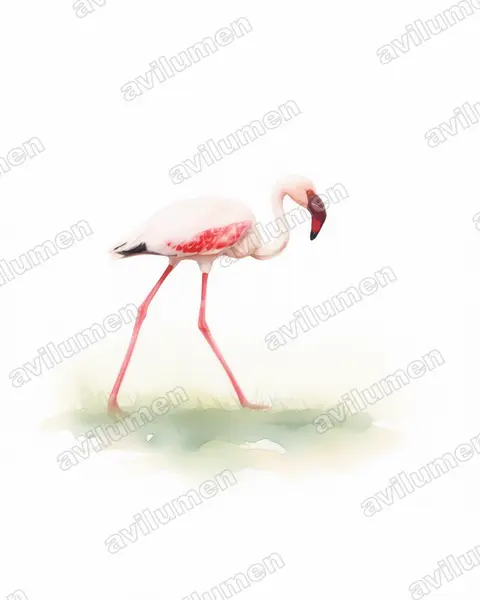
Watercolor 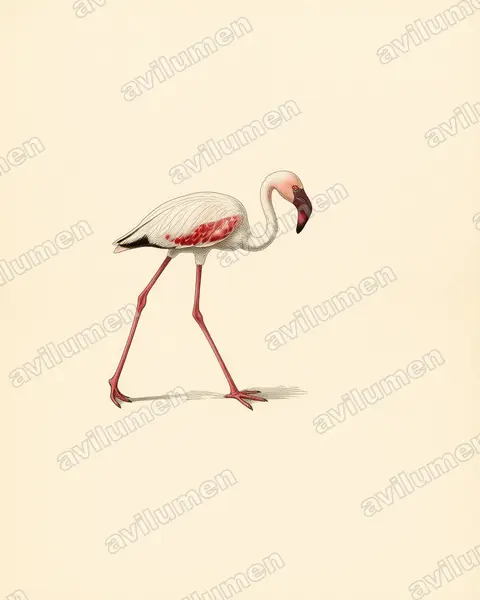
Vintage plate 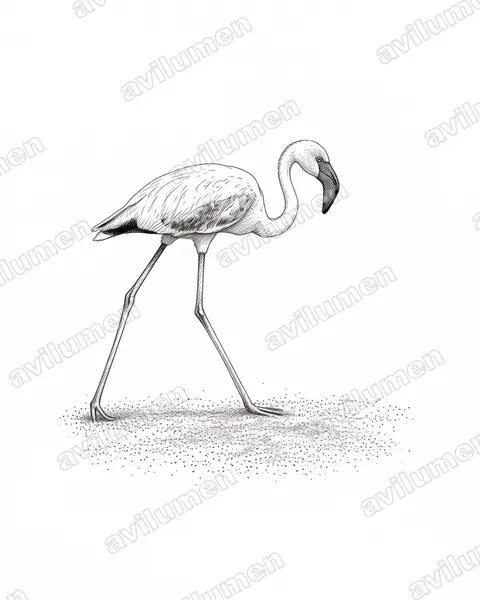
Ink 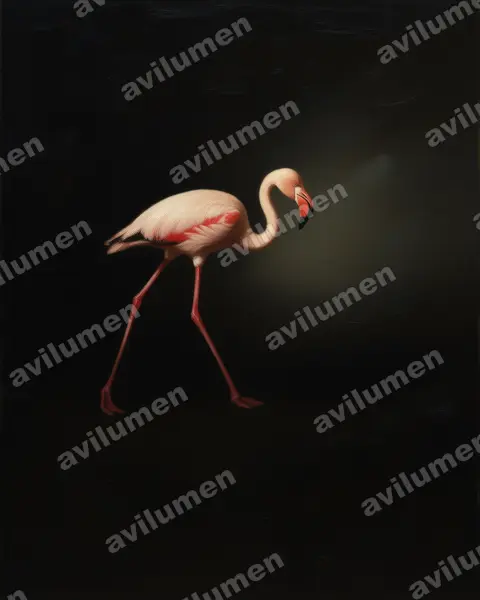
Oil 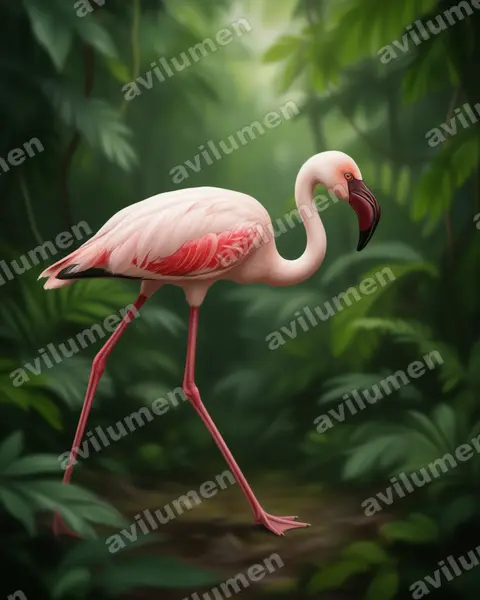
Realistic 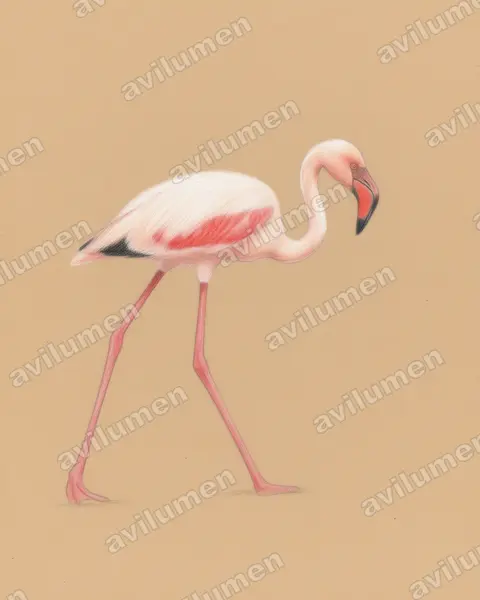
Colored pencil
Illustrations based on the photograph by taken by myself (CC BY-SA 3.0 de), from Wikimedia Commons.
Digital editions
HD Digital Art Pack — Lesser Flamingo
Digital download: 6 high-resolution illustrations of the Lesser Flamingo (Phoeniconaias minor), print-ready. This is a digital file; no animal or physical item is included.
AI Avatar — Lesser Flamingo
Generate an avatar fusing your face with the Lesser Flamingo (Phoeniconaias minor). Delivered digitally in 8K, watermark-free. Digital product; no animals are sold or brokered.
Instant download. No live birds are sold.
Frequently asked questions
- Is Phoeniconaias minor (Lesser Flamingo) endangered?
- The IUCN Red List places Phoeniconaias minor, commonly known as the Lesser Flamingo, in the «Near threatened» category. «Near threatened» means it is not threatened yet, but is close to becoming so.
- Where does Phoeniconaias minor (Lesser Flamingo) live?
- Phoeniconaias minor (Lesser Flamingo) is found in Africa.
- What family does Phoeniconaias minor (Lesser Flamingo) belong to?
- Phoeniconaias minor (Lesser Flamingo) belongs to the family Phoenicopteridae, in the order Phoenicopteriformes.
- What colour is Phoeniconaias minor (Lesser Flamingo)?
- The plumage of Phoeniconaias minor (Lesser Flamingo) combines these colours: Pink.
More from the same family
 Vulnerable
Andean Flamingo
Phoenicoparrus andinus
The Andean flamingo is a species of flamingo native to the Andes mountains of South America. Until 2014, it was classified in genus Phoenicopterus. It is closely related to James's flamingo, and the two make up the genus Phoenicoparrus. The Chilean flamingo, Andean flamingo, and James' flamingo are all sympatric, and all live in colonies.
from $1.99
 Near threatened
James's Flamingo
Phoenicoparrus jamesi
James's flamingo, also known as the puna flamingo, is a species of flamingo that lives at high altitudes in the Andean plateaus of Peru, Chile, Bolivia, and northwest Argentina.
from $1.99
 Near threatened
Chilean Flamingo
Phoenicopterus chilensis
The Chilean flamingo is a species of large flamingo at a height of 110–130 cm (43–51 in) closely related to the American flamingo and the greater flamingo, with which it was previously considered a subspecies before being classified as its own species as a result of their lighter color, smaller size and behavioral differences. The species is listed as Near Threatened on the IUCN Red List.
from $1.99
 Least concern
Greater Flamingo
Phoenicopterus roseus
The greater flamingo is the largest and most widespread species of the flamingo family. Common in the Old World, they are found in Northern (coastal) and Sub-Saharan Africa, the Indian subcontinent, Central Asia, the Middle East, the Levant, the Persian Gulf, the Gulf of Aden, the Red Sea, and the Mediterranean countries of Southern Europe.
from $1.99