Grey-headed Piprites
Piprites griseiceps
Avilumen editorial team ·

The grey-headed piprites is a species of bird in subfamily Pipritinae of family Tyrannidae, the tyrant flycatchers. It is found in Costa Rica, Guatemala, Honduras, Nicaragua, and Panama. Prior to genetic studies in 2009, it was placed in the family Pipritinae with the manakins.
The grey-headed piprites (Piprites griseiceps) is a species of bird in subfamily Pipritinae of family Tyrannidae, the tyrant flycatchers. It is found in Costa Rica, Guatemala, Honduras, Nicaragua, and Panama. Prior to genetic studies in 2009, it was placed in the family Pipritinae with the manakins.
Taxonomy and systematics
The grey-headed piprites is monotypic. It shares genus Piprites with the wing-barred piprites (P. chloris) and the black-capped piprites (P. pileata). The grey-headed and wing-barred piprites form a superspecies. Genetically, it is particularly close to the wing-barred piprites.
Description
The grey-headed piprites is 12 to 13 cm (4.7 to 5.1 in) long and weighs about 16 g (0.56 oz). It is considered as having an especially long tail among similar species. The sexes have the same plumage. Adults have a slate-gray head with a bold white eyering. Their upperparts, wings, and tail are olive-green with yellow-green edges on their flight feathers. Their underparts are yellowish olive that is lightest on their throat and belly. They have a dark iris, a blackish maxilla, a paler mandible, and gray legs and feet.
Distribution and habitat
The grey-headed piprites is found on the Caribbean slope of Central America from far eastern Guatemala through Honduras, Nicaragua, and Costa Rica to Bocas del Toro Province in far western Panama. It inhabits wet primary forest and mature secondary forest. In elevation it mostly occurs from sea level to 750 m (2,500 ft) though it reaches 1,100 m (3,600 ft) in Honduras and 900 m (3,000 ft) in Costa Rica.
Movement
The grey-headed piprites is a year-round resident throughout its range.
Feeding
The grey-headed piprites forages mostly in the forest's middle level. It feeds on small fruits and insects that it takes with a sally from a perch. It often joins mixed-species feeding flocks.
Breeding
Nothing is known about the grey-headed piprites' breeding biology.
Vocalization
The grey-headed piprites' song is "an undulating two-second phrase of quick, sputtering notes". One call is "a liquid whit!". Another is "a soft, liquid, rolling 'purrr'".
Status
The IUCN has assessed the grey-headed piprites as being of Least Concern. It has a large range; its population size is not known and is believed to be decreasing. No immediate threats have been identified. It is overall considered uncommon to rare, and there are especially few records of it in the northernmost and southernmost reaches of its range, with only one sighting in Guatemala. It has been noted in Honduras and Costa Rica, and it occurs in two protected areas in Costa Rica.
Text adapted from Wikipedia · CC BY-SA 4.0
Plumage colours
Distribution

Taxonomy
- Order
- Passeriformes
- Family
- Cotingidae
- Genus
- Piprites
- Conservation status
- Least concern
Listen to its call
No recording yet
Illustration gallery
6 illustrations of Piprites griseiceps (Grey-headed Piprites) in different styles, true to its real plumage. Shown watermarked; the art pack includes the high-resolution originals, ready to print.
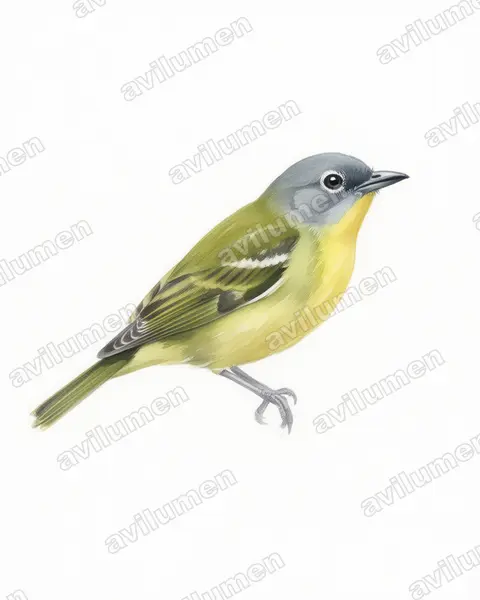
Watercolor 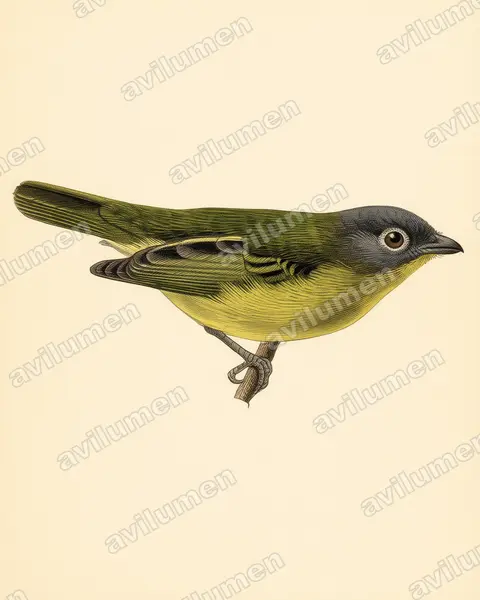
Vintage plate 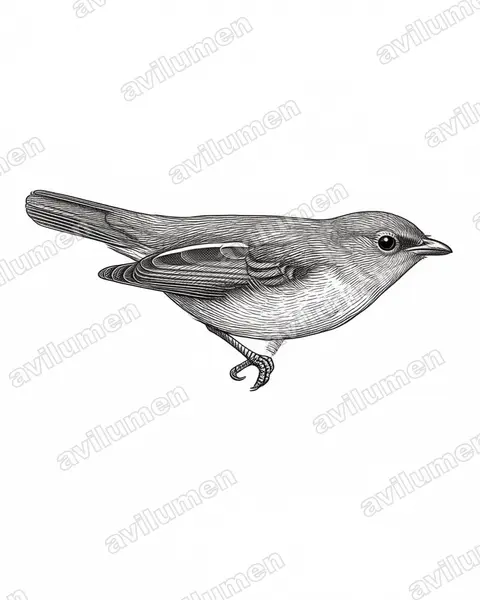
Ink 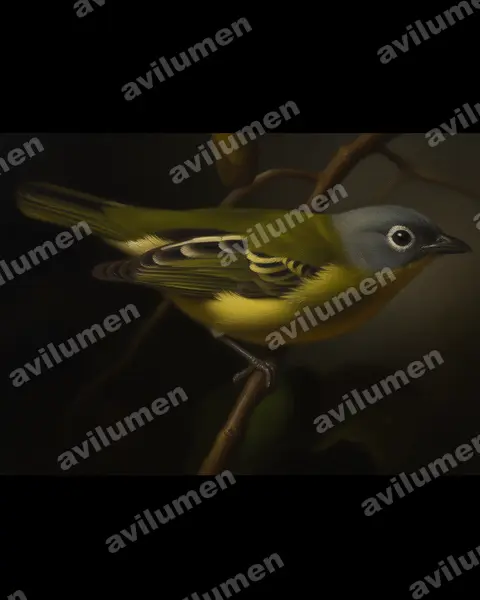
Oil 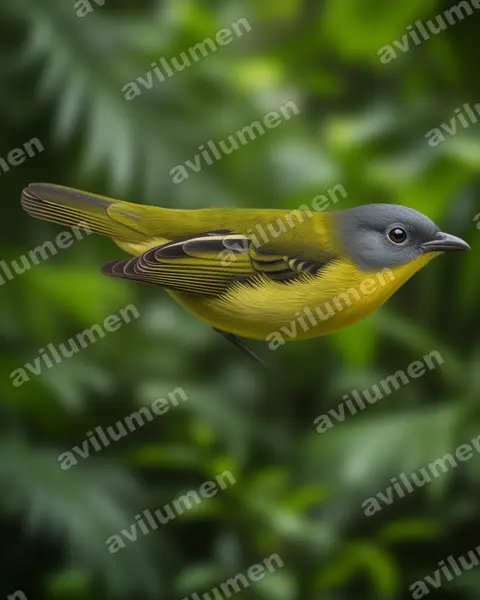
Realistic 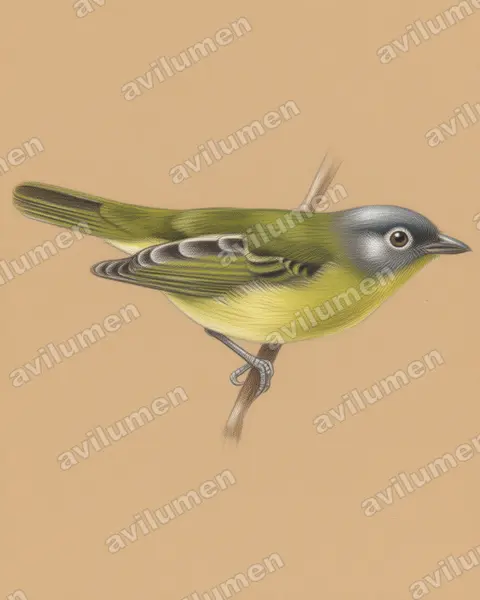
Colored pencil
Illustrations based on the photograph by John Gerrard Keulemans (Public domain), from Wikimedia Commons.
Digital editions
HD Digital Art Pack — Grey-headed Piprites
Digital download: 6 high-resolution illustrations of the Grey-headed Piprites (Piprites griseiceps), print-ready. This is a digital file; no animal or physical item is included.
AI Avatar — Grey-headed Piprites
Generate an avatar fusing your face with the Grey-headed Piprites (Piprites griseiceps). Delivered digitally in 8K, watermark-free. Digital product; no animals are sold or brokered.
Instant download. No live birds are sold.
Frequently asked questions
- Is Piprites griseiceps (Grey-headed Piprites) endangered?
- The IUCN Red List places Piprites griseiceps, commonly known as the Grey-headed Piprites, in the «Least concern» category. «Least concern» means it is not currently threatened.
- What family does Piprites griseiceps (Grey-headed Piprites) belong to?
- Piprites griseiceps (Grey-headed Piprites) belongs to the family Cotingidae, in the order Passeriformes.
- What colour is Piprites griseiceps (Grey-headed Piprites)?
- The plumage of Piprites griseiceps (Grey-headed Piprites) combines these colours: Grey.
More from the same family
 Least concern
Scaled Fruiteater
Ampelioides tschudii
The scaled fruiteater is a species of bird in the family Cotingidae. It is the only member of the genus Ampelioides. This bird is found in Bolivia, Colombia, Ecuador, Peru, and Venezuela, where its natural habitat is the high elevation tropical forests of the Andes mountains. The scaled fruiteater is a chunky, short-tailed, flat-headed bird measuring 19–20 cm (7.5–7.9 in) in length.
from $1.99
 Least concern
Red-crested Cotinga
Ampelion rubrocristatus
The red-crested cotinga is a species of bird in the family Cotingidae. It is found in Bolivia, Colombia, Ecuador, Peru, and Venezuela.
from $1.99
 Least concern
Chestnut-crested Cotinga
Ampelion rufaxilla
The chestnut-crested cotinga is a species of bird in the family Cotingidae. It is found in Bolivia, Colombia, Ecuador, and Peru.
from $1.99
 Critically endangered
Kinglet Calyptura
Calyptura cristata
The kinglet calyptura is a small Critically Endangered passerine bird in the family Tyrannidae, the tyrant flycatchers. It is endemic to southeastern Brazil.
from $1.99