Hooded Pitta
Pitta sordida
Avilumen editorial team ·

The western hooded pitta is a passerine bird in the family Pittidae. It is common in eastern and southeastern Asia and maritime Southeast Asia, where it lives in several types of forests as well as on plantations and other cultivated areas. It is a green bird with a black head and chestnut crown. It forages on the ground for insects and their larvae, and also eats berries.
The western hooded pitta (Pitta sordida) is a passerine bird in the family Pittidae. It is common in eastern and southeastern Asia and maritime Southeast Asia, where it lives in several types of forests as well as on plantations and other cultivated areas. It is a green bird with a black head and chestnut crown. It forages on the ground for insects and their larvae, and also eats berries. It breeds between February and August, the pair being strongly territorial and building their nest on the ground. Incubation and care of the fledglings is done by both parents. The bird has a wide range, and the International Union for Conservation of Nature has assessed its conservation status as being of "least concern". It was formerly considered to be conspecific with the Nicobar hooded pitta, the Minahasa hooded pitta, the eastern hooded pitta and the Biak hooded pitta.
Taxonomy
The western hooded pitta was described by the German zoologist Philipp Statius Müller in 1776 and given the binomial name Turdus sordidus. Statius Müller's description was based on a plate showing the "Merle des Philippines" published by Comte de Buffon in his Planches Enluminées D'Histoire Naturelle. The species is now placed in the genus Pitta that was erected by the French ornithologist Louis Pierre Vieillot in 1816. The specific epithet sordida is Latin for "shabby" or "dirty".
Six subspecies are recognised:
P. s. cucullata Hartlaub, 1843 – north India to south China and Indochina
P. s. mulleri (Bonaparte, 1850) – Malay Peninsula, Sumatra, Java, Borneo and southwest Sulu Archipelago (south Philippines)
P. s. bangkana Schlegel, 1863 – Bangka and Belitung (east of south Sumatra)
P. s. sordida (Müller, PLS, 1776) – Philippines (except Palawan group)
P. s. palawanensis Parkes, 1960 – Palawan group (southwest Philippines)
P. s. sanghirana Schlegel, 1866 – Sangihe Islands (northeast of Sulawesi)
Behaviour
Western hooded pittas can reach a length of 16 to 19 cm (6.3 to 7.5 in) and a weight of 42 to 70 g (1.5 to 2.5 oz). It has a black head, chestnut crown and green body and wings. Its diet consists of various insects (including their larvae), which they hunt on the ground, and berries. In the breeding period, which lasts from February to August, they build nests on the ground; both parent take care of the eggs and the fledglings. They are highly territorial and their fluty double-noted whistle calls ("qweeek-qweeek") can be constantly heard from their territories, sometimes throughout the nights.
The International Union for Conservation of Nature is concerned in particular about the ongoing loss of habitat that this bird suffers, which is reducing its numbers, but has rated it as being a "least concern species" because the rate of population decline is insufficient to warrant a threatened category.
Text adapted from Wikipedia · CC BY-SA 4.0
Taxonomy
- Order
- Passeriformes
- Family
- Pittidae
- Genus
- Pitta
- Conservation status
- Least concern
Listen to its call
No recording yet
Illustration gallery
6 illustrations of Pitta sordida (Hooded Pitta) in different styles, true to its real plumage. Shown watermarked; the art pack includes the high-resolution originals, ready to print.
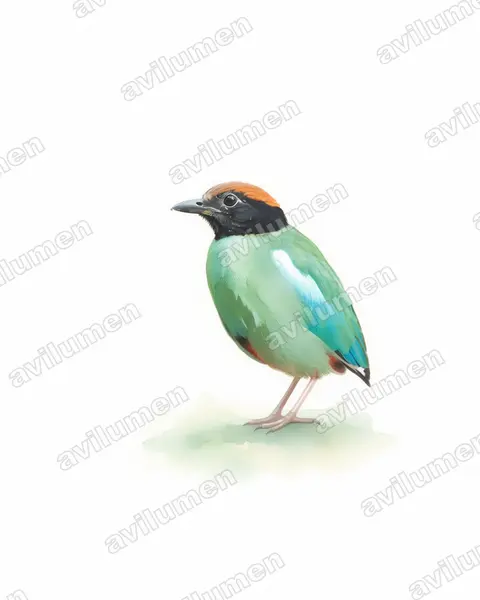
Watercolor 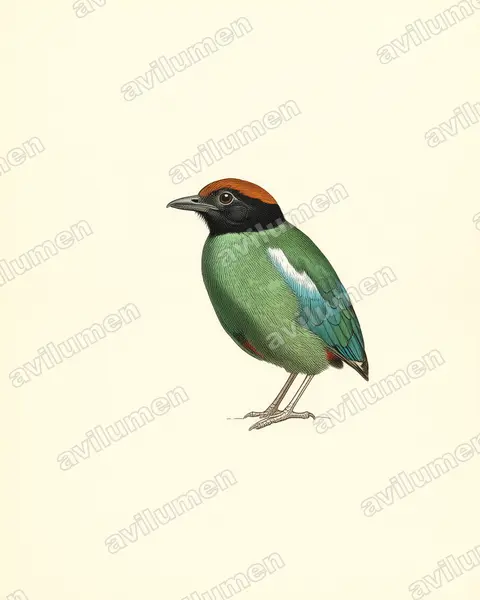
Vintage plate 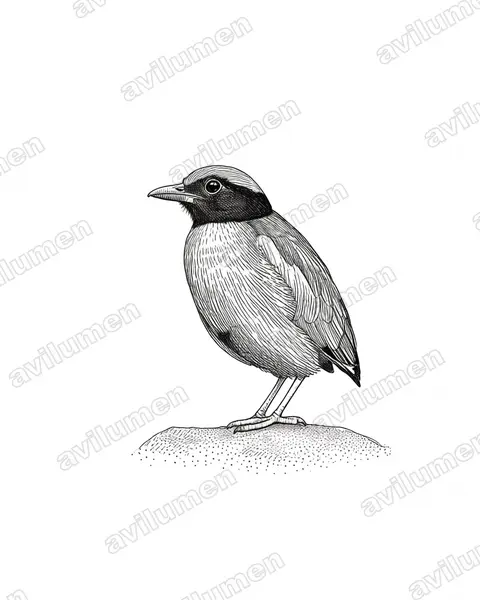
Ink 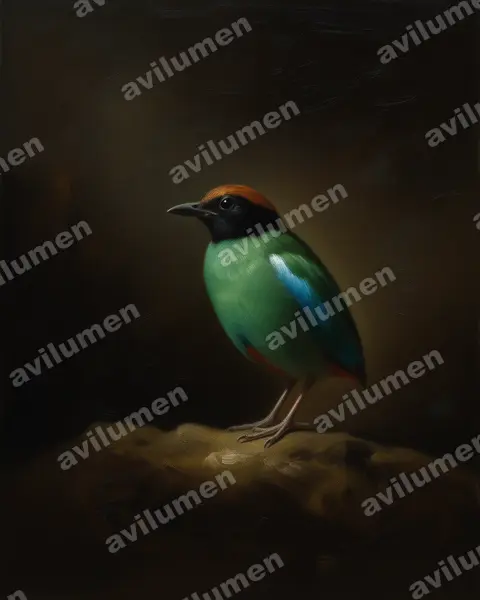
Oil 
Realistic 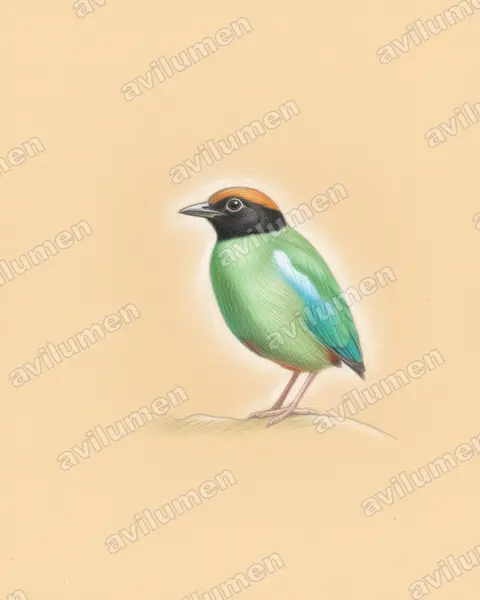
Colored pencil
Illustrations based on the photograph by JJ Harrison (https://www.jjharrison.com.au/) (CC BY-SA 3.0), from Wikimedia Commons.
Digital editions
HD Digital Art Pack — Hooded Pitta
Digital download: 6 high-resolution illustrations of the Hooded Pitta (Pitta sordida), print-ready. This is a digital file; no animal or physical item is included.
AI Avatar — Hooded Pitta
Generate an avatar fusing your face with the Hooded Pitta (Pitta sordida). Delivered digitally in 8K, watermark-free. Digital product; no animals are sold or brokered.
Instant download. No live birds are sold.
Frequently asked questions
- Is Pitta sordida (Hooded Pitta) endangered?
- The IUCN Red List places Pitta sordida, commonly known as the Hooded Pitta, in the «Least concern» category. «Least concern» means it is not currently threatened.
- Where does Pitta sordida (Hooded Pitta) live?
- Pitta sordida (Hooded Pitta) is found in Indonesia.
- What family does Pitta sordida (Hooded Pitta) belong to?
- Pitta sordida (Hooded Pitta) belongs to the family Pittidae, in the order Passeriformes.
- What colour is Pitta sordida (Hooded Pitta)?
- The plumage of Pitta sordida (Hooded Pitta) combines these colours: Green and Black.
More from the same family
 Least concern
Blue-banded Pitta
Erythropitta arquata
The blue-banded pitta is a species of bird in the family Pittidae. It is native to lowlands of the Borneo montane rain forests.
from $1.99
 Endangered
Sangihe pitta
Erythropitta caeruleitorques
The Sulawesi pitta is a species of pitta. It was considered a subspecies of the red-bellied pitta. It is endemic to Indonesia where it occurs in Sulawesi, Manterawu, and Togian Islands. Its natural habitat is subtropical or tropical moist lowland forest. It is threatened by habitat loss.
from $1.99
 Least concern
Sulawesi pitta
Erythropitta celebensis
The Sulawesi pitta is a species of pitta. It was considered a subspecies of the red-bellied pitta. It is endemic to Indonesia where it occurs in Sulawesi, Manterawu, and Togian Islands. Its natural habitat is subtropical or tropical moist lowland forest. It is threatened by habitat loss.
from $1.99
 Near threatened
Sula pitta
Erythropitta dohertyi
The Sula pitta is a species of the pitta. It was considered a subspecies of the red-bellied pitta. It is endemic to Indonesia where it occurs in the Sula and Banggai Islands. Its natural habitat is subtropical or tropical moist lowland forests. It is threatened by habitat loss.
from $1.99