Green-tailed goldenthroat
Polytmus theresiae
Avilumen editorial team ·

The green-tailed goldenthroat is a species of hummingbird in the subfamily Polytminae, the mangoes. It is found in Bolivia, Brazil, Colombia, French Guiana, Guyana, Peru, Suriname, and Venezuela, and possibly Ecuador.
The green-tailed goldenthroat (Polytmus theresiae) is a species of hummingbird in the subfamily Polytminae, the mangoes. It is found in Bolivia, Brazil, Colombia, French Guiana, Guyana, Peru, Suriname, and Venezuela, and possibly Ecuador.
Taxonomy and systematics
The green-tailed goldenthroat was at one time placed in the monotypic genus Psilomycter, then in Smaragdites which had priority; the latter was later merged into Polytmus. The green-tailed goldenthroat has two subspecies, the nominate P. t. theresiae and P. t. leucorrhous.
Description
The green-tailed goldenthroat is 8.9 to 9.9 cm (3.5 to 3.9 in) long and weighs 3.0 to 3.9 g (0.11 to 0.14 oz). Both sexes of both subspecies have a long slightly decurved pinkish and black bill. The male of the nominate subspecies is overall shining green. The tail is rounded and green, with all but the central pair of feathers having white at their base. The area around the eye is dusky gray with a white spot behind the eye. The female is smaller. Its throat and breast are whitish thickly spotted with green, and the outermost tail feathers have white tips. Juveniles are like the adult female but with buffy edges to the head's feathers. P. t. leucorrhous is essentially the same as the nominate but for having a white vent area and undertail coverts.
Distribution and habitat
The nominate subspecies of green-tailed goldenthroat is found in the Guianas and north-central Brazil from the lower Negro and Madeira rivers east into the states of Pará and Amapá. P. t. leucorrhous is found from eastern Colombia and southern Venezuela into the upper Negro River area of Brazil, and separately in eastern Peru and northern Bolivia. In addition, the South American Classification Committee (SACC) of the American Ornithological Society lists it as hypothetical in Ecuador. The species inhabits the edges of sand-soil forest and sandy savanna with scattered small trees and stands of bushes. In elevation it generally ranges between 100 and 300 m (330 and 980 ft).
Movement
The green-tailed goldenthroat is essentially sedentary. However, some January and February movement into coastal mangroves has been noted in Suriname.
Feeding
The green-tailed goldenthroat is primarily a "trap-line" feeder, visiting a circuit of a flowering plants, mostly Melastomataceae, for nectar. The male will sometimes defend a feeding territory. Both sexes also catch arthropods on the wing and by gleaning from leaves.
Breeding
The green-tailed goldenthroat's breeding seasons vary across its range, from March, April, and August to October in the Guianas, October and November in Venezuela, and November to March in Brazil. The female alone builds the nest, incubates the eggs, and cares for the young. The nest is a cup of fine plant fibers and spider silk built in a fork of a low shrub. The clutch size is two eggs. The incubation time is 14 days with fledging 20 to sometimes as long as 28 days after hatch.
Vocalization
The green-tailed goldenthroat's song is "a repeated, long whinnying series of 20–25 notes, first rising then slightly falling, and fading at the end, typically with a single introductory note". The isolated Peruvian population has a similar but faster song with trills. The species also makes "single 'tsit' notes."
Status
The IUCN has assessed the green-tailed goldenthroat as being of Least Concern, though its population size and trend are unknown. It is common to locally abundant in the northern part of its range.
Text adapted from Wikipedia · CC BY-SA 4.0
Where it lives
Plumage colours
Distribution

Taxonomy
- Order
- Apodiformes
- Family
- Trochilidae
- Genus
- Polytmus
- Conservation status
- Least concern
Listen to its call
No recording yet
Illustration gallery
6 illustrations of Polytmus theresiae (Green-tailed goldenthroat) in different styles, true to its real plumage. Shown watermarked; the art pack includes the high-resolution originals, ready to print.
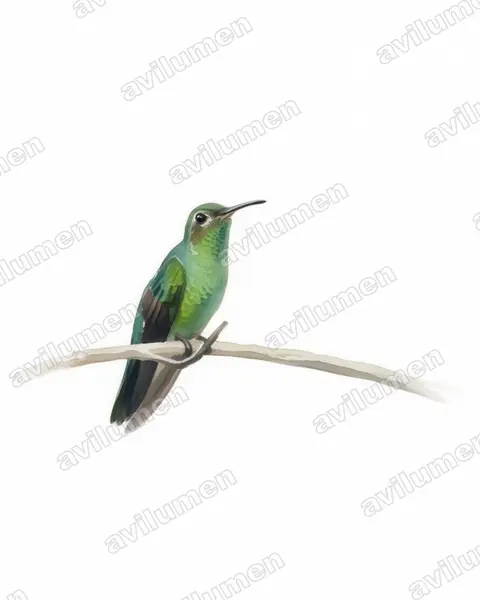
Watercolor 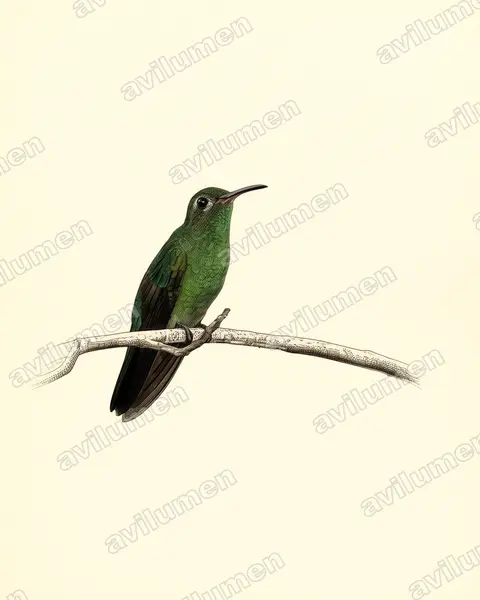
Vintage plate 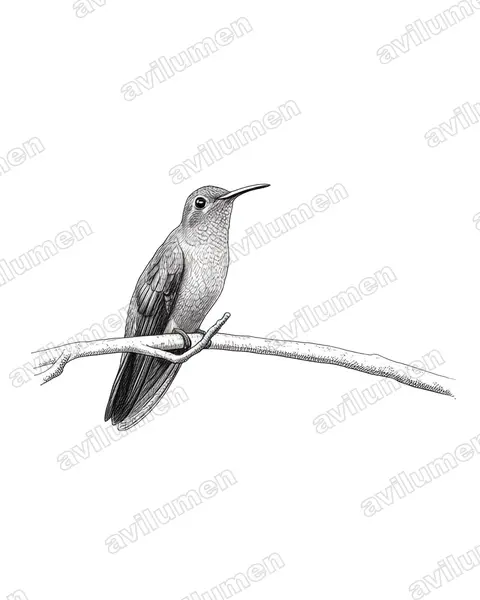
Ink 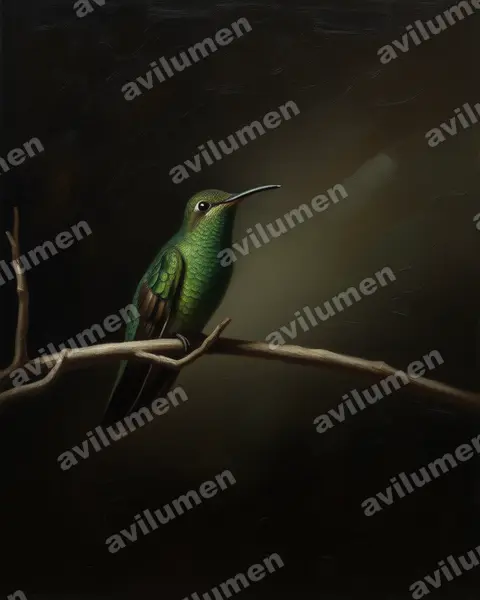
Oil 
Realistic 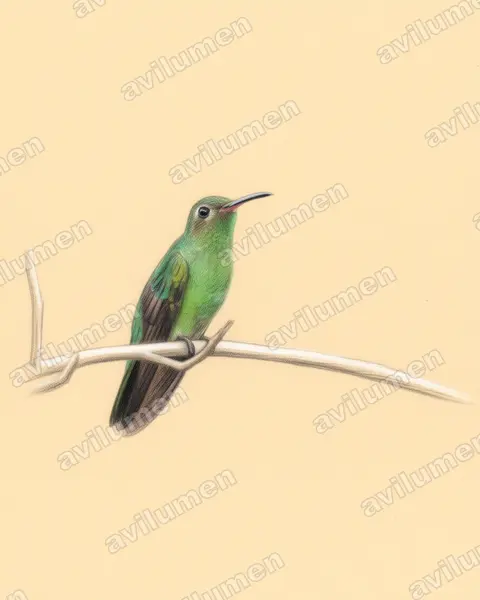
Colored pencil
Illustrations based on the photograph by Hector Bottai (CC BY-SA 4.0), from Wikimedia Commons.
Digital editions
HD Digital Art Pack — Green-tailed goldenthroat
Digital download: 6 high-resolution illustrations of the Green-tailed goldenthroat (Polytmus theresiae), print-ready. This is a digital file; no animal or physical item is included.
AI Avatar — Green-tailed goldenthroat
Generate an avatar fusing your face with the Green-tailed goldenthroat (Polytmus theresiae). Delivered digitally in 8K, watermark-free. Digital product; no animals are sold or brokered.
Instant download. No live birds are sold.
Frequently asked questions
- Is Polytmus theresiae (Green-tailed goldenthroat) endangered?
- The IUCN Red List places Polytmus theresiae, commonly known as the Green-tailed goldenthroat, in the «Least concern» category. «Least concern» means it is not currently threatened.
- Where does Polytmus theresiae (Green-tailed goldenthroat) live?
- Polytmus theresiae (Green-tailed goldenthroat) is found in Brazil and South America.
- What family does Polytmus theresiae (Green-tailed goldenthroat) belong to?
- Polytmus theresiae (Green-tailed goldenthroat) belongs to the family Trochilidae, in the order Apodiformes.
- What colour is Polytmus theresiae (Green-tailed goldenthroat)?
- The plumage of Polytmus theresiae (Green-tailed goldenthroat) combines these colours: Green.
More from the same family
 Least concern
Emerald-chinned Hummingbird
Abeillia abeillei
The emerald-chinned hummingbird is a species of hummingbird in the "emeralds", tribe Trochilini of subfamily Trochilinae.
from $1.99
 Least concern
Speckled hummingbird
Adelomyia melanogenys
The speckled hummingbird is a species of hummingbird. It is the only member of the genus Adelomyia. It inhabits Neotropical montane cloud forests at elevations of 1,000–2,500 meters and is confined to the Andes of Argentina, Bolivia, Peru, Ecuador, Colombia and Venezuela; as well as to some isolated montane forests in western Ecuador and Venezuela.
from $1.99
 Vulnerable
Purple-backed sunbeam
Aglaeactis aliciae
The purple-backed sunbeam is a bird species in the family Trochilidae. It is found only in Peru.
from $1.99
 Near threatened
White-tufted sunbeam
Aglaeactis castelnaudii
The white-tufted sunbeam is a species of hummingbird in the family Trochilidae. It is found only in Peru. Its natural habitats are subtropical or tropical moist montane forest and subtropical or tropical high-altitude shrubland.
from $1.99