Cape Sugarbird
Promerops cafer
Avilumen editorial team ·

The Cape sugarbird is one of the eight bird species endemic to the Fynbos biome of the Western Cape and Eastern Cape provinces of South Africa.
The Cape sugarbird (Promerops cafer) is one of the eight bird species endemic to the Fynbos biome of the Western Cape and Eastern Cape provinces of South Africa.
Taxonomy
The Cape sugarbird was formally described in 1758 by the Swedish naturalist Carl Linnaeus in the tenth edition of his Systema Naturae. He placed it with the bee-eaters in the genus Merops and coined the binomial name Merops cafer. Linnaeus specified the type locality as Ethiopia but this was changed to the Cape of Good Hope by the French zoologist Mathurin Jacques Brisson in 1760. The Cape sugarbird is now placed in the genus Promerops that was introduced for the species by Brisson in 1760. The species is monotypic: no subspecies are recognised.
Description
The Cape sugarbird is a grey-brown bird that is easily recognisable by a spot of yellow under its tail and the very long tail feathers present in males. The male is 34–44 cm long, and the shorter-tailed, shorter-billed, and paler breasted female 25–29 cm long. Another characteristic of the Cape sugarbird is the sound it makes when it flies. The main flight feathers are arranged in such a way that when the bird beats its wings, a frrt-frrt sound is made with the intention of attracting females.
Distribution and status
The Cape sugarbird is distributed throughout most of the fire driven ecosystem of the Fynbos in South Africa, the dominant vegetation type of the Cape Floral Region where there are flowering proteas and ericas. It is most common in areas that have not burnt recently, and almost absent from recently burnt areas. It is also found in gardens in summer when most proteas are not in flower, but urban birds are associated with greater stress measures. With a large population and extensive range, the Cape sugarbird is evaluated as Least Concern on the IUCN Red List of Threatened Species.
Food and feeding
The Cape sugarbird is a specialist nectar feeder when it comes to feeding off Proteaceae. Its long, sharp beak is used to reach the nectar of a variety of species of protea with its long brush-tipped tongue. The staple diet of this sugarbird is nectar; however, it will also eat spiders and insects. The characteristic strong winds in the Cape may make feeding off protea heads difficult, but the Cape sugarbird has adapted to this with the development of sharp claws.
Breeding
The breeding season for the Cape sugarbird is winter when food supplies are ample. Breeding males set up territories in mature stands of Protea bushes, where they perform vocal displays.
Text adapted from Wikipedia · CC BY-SA 4.0
Where it lives
Taxonomy
- Order
- Passeriformes
- Family
- Nectariniidae
- Genus
- Promerops
- Conservation status
- Least concern
Listen to its call
No recording yet
Illustration gallery
6 illustrations of Promerops cafer (Cape Sugarbird) in different styles, true to its real plumage. Shown watermarked; the art pack includes the high-resolution originals, ready to print.
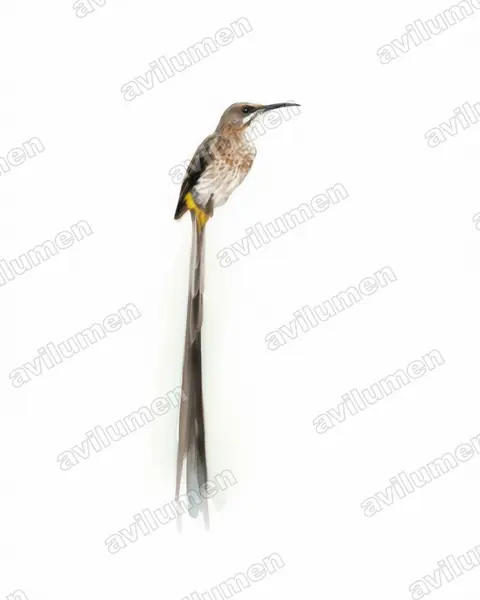
Watercolor 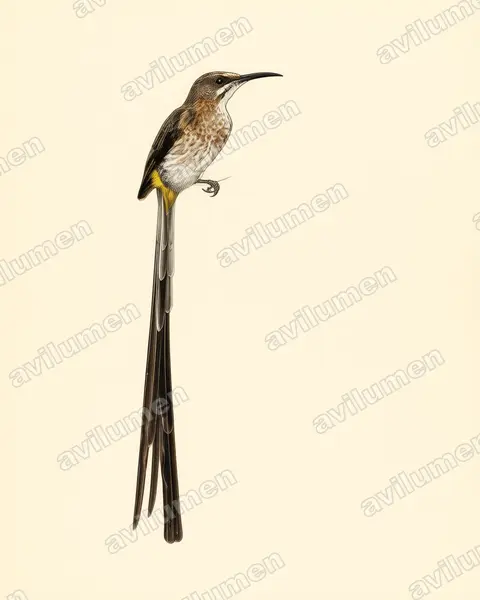
Vintage plate 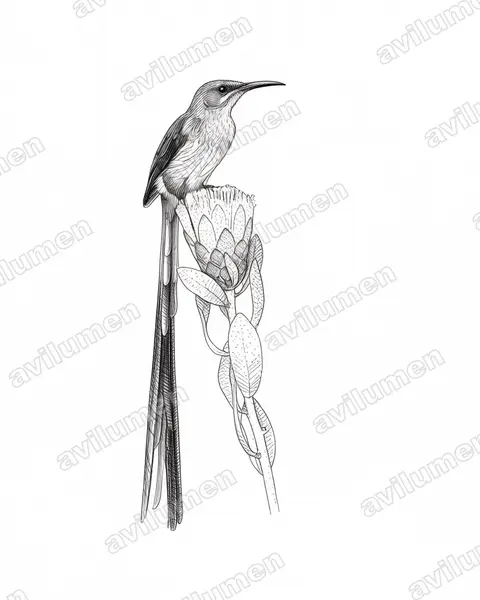
Ink 
Oil 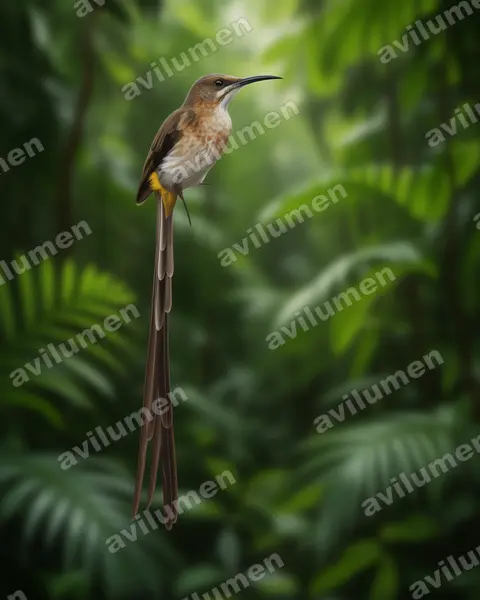
Realistic 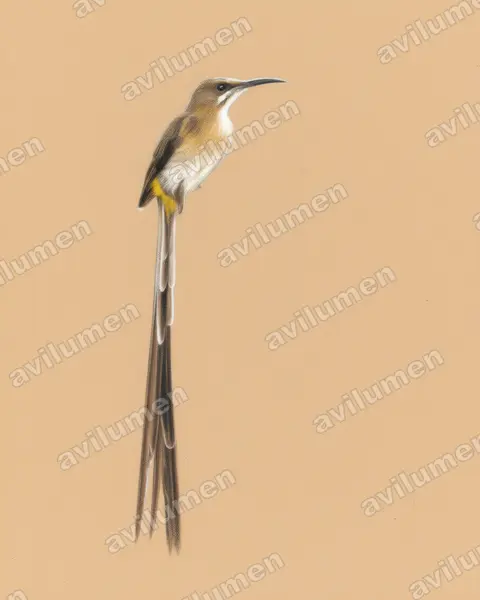
Colored pencil
Illustrations based on the photograph by Alan Manson (CC BY-SA 2.0), from Wikimedia Commons.
Digital editions
HD Digital Art Pack — Cape Sugarbird
Digital download: 6 high-resolution illustrations of the Cape Sugarbird (Promerops cafer), print-ready. This is a digital file; no animal or physical item is included.
AI Avatar — Cape Sugarbird
Generate an avatar fusing your face with the Cape Sugarbird (Promerops cafer). Delivered digitally in 8K, watermark-free. Digital product; no animals are sold or brokered.
Instant download. No live birds are sold.
Frequently asked questions
- Is Promerops cafer (Cape Sugarbird) endangered?
- The IUCN Red List places Promerops cafer, commonly known as the Cape Sugarbird, in the «Least concern» category. «Least concern» means it is not currently threatened.
- Where does Promerops cafer (Cape Sugarbird) live?
- Promerops cafer (Cape Sugarbird) is found in Africa and South Africa.
- What family does Promerops cafer (Cape Sugarbird) belong to?
- Promerops cafer (Cape Sugarbird) belongs to the family Nectariniidae, in the order Passeriformes.
- What colour is Promerops cafer (Cape Sugarbird)?
- The plumage of Promerops cafer (Cape Sugarbird) combines these colours: Brown and Yellow.
More from the same family
 Least concern
Handsome Sunbird
Aethopyga bella
The handsome sunbird is a species of bird in the family Nectariniidae. It is endemic to the Philippines.
from $1.99
 Least concern
Apo Sunbird
Aethopyga boltoni
The Apo sunbird is a species of bird in the sunbird family Nectariniidae. It is endemic to the island of Mindanao in the Philippines. It is found in tropical moist montane forests at elevations ranging from 820 to 2,000 metres above sea level.
from $1.99
 Least concern
Fork-tailed Sunbird
Aethopyga christinae
The fork-tailed sunbird is a bird in the family Nectariniidae. The species was first described by Robert Swinhoe in 1869.
from $1.99
 Endangered
Elegant Sunbird
Aethopyga duyvenbodei
The elegant sunbird is a large, up to 12 cm long, Australasian sunbird in the genus Aethopyga. The male has an iridescent blue-green crown, shoulder patch and uppertail coverts, yellow bar across lower back, red ear coverts, olive back, yellow throat, red neck collar and yellow below. The female has a yellowish olive upperparts, scaly crown and yellow underparts.
from $1.99