Yellow-throated Toucan
Ramphastos ambiguus
Avilumen editorial team ·

The yellow-throated toucan is a Least Concern species of bird in the family Ramphastidae, the toucans, toucanets, and aracaris. It is found from Honduras south into northern South America and beyond to Peru.
The yellow-throated toucan (Ramphastos ambiguus) is a Least Concern species of bird in the family Ramphastidae, the toucans, toucanets, and aracaris. It is found from Honduras south into northern South America and beyond to Peru.
Taxonomy and systematics
Three subspecies of yellow-throated toucan are recognized:
All three subspecies were originally described as separate species. R. a. abbreviatus was relatively early reassigned as a subspecies of R. a. ambiguus. Subspecies R. a. swainsonii differs from ambiguus by 1.35% in mitochondrial DNA which led to its treatment as a species by major taxonomies until about 2010.
Description
The yellow-throated toucan is 47 to 61 cm (19 to 24 in) long and weighs 584 to 746 g (1.3 to 1.6 lb). The three subspecies differ little in their dimensions, though females' bills are shorter than males' in all three. Bill lengths vary between 15.1 and 19.8 cm (5.9 and 7.8 in) in males and 12.9 and 16.0 cm (5.1 and 6.3 in) in females. Other measurements differ little by sex. Their wing chord is 20.4 to 24.8 cm (8.0 to 9.8 in), their tail length is 14.0 to 16.2 cm (5.5 to 6.4 in), and their tarsus is 4.7 to 5.5 cm (1.9 to 2.2 in) long.
The yellow-throated toucan's subspecies have essentially the same plumage. They are mostly black, with a maroon tint to the hindneck and upper back and white uppertail coverts. Their face, throat, and upper breast are bright yellow with white and crimson bands below the breast. Their vent and undertail coverts are bright red. The bare skin around their eye does differ: sky blue in the nominate R. a. ambiguus, yellow green in R. a. abbreviatus, and varying between yellow and bright green in R. a. swainsonii. The three subspecies' bills differ as well. All have a mostly yellow maxilla with a greenish yellow stripe on the culmen and a thin black line at the base. The nominate and R. a. abbreviatus have black mandibles; R. a. swainsonii' is maroon to reddish chestnut brown.
Distribution and habitat
The "chestnut mandibled" R. a. swainsonii primarily inhabits lowland evergreen primary forest and also occurs in gallery forest, older secondary forest, and well-treed parks and gardens. It shuns dry forest and large open areas but can be found in plantations with fruiting trees that border forest. The two "black-mandibled" subspecies are usually found in the interior of humid primary montane forest but also occur at its edges and clearings and in older secondary forest. In Ecuador the "chestnut-mandibled" is found from sea level to 1,000 m (3,300 ft), in Colombia below 2,000 m (6,600 ft), and in Costa Rica to 1,200 m (3,900 ft). The "black-mandibled" occurs between 1,000 and 1,600 m (3,300 and 5,200 ft) in Ecuador and up to 2,500 m (8,200 ft) in Colombia.
Movement
As far as is known the yellow-throated toucan is a year-round resident throughout its range.
Feeding
Most of the data on the yellow-throated toucan's diet and foraging behavior are from studies of the wide-ranging R. a. swainsonii. It is primarily a fruit eater, with small amounts of animal matter such as insects and other arthropods, small lizards, and the eggs and young of other birds. Most of the animal matter is apparently fed to nestlings. The species forages mainly in the forest canopy, singly, in pairs, or in small groups, but also retrieves fallen fruit from the ground. They take fruit by hopping from branch to branch and may hang upside down to reach it. Though the species is not territorial, individuals often defend a single fruiting tree.
Breeding
The yellow-throated toucan's breeding season varies latitudinally, from March to June in Costa Rica, January to July in Panama and Colombia, and between December and May in Ecuador. Males allopreen and courtship-feed females. The species nests in tree cavities formed by rot; they may enlarge it but cannot truly excavate. The cavity is typically between 9 and 30 m (30 and 98 ft) above the ground. The clutch size is thought to be two or three eggs. The incubation period and time to fledging are not known. Both parents defend the nest and care for young.
Vocal and non-vocal sounds
The yellow-throated toucan's primary vocalization is "a series of loud, far-carrying yelps." The call is somewhat variable in tempo and the number of notes. It has been transcribed as "Díos te dé te dé", which translates from Spanish as "God give you". The species calls year round, usually from the tops of trees, and especially near dawn and dusk. It also "grunts, croaks, and rattles loudly in aggressive displays." In flight its wings rustle due to notches in the two outer primaries.
Status
The IUCN has assessed the yellow-throated toucan as Least Concern. It has a very large range, and its population is decreasing, but not at a rate that would merit a Vulnerable assessment. The major threat is continuing conversion of its forest habitat to agriculture and ranching; hunting is also a threat. "Yellow-throated Toucan is able to tolerate some human disturbance and forest alteration, but is nonetheless affected greatly by habitat loss."
Text adapted from Wikipedia · CC BY-SA 4.0
Where it lives
Distribution

Taxonomy
- Order
- Piciformes
- Family
- Ramphastidae
- Genus
- Ramphastos
- Conservation status
- Near threatened
Listen to its call
No recording yet
Care guide
Toucan and Aracari Care Guide: Diet and Housing
How to care for toucans and aracaris: low-iron diet, iron storage disease (hemochromatosis), aviary setup, health, behavior and CITES legal status.
Read the guide →Illustration gallery
6 illustrations of Ramphastos ambiguus (Yellow-throated Toucan) in different styles, true to its real plumage. Shown watermarked; the art pack includes the high-resolution originals, ready to print.
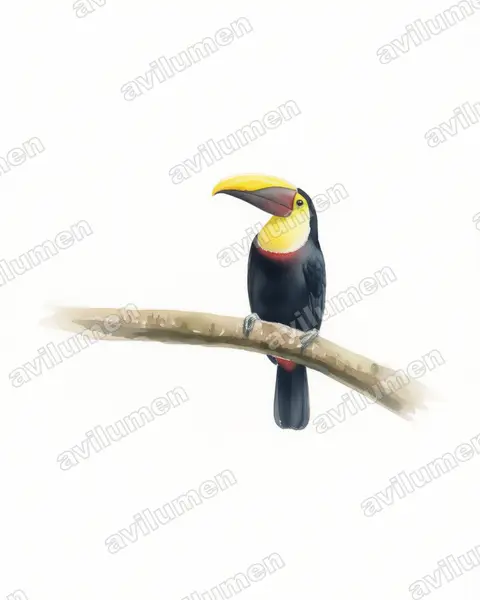
Watercolor 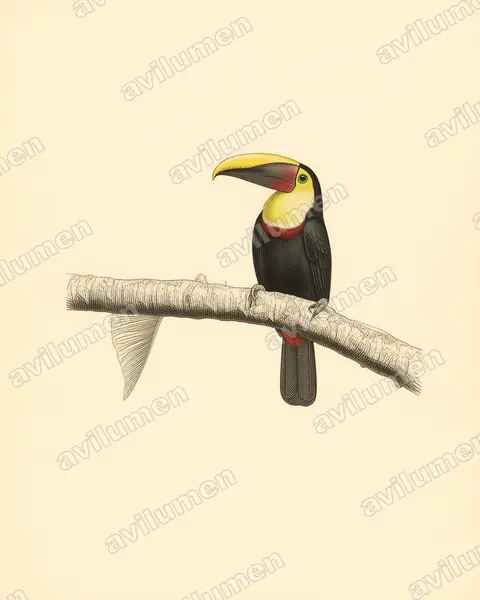
Vintage plate 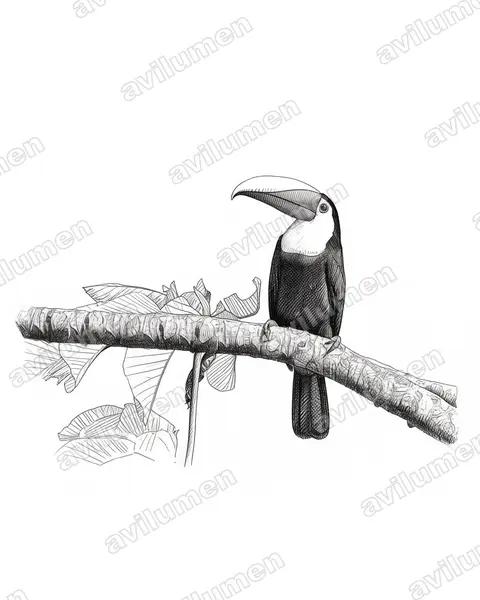
Ink 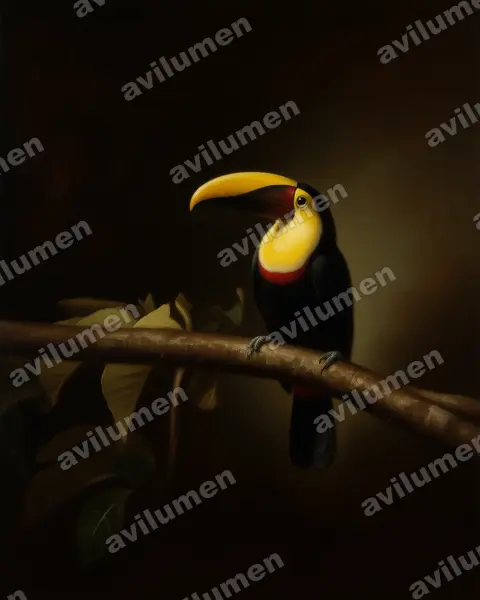
Oil 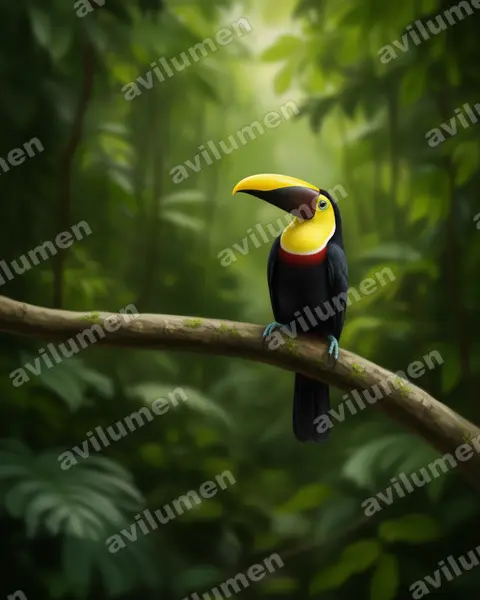
Realistic 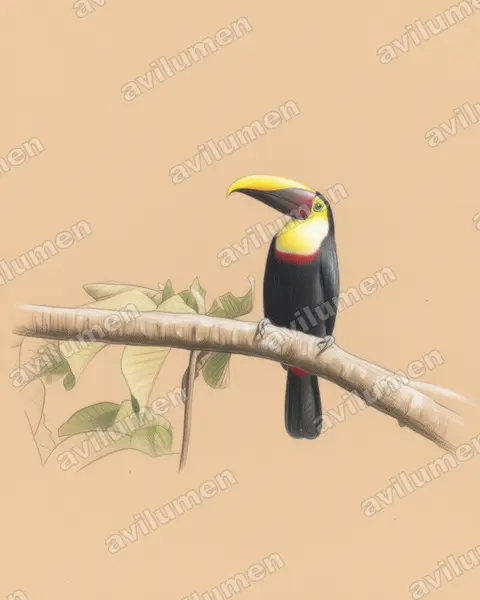
Colored pencil
Illustrations based on the photograph by Rhododendrites (CC BY-SA 4.0), from Wikimedia Commons.
Digital editions
HD Digital Art Pack — Yellow-throated Toucan
Digital download: 6 high-resolution illustrations of the Yellow-throated Toucan (Ramphastos ambiguus), print-ready. This is a digital file; no animal or physical item is included.
AI Avatar — Yellow-throated Toucan
Generate an avatar fusing your face with the Yellow-throated Toucan (Ramphastos ambiguus). Delivered digitally in 8K, watermark-free. Digital product; no animals are sold or brokered.
Instant download. No live birds are sold.
Frequently asked questions
- Is Ramphastos ambiguus (Yellow-throated Toucan) endangered?
- The IUCN Red List places Ramphastos ambiguus, commonly known as the Yellow-throated Toucan, in the «Near threatened» category. «Near threatened» means it is not threatened yet, but is close to becoming so.
- Where does Ramphastos ambiguus (Yellow-throated Toucan) live?
- Ramphastos ambiguus (Yellow-throated Toucan) is found in South America.
- What family does Ramphastos ambiguus (Yellow-throated Toucan) belong to?
- Ramphastos ambiguus (Yellow-throated Toucan) belongs to the family Ramphastidae, in the order Piciformes.
- What colour is Ramphastos ambiguus (Yellow-throated Toucan)?
- The plumage of Ramphastos ambiguus (Yellow-throated Toucan) combines these colours: Black and Yellow.
More from the same family
 Least concern
Hooded Mountain Toucan
Andigena cucullata
The hooded mountain toucan is a species of bird in the toucan family Ramphastidae. It is found in Bolivia and Peru.
from $1.99
 Near threatened
Grey-breasted Mountain Toucan
Andigena hypoglauca
The grey-breasted mountain toucan is a least-concern species of bird in the toucan family, Ramphastidae. It is found in South American countries such as Colombia, Ecuador and Peru.
from $1.99
 Near threatened
Plate-billed Mountain Toucan
Andigena laminirostris
The plate-billed mountain toucan is a species of bird in the family Ramphastidae. It is native to the west slope of Ecuador and extreme southern Colombia, where it lives in the high-altitude humid mountain forests of the Andes.
from $1.99
 Least concern
Black-billed Mountain Toucan
Andigena nigrirostris
The black-billed mountain toucan is a species of bird in the toucan family Ramphastidae. It is found in Colombia, Ecuador, Peru, and Venezuela.
from $1.99