Green-billed Toucan
Ramphastos dicolorus
Avilumen editorial team ·

The red-breasted toucan or green-billed toucan is a bird in the family Ramphastidae, the toucans, toucanets, and aracaris. It is found in Argentina, Brazil and Paraguay.
The red-breasted toucan or green-billed toucan (Ramphastos dicolorus) is a bird in the family Ramphastidae, the toucans, toucanets, and aracaris. It is found in Argentina, Brazil and Paraguay.
Taxonomy and systematics
The red-breasted toucan is sister to the channel-billed toucan (R. vitellinus) and Choco toucan (R. brevis). It is monotypic.
Description
The red-breasted toucan is 42 to 48 cm (17 to 19 in) long and weighs 265 to 400 g (9.3 to 14 oz); it is the smallest member of genus Ramphastos. The sexes are alike though the female's bill is shorter than the male's. Their bill is mostly green to green-yellow, with a vertical black line at its base, red and ivory tomial "teeth", and some green striations on the maxilla. Their crown, nape, upperparts, and tail are black but for red uppertail coverts. Their face is yellow with bare red, blue, and yellow-green skin around the eye. Their throat and breast are yellow with a red area within the lower breast. Their belly and undertail coverts are red and their flanks black.
Distribution and habitat
The red-breasted toucan is found from Tocantins, Minas Gerais, and Espírito Santo
in south-central, east-central, and southeastern Brazil south through eastern Paraguay, Bolivia and into northern Argentina's Formosa, Chaco, Corrientes, and Misiones provinces. It primarily inhabits subtropical and tropical, sub-montane and montane forest, but also scrublands, savanna with trees, and plantations. In elevation it mostly ranges between 100 and 1,500 m (300 and 4,900 ft); it occurs as high as 2,070 m (6,800 ft) but only rarely.
Movement
In the southern part of its range the red-breasted toucan moves to lower elevations in the austral winter. After breeding some move from natural forest into plantations.
Feeding
The red-breasted toucan feeds mostly on fruits, of both native and introduced plants as well as green coffee beans and fruit in orchards. To a lesser extent it also feeds on insects and small birds. It usually forages in pairs and small groups but 20 or more may gather at times. It usually forages in the forest canopy but will pick up fallen fruit from the ground.
Breeding
The red-breasted toucan breeds between October and February in the southern part of its range and from January to June in the north. Pairs are territorial. Males allopreen and courtship-feed females. The species nests in cavities in both living and dead trees, either those made by natural decay or excavated by woodpeckers, and will enlarge both the entrance hole and the cavity if needed. Typically the bottom of the cavity has a layer of ejested seeds. The few nests studied have ranged from 0.7 to 6.0 m (2 to 20 ft) above the ground. The clutch size is two to four eggs. Both adults incubate the eggs and both provision nestlings. The incubation period is about 16 to 19 days and fledging occurs 40 to 50 days after hatch.
Vocal and non-vocal sounds
The red-breasted toucan is one of the "croaker" group of toucans. Its song is a "loud, raucous 'WRèh' or 'niuh'." Other vocalizations are a "long series of noisy honking 'grrekk' notes" and "low 'ek', 'zneep', [and] growl-like begging". It also claps its bill and rattles its tongue in the bill.
Status
The IUCN originally assessed the red-breasted toucan as Near Threatened but since 2004 has rated it as being of Least Concern. It has a very large range, but its population size is not known and is believed to be decreasing. No immediate threats have been identified. It is thought to be "reasonably common in general." It occurs in several protected areas but outside them is sometimes hunted or persecuted for taking orchard fruit.
Text adapted from Wikipedia · CC BY-SA 4.0
Where it lives
Distribution

Taxonomy
- Order
- Piciformes
- Family
- Ramphastidae
- Genus
- Ramphastos
- Conservation status
- Least concern
Listen to its call
No recording yet
Care guide
Toucan and Aracari Care Guide: Diet and Housing
How to care for toucans and aracaris: low-iron diet, iron storage disease (hemochromatosis), aviary setup, health, behavior and CITES legal status.
Read the guide →Illustration gallery
6 illustrations of Ramphastos dicolorus (Green-billed Toucan) in different styles, true to its real plumage. Shown watermarked; the art pack includes the high-resolution originals, ready to print.
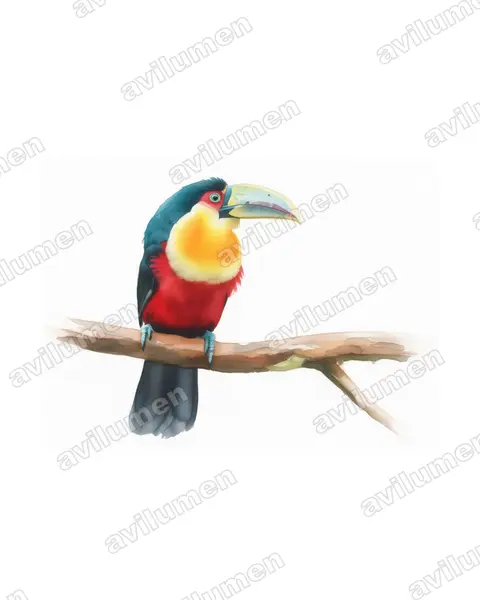
Watercolor 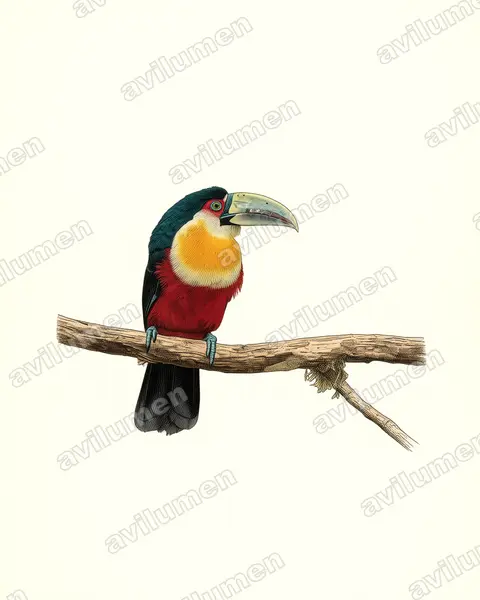
Vintage plate 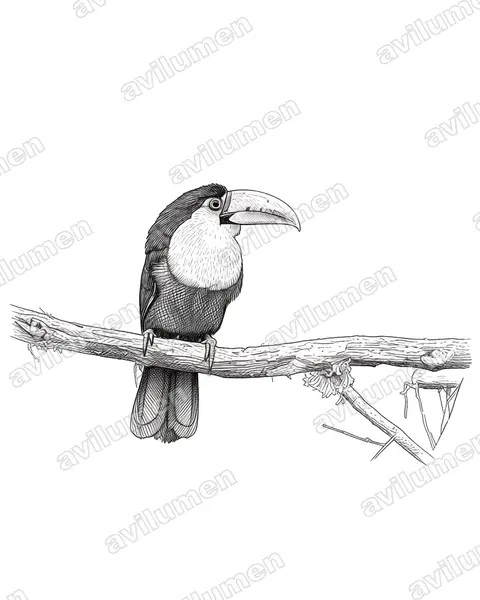
Ink 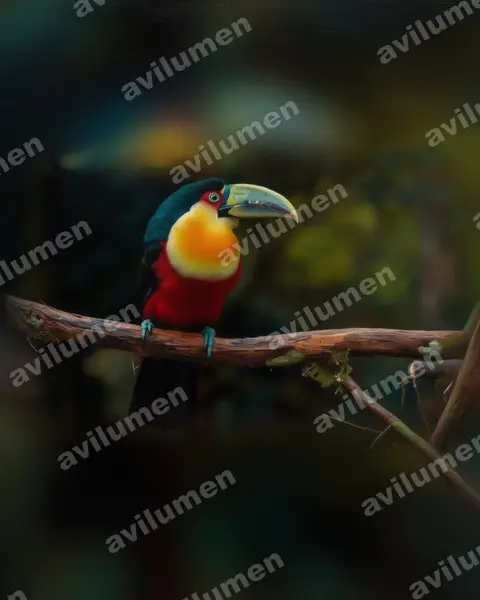
Oil 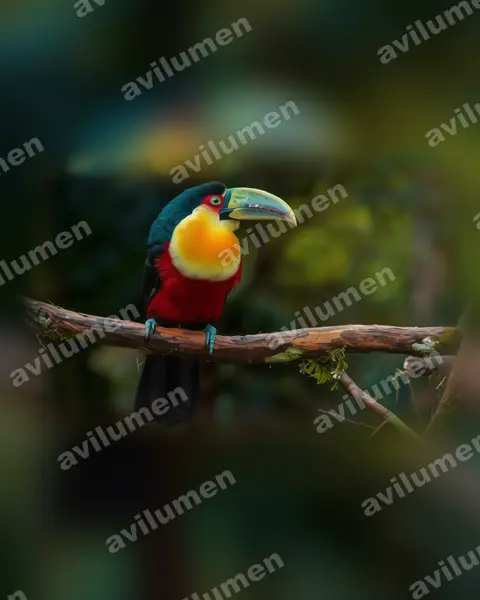
Realistic 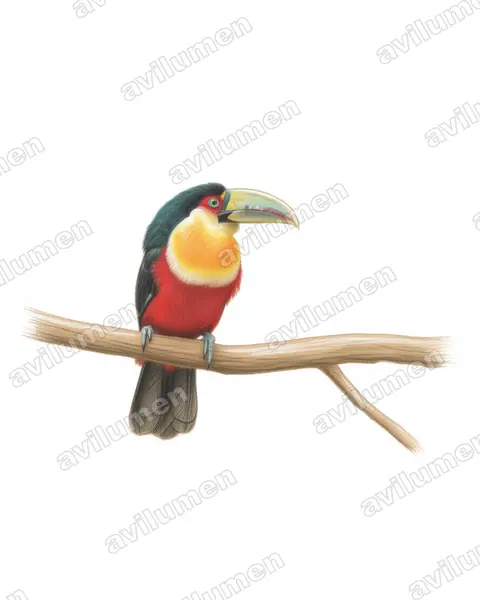
Colored pencil
Illustrations based on the photograph by Jairmoreirafotografia (CC BY-SA 4.0), from Wikimedia Commons.
Digital editions
HD Digital Art Pack — Green-billed Toucan
Digital download: 6 high-resolution illustrations of the Green-billed Toucan (Ramphastos dicolorus), print-ready. This is a digital file; no animal or physical item is included.
AI Avatar — Green-billed Toucan
Generate an avatar fusing your face with the Green-billed Toucan (Ramphastos dicolorus). Delivered digitally in 8K, watermark-free. Digital product; no animals are sold or brokered.
Instant download. No live birds are sold.
Frequently asked questions
- Is Ramphastos dicolorus (Green-billed Toucan) endangered?
- The IUCN Red List places Ramphastos dicolorus, commonly known as the Green-billed Toucan, in the «Least concern» category. «Least concern» means it is not currently threatened.
- Where does Ramphastos dicolorus (Green-billed Toucan) live?
- Ramphastos dicolorus (Green-billed Toucan) is found in Brazil and South America.
- What family does Ramphastos dicolorus (Green-billed Toucan) belong to?
- Ramphastos dicolorus (Green-billed Toucan) belongs to the family Ramphastidae, in the order Piciformes.
- What colour is Ramphastos dicolorus (Green-billed Toucan)?
- The plumage of Ramphastos dicolorus (Green-billed Toucan) combines these colours: Black and Yellow.
More from the same family
 Least concern
Hooded Mountain Toucan
Andigena cucullata
The hooded mountain toucan is a species of bird in the toucan family Ramphastidae. It is found in Bolivia and Peru.
from $1.99
 Near threatened
Grey-breasted Mountain Toucan
Andigena hypoglauca
The grey-breasted mountain toucan is a least-concern species of bird in the toucan family, Ramphastidae. It is found in South American countries such as Colombia, Ecuador and Peru.
from $1.99
 Near threatened
Plate-billed Mountain Toucan
Andigena laminirostris
The plate-billed mountain toucan is a species of bird in the family Ramphastidae. It is native to the west slope of Ecuador and extreme southern Colombia, where it lives in the high-altitude humid mountain forests of the Andes.
from $1.99
 Least concern
Black-billed Mountain Toucan
Andigena nigrirostris
The black-billed mountain toucan is a species of bird in the toucan family Ramphastidae. It is found in Colombia, Ecuador, Peru, and Venezuela.
from $1.99