Volcano hummingbird
Selasphorus flammula
Avilumen editorial team ·

The volcano hummingbird is a species of hummingbird in tribe Mellisugini of subfamily Trochilinae, the "bee hummingbirds". It is found in Costa Rica and Panama. This hummingbird is the one that appears on the 20 thousand colones bill from Costa Rica.
The volcano hummingbird (Selasphorus flammula) is a species of hummingbird in tribe Mellisugini of subfamily Trochilinae, the "bee hummingbirds". It is found in Costa Rica and Panama. This hummingbird is the one that appears on the 20 thousand colones bill from Costa Rica.
Taxonomy and systematics
The volcano hummingbird has three subspecies, the nominate S. f. flammula, S. f. torridus, and S. f. simoni. All three have at times been treated as color morphs rather than subspecies and at other times as individual species.
Description
The volcano hummingbird is 7.5 to 8 cm (3.0 to 3.1 in) long. Males weigh about 2.5 g (0.088 oz) and females 2.8 g (0.099 oz). Both sexes of all subspecies have a short, straight, black bill and a small white spot behind the eye. The adult male of the nominate subspecies has bronze-green upperparts and rufous-edged black outer tail feathers. Its gorget is mauve-purple and the rest of the underparts mostly white. The sides of the breast have a buffy to pale cinnamon wash and green speckles. The adult female is also bronze-green above. Its central tail feathers are green and the rest have rufous bases, a black band near the end, and buffy to white tips. The throat is whitish with dusky bronze speckles and the rest of the underparts are like the male's. Juveniles are similar to the adult female but have buffy fringes on the upperparts' feathers.
Both sexes of subspecies S. f. torridus are whiter below than the nominate, and males have a purplish-gray gorget. Both sexes of S. f. simoni are buffier below than the nominate and have more black on the tail. The male's gorget is rose red.
Distribution and habitat
The nominate subspecies of volcano hummingbird is found on Volcanoes Irazú and Turrialba in central Costa Rica. Subspecies S. f. torridus is found on the Cordillera de Talamanca of southern Costa Rica and on Volcán Barú in extreme western Panama. S. f. simoni is found on Volcanes Poás and Barva (or Barba) in central Costa Rica.
The species inhabits a variety of semi-open to open habitats on high mountain slopes. Examples include páramo, second growth on landslide scars or ashfall areas, scrubby pastures, and the edges of elfin forest and taller forest. It is found mostly between elevations of 2,000 and 3,500 m (6,600 and 11,500 ft) but occurs locally down to 1,800 m (5,900 ft) and seasonally as low as 1,350 m (4,400 ft).
Movement
The volcano hummingbird breeds at the higher elevations of its range, and after breeding some descend much lower and may even move to an adjacent mountain. The latter allows some mixing of the subspecies.
Feeding
The volcano hummingbird forages for nectar at a wide variety of flowers, mostly small ones on shrubs, vines, herbs, and small trees. It also feeds from larger flowers that bees or flowerpiercers (Diglossa) have made holes in. Males commonly defend clusters of flowers and females do so less frequently. In addition to nectar the species feeds on small arthropods taken on the wing or, for the female especially, by gleaning from foliage or picking from spider webs.
Breeding
The volcano hummingbird's breeding season spans from August or September to February. The male defends small territories that are independent of nectar resources though flowers are usually nearby, and makes dive displays directed at females. The female makes a cup nest of plant down and spider web covered with moss and lichens. It is placed at the outermost end of a twig, usually between 1 and 5 m (3 and 20 ft) above the ground. Nests are sometimes also attached to a rootly drooping from a projecting earth bank such as by a road. The incubation period and time to fledging are not known.
Vocal and non-vocal sounds
The volcano hummingbird makes "soft chip notes" while foraging. Males make "a thin whistled 'teeeeeuu'" whose purpose is not noted and "a twittering 'scolding'" call during agonistic encounters with other males. During the dive display the male's tail feathers make a series of broad-frequency pulses.
Status
The IUCN has assessed the volcano hummingbird as being of Least Concern. It has a fairly large range and an apparently stable population between 20,000 and 50,000 mature individuals. All three subspecies occur in protected areas, and outside them they might benefit from human activity as they are more abundant in open areas than forest.
Text adapted from Wikipedia · CC BY-SA 4.0
Distribution

Taxonomy
- Order
- Apodiformes
- Family
- Trochilidae
- Genus
- Selasphorus
- Conservation status
- Least concern
Listen to its call
No recording yet
Illustration gallery
6 illustrations of Selasphorus flammula (Volcano hummingbird) in different styles, true to its real plumage. Shown watermarked; the art pack includes the high-resolution originals, ready to print.
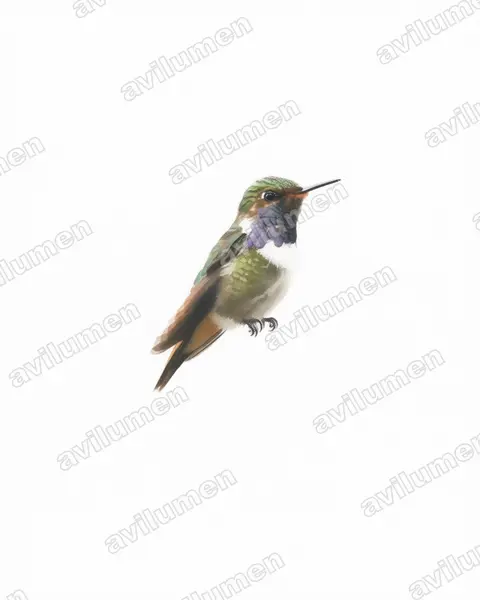
Watercolor 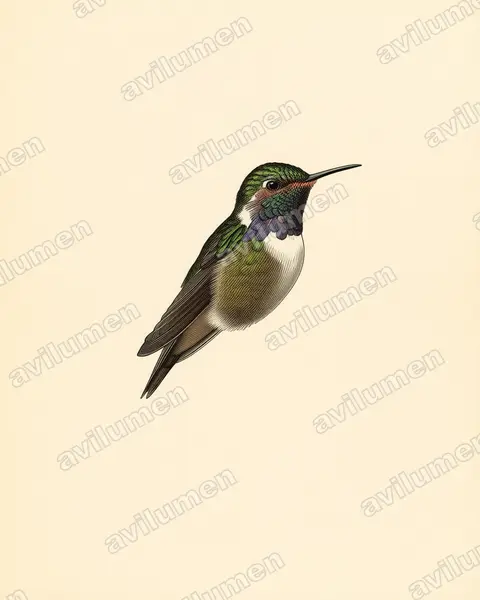
Vintage plate 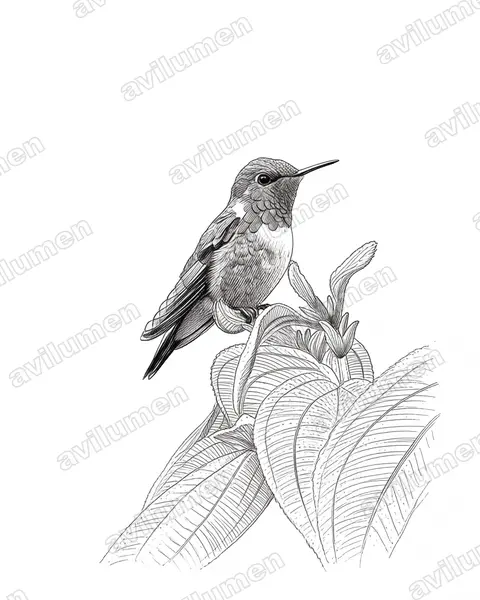
Ink 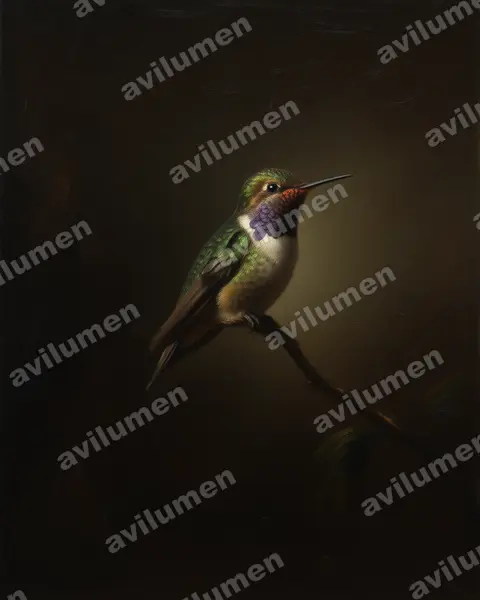
Oil 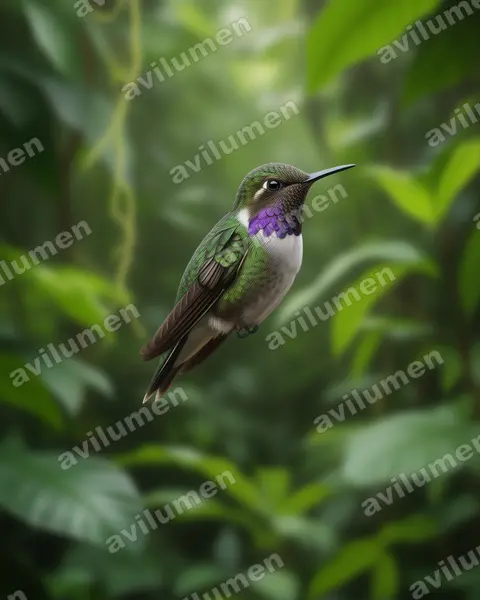
Realistic 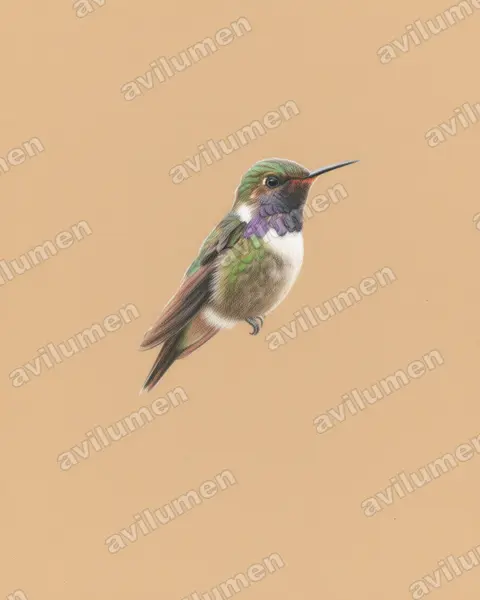
Colored pencil
Illustrations based on the photograph by Jerry Oldenettel from Socorro, NM, USA (CC BY-SA 2.0), from Wikimedia Commons.
Digital editions
HD Digital Art Pack — Volcano hummingbird
Digital download: 6 high-resolution illustrations of the Volcano hummingbird (Selasphorus flammula), print-ready. This is a digital file; no animal or physical item is included.
AI Avatar — Volcano hummingbird
Generate an avatar fusing your face with the Volcano hummingbird (Selasphorus flammula). Delivered digitally in 8K, watermark-free. Digital product; no animals are sold or brokered.
Instant download. No live birds are sold.
Frequently asked questions
- Is Selasphorus flammula (Volcano hummingbird) endangered?
- The IUCN Red List places Selasphorus flammula, commonly known as the Volcano hummingbird, in the «Least concern» category. «Least concern» means it is not currently threatened.
- What family does Selasphorus flammula (Volcano hummingbird) belong to?
- Selasphorus flammula (Volcano hummingbird) belongs to the family Trochilidae, in the order Apodiformes.
- What colour is Selasphorus flammula (Volcano hummingbird)?
- The plumage of Selasphorus flammula (Volcano hummingbird) combines these colours: Green and Orange.
More from the same family
 Least concern
Emerald-chinned Hummingbird
Abeillia abeillei
The emerald-chinned hummingbird is a species of hummingbird in the "emeralds", tribe Trochilini of subfamily Trochilinae.
from $1.99
 Least concern
Speckled hummingbird
Adelomyia melanogenys
The speckled hummingbird is a species of hummingbird. It is the only member of the genus Adelomyia. It inhabits Neotropical montane cloud forests at elevations of 1,000–2,500 meters and is confined to the Andes of Argentina, Bolivia, Peru, Ecuador, Colombia and Venezuela; as well as to some isolated montane forests in western Ecuador and Venezuela.
from $1.99
 Vulnerable
Purple-backed sunbeam
Aglaeactis aliciae
The purple-backed sunbeam is a bird species in the family Trochilidae. It is found only in Peru.
from $1.99
 Near threatened
White-tufted sunbeam
Aglaeactis castelnaudii
The white-tufted sunbeam is a species of hummingbird in the family Trochilidae. It is found only in Peru. Its natural habitats are subtropical or tropical moist montane forest and subtropical or tropical high-altitude shrubland.
from $1.99