Green-crowned plovercrest
Stephanoxis lalandi
Avilumen editorial team ·

The green-crowned plovercrest, also black-breasted plovercrest or simply plovercrest, is a species of hummingbird in the "emeralds", tribe Trochilini of subfamily Trochilinae. It is endemic to Brazil.
The green-crowned plovercrest, also black-breasted plovercrest or simply plovercrest, (Stephanoxis lalandi) is a species of hummingbird in the "emeralds", tribe Trochilini of subfamily Trochilinae. It is endemic to Brazil.
Taxonomy and systematics
The green-crowned plovercrest and purple-crowned plovercrest (Stephanoxis loddigesii) were originally treated as separate species but in the mid-1900s were combined under the name "plovercrest" with the binomial S. lalandi. A study published in 2014 provided evidence that the original two-species treatment was correct. Taxonomists worldwide agreed and the two taxa were restored to species status. They are the only members of the genus and are monotypic.
Description
The green-crowned plovercrest is 8.5 to 9 cm (3.3 to 3.5 in) long. Males weigh 3 to 3.4 g (0.11 to 0.12 oz) and females about 2.2 g (0.078 oz). Both sexes have a short, straight, black bill. Adult males have a shaggy, mostly iridescent green, crest whose longest feather is purplish black. Their face is gray with a white spot behind the eye. Their upperparts are shining bronze-green. Their chin to upper belly is violet-blue and the rest of the underparts are gray. Their central tail feathers are green and the rest green with a blackish band near the end and grayish white tips. Adult females and juveniles have a smaller crest. Their upperparts are shining green and their underparts gray.
Distribution and habitat
The green-crowned plovercrest is found in the eastern Brazilian states of Minas Gerais, Espírito Santo, São Paulo, and Rio de Janeiro. It inhabits the understory of forest, scrublands, and vegetation along watercourses. In elevation it mostly ranges between sea level and about 1,500 m (4,900 ft) but has been found as high as 2,900 m (9,500 ft).
Movement
The green-crowned plovercrest is mostly sedentary, though it might make some seasonal movements.
Feeding
The green-crowned plovercrest forages for nectar from near the ground to the canopy, utilizing both native and introduced flowering species. Males defend feeding territories during the breeding season. In addition to nectar, the species feeds on insects caught in flight or gleaned from leaves.
Breeding
The green-crowned plovercrest's breeding season spans from October to March. Males usually gather at leks to court females, but single birds also display. Females make a cup nest of soft plant and seed fibers bound with spiderweb. It is typically placed on a forked branch in vegetation at about 1 to 3 m (3 to 10 ft) above the ground. Females incubate the clutch of two eggs for 14 to 16 days and fledging occurs 24 to 28 days after hatch.
Vocalization
The male green-crowned plovercrest's song is "a long series of a repeated modulated note, 'tsi-ling...tsi-ling...tsi-ling...'", which typically starts with "a high-pitched 'tsee'."
Status
The IUCN has assessed the green-crowned plovercrest as being of Least Concern, though its population size and trend are unknown. No immediate threats have been identified. It is considered patchily distributed and locally common. It occurs in three national parks and " [r]eadily takes to man-made habitats such as farmland" as long as patches of scrub or forest remain.
Text adapted from Wikipedia · CC BY-SA 4.0
Where it lives
Plumage colours
Distribution

Taxonomy
- Order
- Apodiformes
- Family
- Trochilidae
- Genus
- Stephanoxis
- Conservation status
- Least concern
Listen to its call
No recording yet
Illustration gallery
6 illustrations of Stephanoxis lalandi (Green-crowned plovercrest) in different styles, true to its real plumage. Shown watermarked; the art pack includes the high-resolution originals, ready to print.
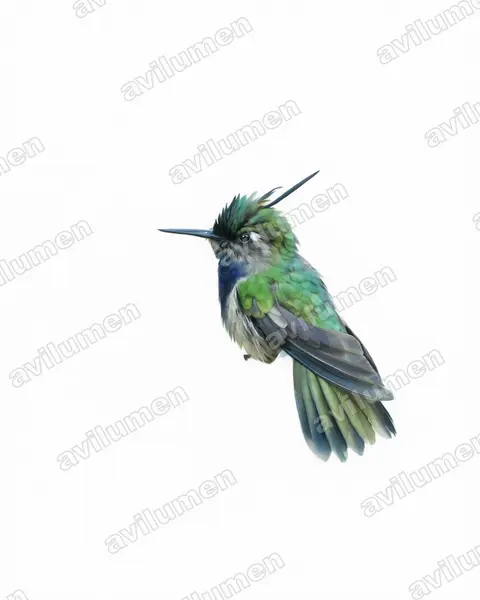
Watercolor 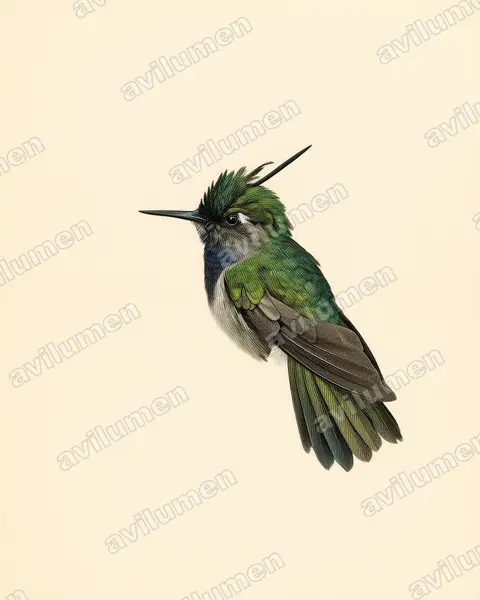
Vintage plate 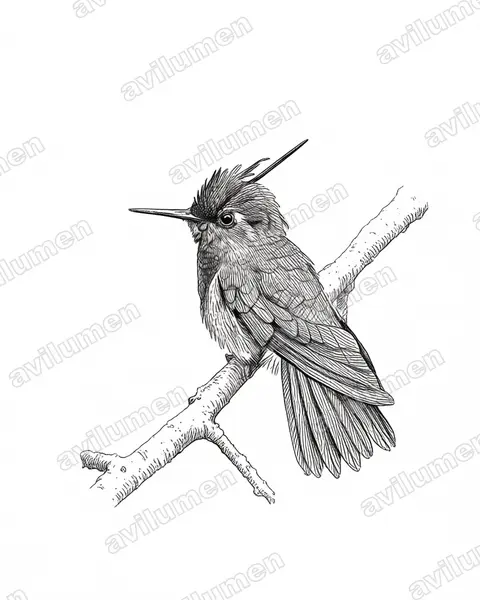
Ink 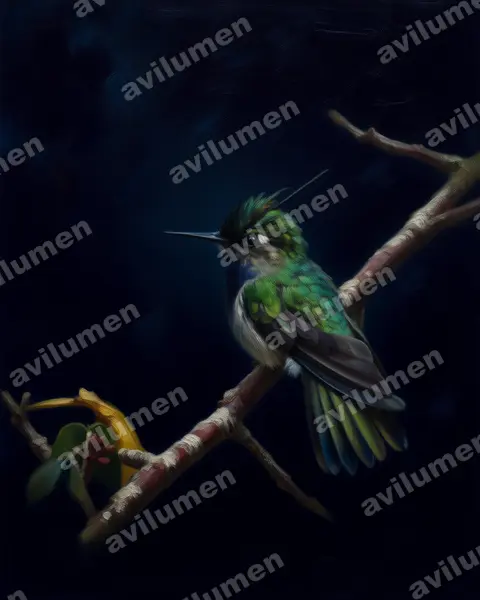
Oil 
Realistic 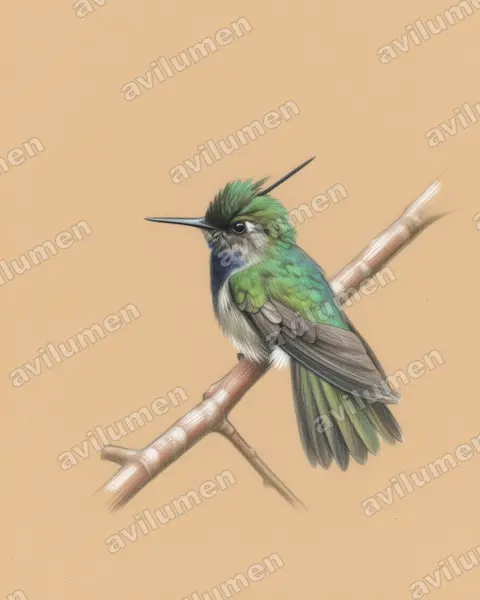
Colored pencil
Illustrations based on the photograph by Dario Sanches from São Paulo, Brazil (CC BY-SA 2.0), from Wikimedia Commons.
Digital editions
HD Digital Art Pack — Green-crowned plovercrest
Digital download: 6 high-resolution illustrations of the Green-crowned plovercrest (Stephanoxis lalandi), print-ready. This is a digital file; no animal or physical item is included.
AI Avatar — Green-crowned plovercrest
Generate an avatar fusing your face with the Green-crowned plovercrest (Stephanoxis lalandi). Delivered digitally in 8K, watermark-free. Digital product; no animals are sold or brokered.
Instant download. No live birds are sold.
Frequently asked questions
- Is Stephanoxis lalandi (Green-crowned plovercrest) endangered?
- The IUCN Red List places Stephanoxis lalandi, commonly known as the Green-crowned plovercrest, in the «Least concern» category. «Least concern» means it is not currently threatened.
- Where does Stephanoxis lalandi (Green-crowned plovercrest) live?
- Stephanoxis lalandi (Green-crowned plovercrest) is found in Brazil and South America.
- What family does Stephanoxis lalandi (Green-crowned plovercrest) belong to?
- Stephanoxis lalandi (Green-crowned plovercrest) belongs to the family Trochilidae, in the order Apodiformes.
- What colour is Stephanoxis lalandi (Green-crowned plovercrest)?
- The plumage of Stephanoxis lalandi (Green-crowned plovercrest) combines these colours: Green.
More from the same family
 Least concern
Emerald-chinned Hummingbird
Abeillia abeillei
The emerald-chinned hummingbird is a species of hummingbird in the "emeralds", tribe Trochilini of subfamily Trochilinae.
from $1.99
 Least concern
Speckled hummingbird
Adelomyia melanogenys
The speckled hummingbird is a species of hummingbird. It is the only member of the genus Adelomyia. It inhabits Neotropical montane cloud forests at elevations of 1,000–2,500 meters and is confined to the Andes of Argentina, Bolivia, Peru, Ecuador, Colombia and Venezuela; as well as to some isolated montane forests in western Ecuador and Venezuela.
from $1.99
 Vulnerable
Purple-backed sunbeam
Aglaeactis aliciae
The purple-backed sunbeam is a bird species in the family Trochilidae. It is found only in Peru.
from $1.99
 Near threatened
White-tufted sunbeam
Aglaeactis castelnaudii
The white-tufted sunbeam is a species of hummingbird in the family Trochilidae. It is found only in Peru. Its natural habitats are subtropical or tropical moist montane forest and subtropical or tropical high-altitude shrubland.
from $1.99