Mexican woodnymph
Thalurania ridgwayi
Avilumen editorial team ·

The Mexican woodnymph is a species of hummingbird in the family Trochilidae endemic to western Mexico. It lives in subtropical or tropical moist lowland/foothill forest and plantations, feeding on flower nectar and insects. Mexican woodnymphs are vulnerable, threatened by habitat loss through deforestation.
The Mexican woodnymph (Eupherusa ridgwayi) is a species of hummingbird in the family Trochilidae endemic to western Mexico. It lives in subtropical or tropical moist lowland/foothill forest and plantations, feeding on flower nectar and insects. Mexican woodnymphs are vulnerable, threatened by habitat loss through deforestation.
Taxonomy
The Mexican woodnymph was formerly placed in the genus Thalurania that contains other species with "woodnymph" in their English names. A molecular phylogenetic study published in 2014 found that Thalurania was non-monophyletic and that the Mexican woodnymph is closely related to species in the genus Eupherusa. Based on this result the Mexican woodnymph is now placed in Eupherusa. The Mexican woodnymph is monotypic: there are no recognised subspecies.
Description
Mexican woodnymphs are small birds, generally 9–10 centimetres (3.5–3.9 in) long. Females weigh around 3.5 grams (0.12 oz) and males weigh from 3.5 to 4.2 grams (0.12 to 0.15 oz). Males have a straight black bill, mostly green body, a dull green chest, a blue-black forked tail, and an indigo crown. Females are similar, mostly green with darker green tail and wings, a light gray chest. They lack the characteristic indigo crown, instead have a white spot behind their eyes and green disks on the sides of their chest.
One known vocalization consists of an irregular series of 2–4 quick notes. Their call has been described as a "liquid rattle".
Distribution and habitat
Mexican woodnymphs live exclusively in the northern mountains of western Mexico, with habitat in the states of Nayarit, Jalisco and Colima. They are not migratory and spend the whole year in their small range. They are the northernmost species of their genus.
Although there is little known of the specific habitat requirements for Mexican woodnymphs, we are aware that they reside in humid forests, canyons and foothills at elevations of 250–1,200 metres (820–3,940 ft). They can be found at the forest and open woodland, and may inhabit some coffee plantations.
Breeding
Mexican woodnymphs breed in February and March. They are sexually dimorphic, and it is believed that male hummingbirds are sexually selected for based on their feather arrangement and coloring, resulting in a wide range of colors and looks.
Food and feeding
Mexican woodnymphs are nectivorous and insectivorous. They feed primarily on flower nectar from a variety of flowering plants, including: Rubiaceae, Zingiberaceae and epiphytes. They also eat arthropods by catching them in the air or eating them off vegetation.
Conservation status
Mexican woodnymphs are listed as vulnerable due to habitat loss. As evident from their restricted range, they are dependent on the forest health of western Mexico, where deforestation is threatening the habitat. Unfortunately, since there is little information on their habitat needs and natural history, there is insufficient data on how to protect this species.
Text adapted from Wikipedia · CC BY-SA 4.0
Distribution

Taxonomy
- Order
- Apodiformes
- Family
- Trochilidae
- Genus
- Thalurania
- Conservation status
- Vulnerable
Listen to its call
No recording yet
Illustration gallery
6 illustrations of Thalurania ridgwayi (Mexican woodnymph) in different styles, true to its real plumage. Shown watermarked; the art pack includes the high-resolution originals, ready to print.
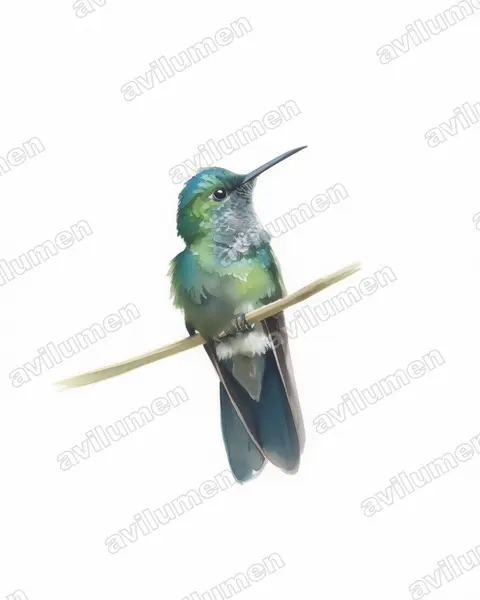
Watercolor 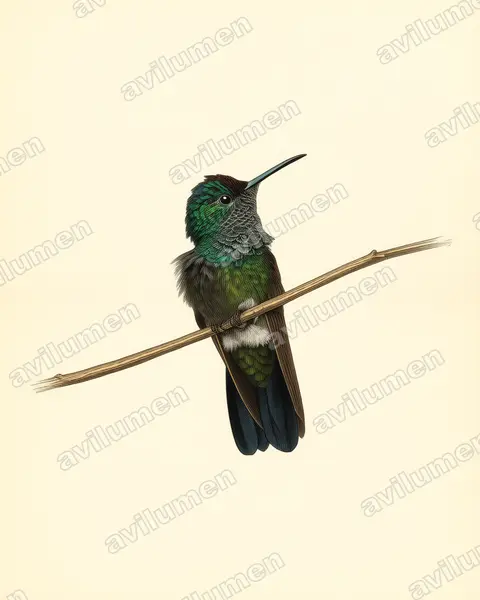
Vintage plate 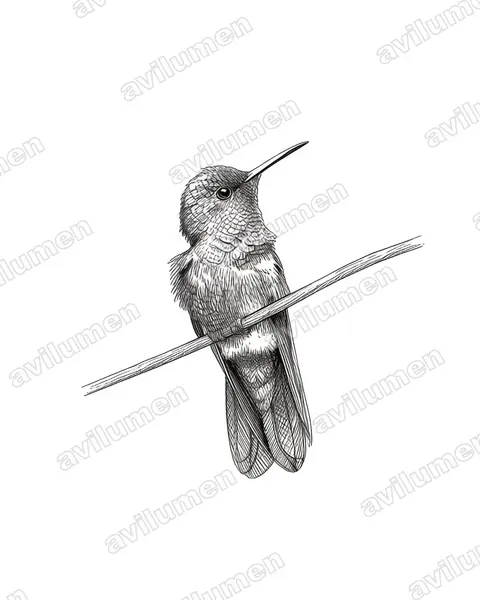
Ink 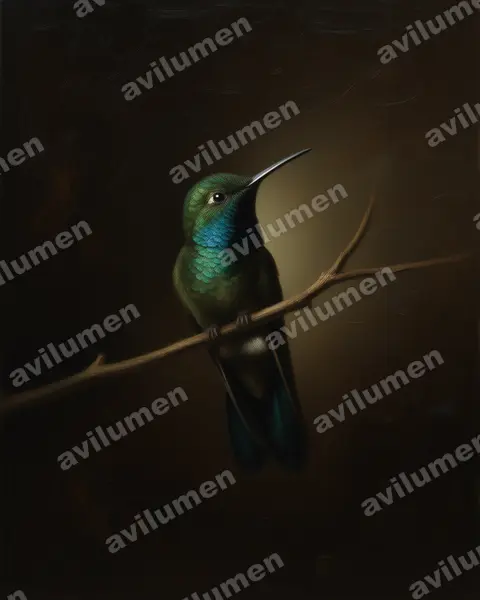
Oil 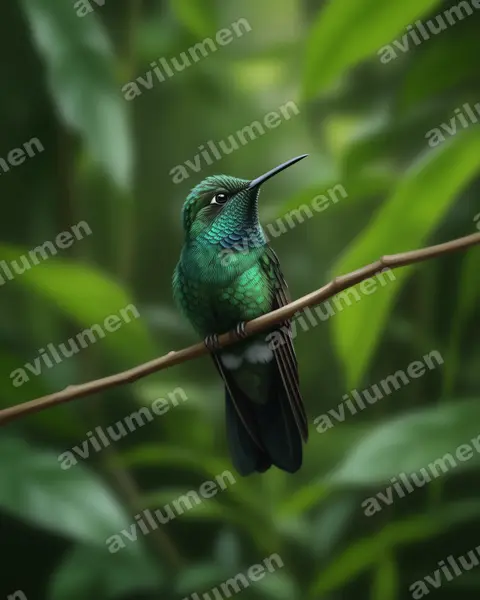
Realistic 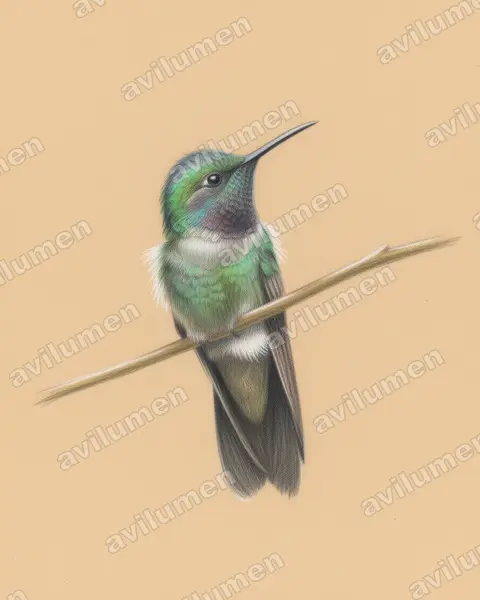
Colored pencil
Illustrations based on the photograph by Moore Laboratory (CC BY 2.0), from Wikimedia Commons.
Digital editions
HD Digital Art Pack — Mexican woodnymph
Digital download: 6 high-resolution illustrations of the Mexican woodnymph (Thalurania ridgwayi), print-ready. This is a digital file; no animal or physical item is included.
AI Avatar — Mexican woodnymph
Generate an avatar fusing your face with the Mexican woodnymph (Thalurania ridgwayi). Delivered digitally in 8K, watermark-free. Digital product; no animals are sold or brokered.
Instant download. No live birds are sold.
Frequently asked questions
- Is Thalurania ridgwayi (Mexican woodnymph) endangered?
- The IUCN Red List places Thalurania ridgwayi, commonly known as the Mexican woodnymph, in the «Vulnerable» category. «Vulnerable» means it faces a high risk of extinction in the medium term.
- What family does Thalurania ridgwayi (Mexican woodnymph) belong to?
- Thalurania ridgwayi (Mexican woodnymph) belongs to the family Trochilidae, in the order Apodiformes.
- What colour is Thalurania ridgwayi (Mexican woodnymph)?
- The plumage of Thalurania ridgwayi (Mexican woodnymph) combines these colours: Green and Blue.
More from the same family
 Least concern
Emerald-chinned Hummingbird
Abeillia abeillei
The emerald-chinned hummingbird is a species of hummingbird in the "emeralds", tribe Trochilini of subfamily Trochilinae.
from $1.99
 Least concern
Speckled hummingbird
Adelomyia melanogenys
The speckled hummingbird is a species of hummingbird. It is the only member of the genus Adelomyia. It inhabits Neotropical montane cloud forests at elevations of 1,000–2,500 meters and is confined to the Andes of Argentina, Bolivia, Peru, Ecuador, Colombia and Venezuela; as well as to some isolated montane forests in western Ecuador and Venezuela.
from $1.99
 Vulnerable
Purple-backed sunbeam
Aglaeactis aliciae
The purple-backed sunbeam is a bird species in the family Trochilidae. It is found only in Peru.
from $1.99
 Near threatened
White-tufted sunbeam
Aglaeactis castelnaudii
The white-tufted sunbeam is a species of hummingbird in the family Trochilidae. It is found only in Peru. Its natural habitats are subtropical or tropical moist montane forest and subtropical or tropical high-altitude shrubland.
from $1.99