Long-tailed woodnymph
Thalurania watertonii
Avilumen editorial team ·

The long-tailed woodnymph is a species of hummingbird in the family Trochilidae. It is found in humid forest in northeastern Brazil, where it is known from the states of Pernambuco, Alagoas, Sergipe and the northernmost Bahia. It is usually thought to be widespread, but seen at low density in its increasingly fragmented range.
The long-tailed woodnymph (Thalurania watertonii) is a species of hummingbird in the family Trochilidae. It is found in humid forest in northeastern Brazil, where it is known from the states of Pernambuco, Alagoas, Sergipe and the northernmost Bahia. It is usually thought to be widespread, but seen at low density in its increasingly fragmented range. Its population is estimated to be around 1,000–2,500 individuals, currently in decline due to deforestation and habitat loss.
Description
The long-tailed woodnymph is sexually dimorphic. The males are heavier, with significantly larger wings and tails, whereas the females have longer bills. Males are approximately 11.8–13 centimetres (4.6–5.1 in) long, including a tail of 6 centimetres (2.4 in) cm; while females measure roughly 10–11 centimetres (3.9–4.3 in) in length, with a tail of 3.6 centimetres (1.4 in). Individuals have a weight of 3.7–5.2 g.
Males have a conspicuous iridescent plumage in blue, green and purple. The crown and neck are bronze-green, back is iridescent violet-blue, shining grass-green undersides and violet-blue flanks; Its long, deeply-forked tail is blue. Female plumage is much more faint, allowing them to stay unnoticeable as they build nests and care for their young, and a shorter, slightly forked white-tipped tail with a blue subterminal band and a pair of blue-green rectrices. Juveniles are similar to adult females.
Distribution and habitat
This species is restricted to the Brazilian states of Pernambuco, Alagoas, Sergipe and apparently to northern Bahia, though there are no recent records. The species is thought to be found only in the Atlantic Forest. Reports from eastern Pará are possibly inaccurate, and there is one specimen which was attributed to Guyana, although its true origin is unknown.
The long-tailed woodnymph inhabits coastal lowland habitats such as coastal rainforest, cerrado, plantations and parks throughout its Atlantic forest range, from sea-level to 550 metres (1,800 ft). It forages at low to medium heights, generally at the periphery of vegetation.
Ecology and behavior
The long-tailed woodnymph feeds on the nectar of flowering vines, cacti, epiphytes, trees and bushes, occasionally foraging on invertebrates captured in the air. Male establishes feeding territories, which are aggressively defended against intraspecific and interspecific intruders.
Breeding takes place between November and February. The woodnymph builds a cup-shaped nest made of fine rootlets and moss, tightly tied together by a spider's web. The nest is attached to a horizontal branch in a shrub or small tree, usually protected by overhanging leaves, 1.5–2.5 metres (4.9–8.2 ft) above the ground. The female typically lays two eggs, with an incubation period of 14–15 days, often carried by the female.
Conservation status
Thalurania watertonii is listed as endangered by the IUCN Red List, due to the ongoing reduction of its populations, mainly due to the extensive and continuing loss of habitat and the depletion of lowland forests in north-eastern Brazil. Its occupation area is currently less than 500 km2. The population is severely fragmented, with the total population estimated to be less than 2,500 individuals, and each subpopulation contains less than 250 of them.
Text adapted from Wikipedia · CC BY-SA 4.0
Where it lives
Distribution

Taxonomy
- Order
- Apodiformes
- Family
- Trochilidae
- Genus
- Thalurania
- Conservation status
- Endangered
Listen to its call
No recording yet
Illustration gallery
6 illustrations of Thalurania watertonii (Long-tailed woodnymph) in different styles, true to its real plumage. Shown watermarked; the art pack includes the high-resolution originals, ready to print.
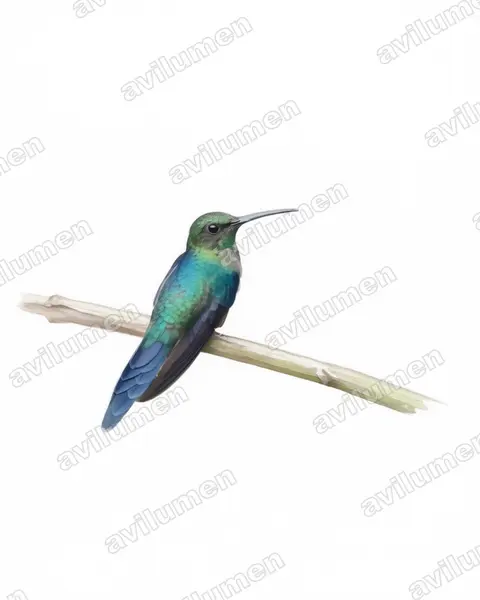
Watercolor 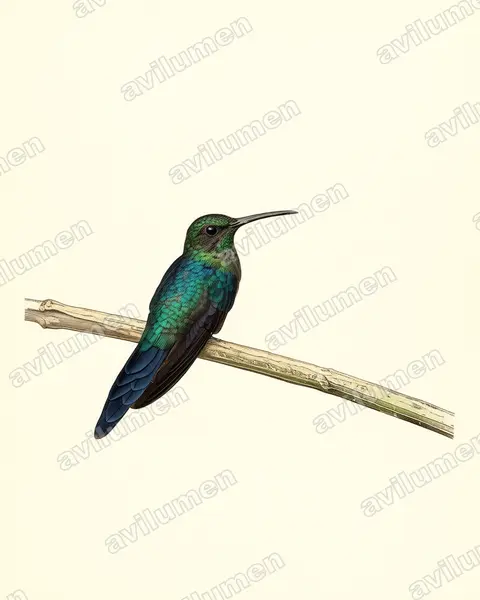
Vintage plate 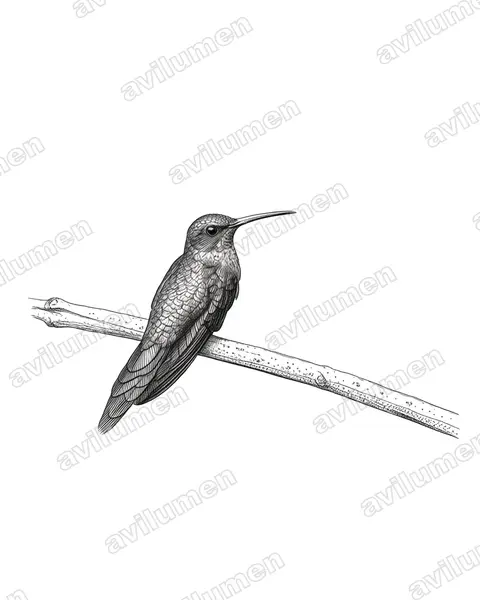
Ink 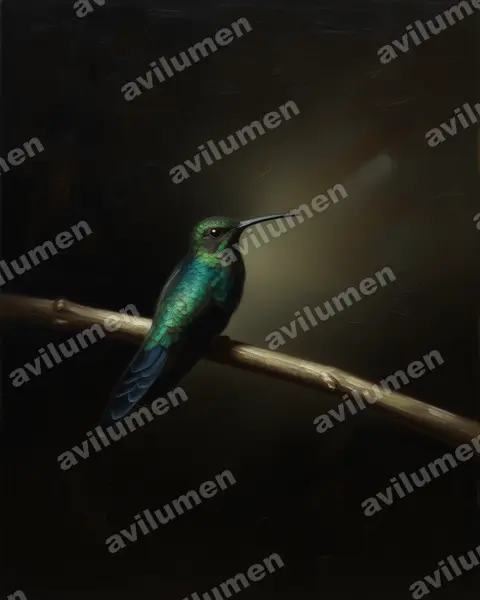
Oil 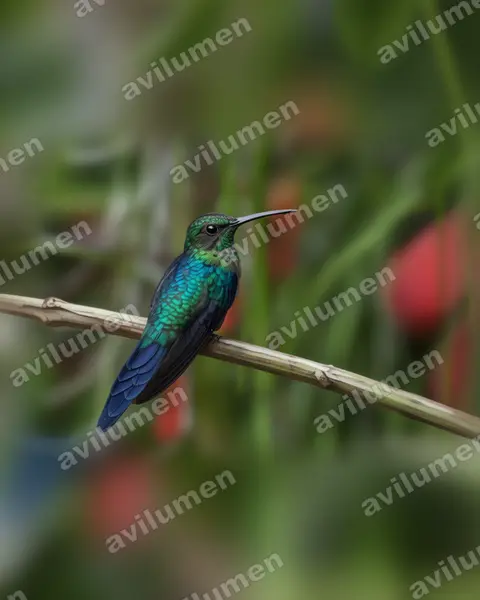
Realistic 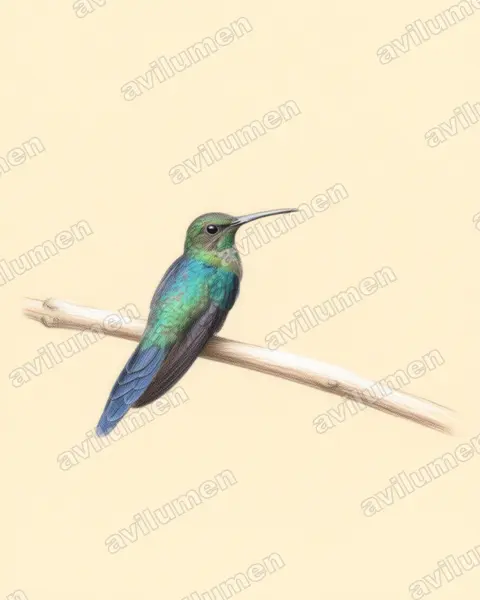
Colored pencil
Illustrations based on the photograph by Hector Bottai (CC BY-SA 4.0), from Wikimedia Commons.
Digital editions
HD Digital Art Pack — Long-tailed woodnymph
Digital download: 6 high-resolution illustrations of the Long-tailed woodnymph (Thalurania watertonii), print-ready. This is a digital file; no animal or physical item is included.
AI Avatar — Long-tailed woodnymph
Generate an avatar fusing your face with the Long-tailed woodnymph (Thalurania watertonii). Delivered digitally in 8K, watermark-free. Digital product; no animals are sold or brokered.
Instant download. No live birds are sold.
Frequently asked questions
- Is Thalurania watertonii (Long-tailed woodnymph) endangered?
- The IUCN Red List places Thalurania watertonii, commonly known as the Long-tailed woodnymph, in the «Endangered» category. «Endangered» means it faces a very high risk of disappearing in the wild.
- Where does Thalurania watertonii (Long-tailed woodnymph) live?
- Thalurania watertonii (Long-tailed woodnymph) is found in Brazil and South America.
- What family does Thalurania watertonii (Long-tailed woodnymph) belong to?
- Thalurania watertonii (Long-tailed woodnymph) belongs to the family Trochilidae, in the order Apodiformes.
- What colour is Thalurania watertonii (Long-tailed woodnymph)?
- The plumage of Thalurania watertonii (Long-tailed woodnymph) combines these colours: Green and Blue.
More from the same family
 Least concern
Emerald-chinned Hummingbird
Abeillia abeillei
The emerald-chinned hummingbird is a species of hummingbird in the "emeralds", tribe Trochilini of subfamily Trochilinae.
from $1.99
 Least concern
Speckled hummingbird
Adelomyia melanogenys
The speckled hummingbird is a species of hummingbird. It is the only member of the genus Adelomyia. It inhabits Neotropical montane cloud forests at elevations of 1,000–2,500 meters and is confined to the Andes of Argentina, Bolivia, Peru, Ecuador, Colombia and Venezuela; as well as to some isolated montane forests in western Ecuador and Venezuela.
from $1.99
 Vulnerable
Purple-backed sunbeam
Aglaeactis aliciae
The purple-backed sunbeam is a bird species in the family Trochilidae. It is found only in Peru.
from $1.99
 Near threatened
White-tufted sunbeam
Aglaeactis castelnaudii
The white-tufted sunbeam is a species of hummingbird in the family Trochilidae. It is found only in Peru. Its natural habitats are subtropical or tropical moist montane forest and subtropical or tropical high-altitude shrubland.
from $1.99