Von der Decken's Hornbill
Tockus deckeni
Avilumen editorial team ·

Von der Decken's hornbill is a hornbill found in East Africa, especially to the east of the East African Rift, from Ethiopia south to Tanzania. It is found mainly in thorn scrub and similar arid habitats. Jackson's hornbill is often treated as a subspecies of it. It was named after the German explorer Baron Karl Klaus von der Decken (1833–1865).
Von der Decken's hornbill (Tockus deckeni) is a hornbill found in East Africa, especially to the east of the East African Rift, from Ethiopia south to Tanzania. It is found mainly in thorn scrub and similar arid habitats. Jackson's hornbill is often treated as a subspecies of it. It was named after the German explorer Baron Karl Klaus von der Decken (1833–1865).
Description
This species is a small hornbill with blackish upperparts and mainly whitish underparts and head. It has a long tail and a long curved bill which lacks a casque. It is similar to the red-billed hornbill except for the bill colour and the lack of spotting on the wing coverts in both male and female.
The species shows sexual dimorphism; the female has a black bill, whereas the male has a red bill with a cream tip and a black cutting edge.
Breeding
During incubation, the female lays two or three white eggs in a tree hole, which is blocked off with a cement made of mud, droppings and fruit pulp. There is only one narrow aperture, just big enough for the male to transfer food to the mother and chicks.
When the chicks and the female are too big for the nest, the mother breaks out and rebuilds the wall. Then both parents feed the chicks.
Captive breeding can be achieved by providing a small barrel or hollow tree with an entrance hole 5 inches (13 cm) tall and 3 inches (7.6 cm) wide. The birds will block off the hole once the hen is ready.
Food and feeding
Von der Decken's hornbill is omnivorous, taking insects, fruit and seeds. It feeds mainly on the ground and will form flocks outside the breeding season. In captivity, Von Der Decken's hornbill will readily eat papaya, cantaloupe, blueberries, bananas, and apples. Live food such as crickets and mealworms should also be offered daily. Small rodents are readily taken but should only be offered two or three times a week.
Text adapted from Wikipedia · CC BY-SA 4.0
Distribution

Taxonomy
- Order
- Bucerotiformes
- Family
- Bucerotidae
- Genus
- Tockus
- Conservation status
- Least concern
Listen to its call
No recording yet
Illustration gallery
6 illustrations of Tockus deckeni (Von der Decken's Hornbill) in different styles, true to its real plumage. Shown watermarked; the art pack includes the high-resolution originals, ready to print.
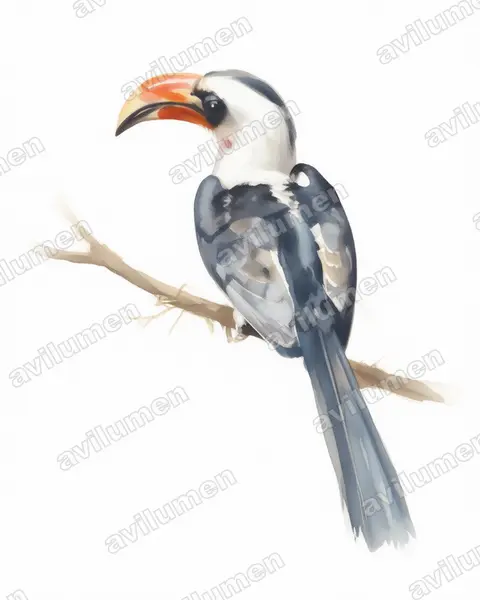
Watercolor 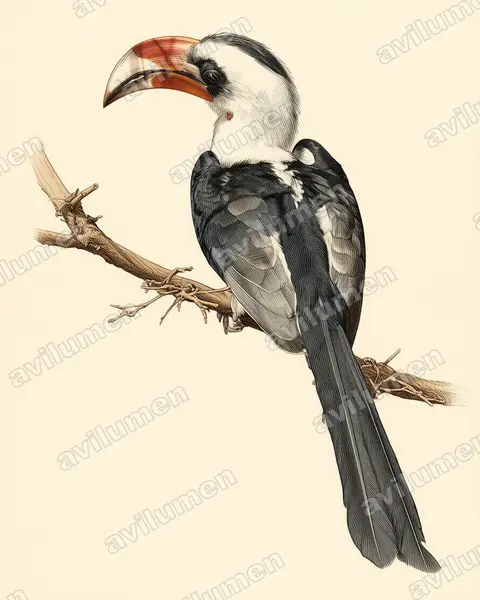
Vintage plate 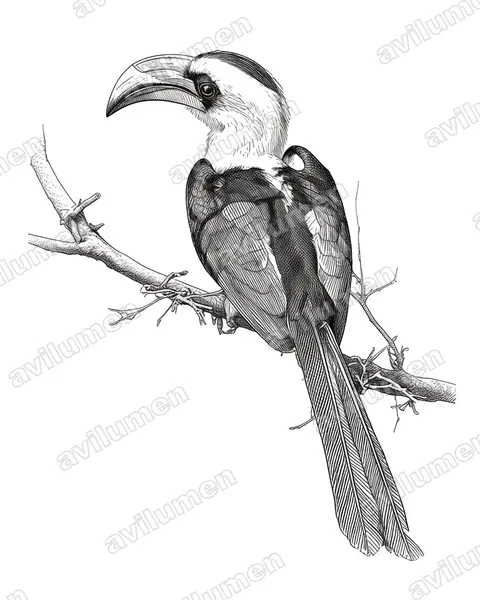
Ink 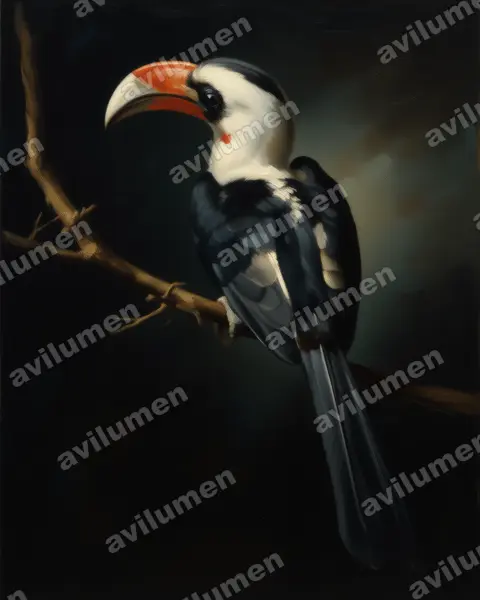
Oil 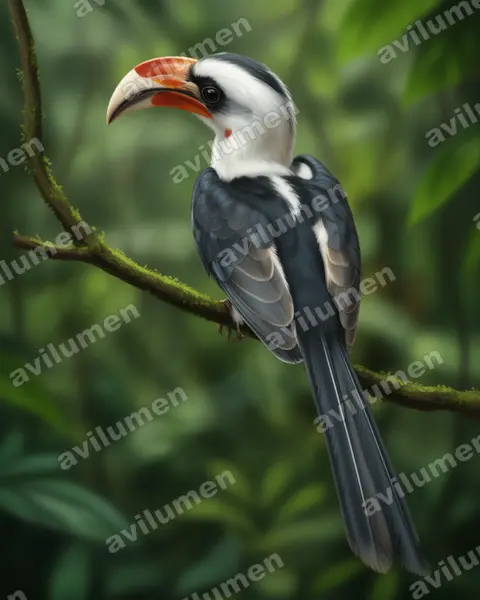
Realistic 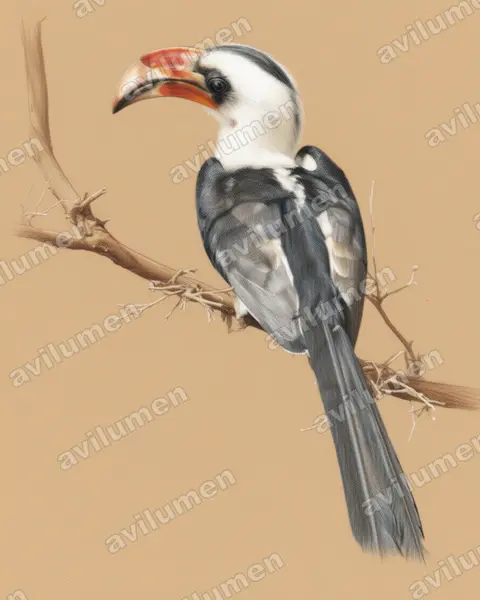
Colored pencil
Illustrations based on the photograph by Lip Kee Yap (CC BY-SA 2.0), from Wikimedia Commons.
Digital editions
HD Digital Art Pack — Von der Decken's Hornbill
Digital download: 6 high-resolution illustrations of the Von der Decken's Hornbill (Tockus deckeni), print-ready. This is a digital file; no animal or physical item is included.
AI Avatar — Von der Decken's Hornbill
Generate an avatar fusing your face with the Von der Decken's Hornbill (Tockus deckeni). Delivered digitally in 8K, watermark-free. Digital product; no animals are sold or brokered.
Instant download. No live birds are sold.
Frequently asked questions
- Is Tockus deckeni (Von der Decken's Hornbill) endangered?
- The IUCN Red List places Tockus deckeni, commonly known as the Von der Decken's Hornbill, in the «Least concern» category. «Least concern» means it is not currently threatened.
- Where does Tockus deckeni (Von der Decken's Hornbill) live?
- Tockus deckeni (Von der Decken's Hornbill) is found in Africa.
- What family does Tockus deckeni (Von der Decken's Hornbill) belong to?
- Tockus deckeni (Von der Decken's Hornbill) belongs to the family Bucerotidae, in the order Bucerotiformes.
- What colour is Tockus deckeni (Von der Decken's Hornbill)?
- The plumage of Tockus deckeni (Von der Decken's Hornbill) combines these colours: Black and Yellow.
More from the same family
 Vulnerable
Rufous-necked Hornbill
Aceros nipalensis
The rufous-necked hornbill is a species of hornbill in Bhutan, northeastern India, especially in Arunachal Pradesh, Indian subcontinent and Southeast Asia. It is locally extinct in Nepal due to hunting and significant loss of habitat. There are less than 10,000 adults left in the wild. With a length of about 117 cm (46 in), it is among the largest Bucerotine hornbills.
from $1.99
 Near threatened
Austen's Brown Hornbill
Anorrhinus austeni
Austen's brown hornbill, also known as the white-throated brown hornbill or brown hornbill, is a medium-sized species of hornbill found in forests from northeastern India to Vietnam and northern Thailand. It is rare throughout its range and is threatened by habitat loss and fragmentation.
from $1.99
 Near threatened
Bushy-crested Hornbill
Anorrhinus galeritus
The bushy-crested hornbill is a bird in the hornbill family. It is found in Brunei, Indonesia, Malaysia, Myanmar, and Thailand. Its natural habitat is subtropical or tropical moist lowland forests.
from $1.99
 Near threatened
Austen's Brwon Hornbill
Anorrhinus tickelli
Tickell's brown hornbill, also known as the rusty-cheeked hornbill, is a species of hornbill found in forests in Burma and adjacent western Thailand. Austen's brown hornbill is sometimes considered as a subspecies of Tickell's brown hornbill.
from $1.99