Black-cheeked Lovebird
Agapornis nigrigenis
Avilumen editorial team ·

The black-cheeked lovebird is a small parrot species of the lovebird genus. It is mainly green and has a brown head, red beak, and white eyerings. It is endemic to a relatively small range in southwest Zambia, where it is vulnerable to habitat loss.
The black-cheeked lovebird (Agapornis nigrigenis) is a small parrot species of the lovebird genus. It is mainly green and has a brown head, red beak, and white eyerings. It is endemic to a relatively small range in southwest Zambia, where it is vulnerable to habitat loss.
Taxonomy
The black-cheeked lovebird is monotypic. The black-cheeked lovebird is sometimes seen as a race of Lilian's lovebird.
Description
The black-cheeked lovebird is 14 cm (5.5 in) in length, with mostly green plumage, reddish-brown forehead and forecrown, brownish-black cheeks and throat, orange bib below the throat which fades to yellowish-green, white eye-rings and grey feet. Adult have bright red beaks, while juveniles of the species are similar but with a more orange bill. Vocalizations are loud, piercing shrieks, which sound like the calls of other lovebirds.
Distribution and habitat
The black-cheeked lovebird inhabits deciduous woodland, where permanent supplies of surface water exist, as it needs daily access to water. In the dry season, these birds may congregate in large flocks of up to 800 or more. They are found in Zambia and may occur in Zimbabwe, Botswana and Namibia.
Conservation
It is listed as a vulnerable species as its population is in decline due to continuous habitat loss. This is due to gradual desiccation of water bodies, causing drought, farming practices, hunting and trapping, fishing, logging and diseases. There are currently only between 2,500 and 9,999 mature individuals. However, they occur in nature reserves and there is an action plan in place to help them.
Diet
The black-cheeked lovebird feeds mainly at ground-level on annual grass seeds, but also on other vegetable matter and insect larvae, and on corn, sorghum, and millet.
Aviculture
The black-cheeked lovebird is relatively easy to breed in aviculture, but there was little interest in breeding them during the first half of the twentieth century at a time when imports were numerous. Now they are uncommon in aviculture and uncommon as pets.
Text adapted from Wikipedia · CC BY-SA 4.0
Distribution

Taxonomy
- Order
- Psittaciformes
- Family
- Psittaculidae
- Genus
- Agapornis
- Conservation status
- Vulnerable
Listen to its call
No recording yet
Care guide
Lovebird Care Guide: Diet, Housing and Breeding
How to care for lovebirds: diet, cage size, whether they need a mate, health, breeding, color mutations and legal status. A practical guide for owners.
Read the guide →Illustration gallery
6 illustrations of Agapornis nigrigenis (Black-cheeked Lovebird) in different styles, true to its real plumage. Shown watermarked; the art pack includes the high-resolution originals, ready to print.
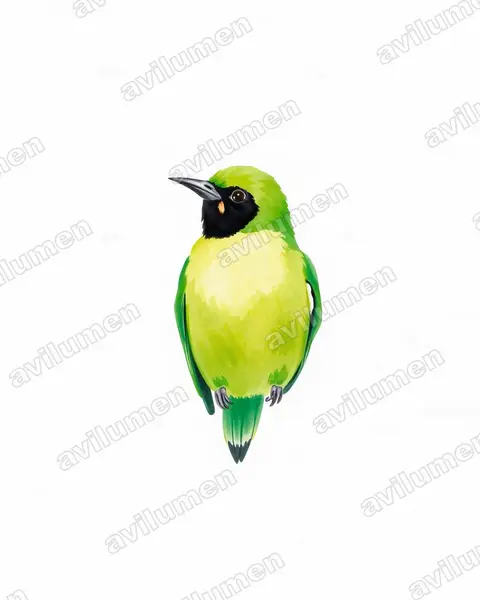
Watercolor 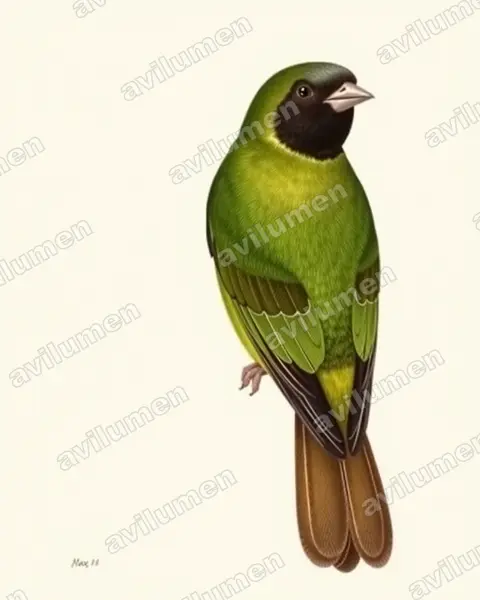
Vintage plate 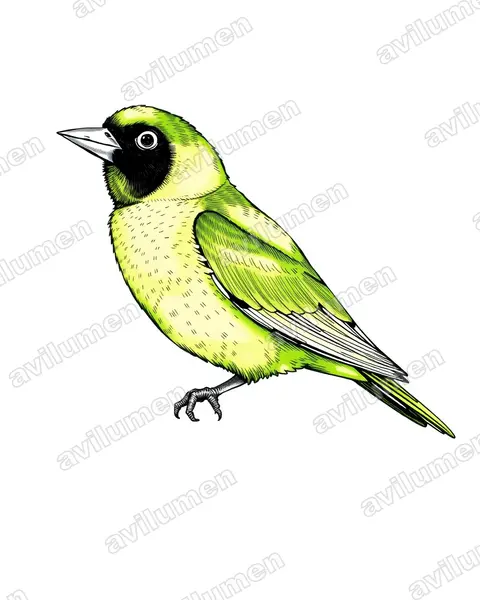
Ink 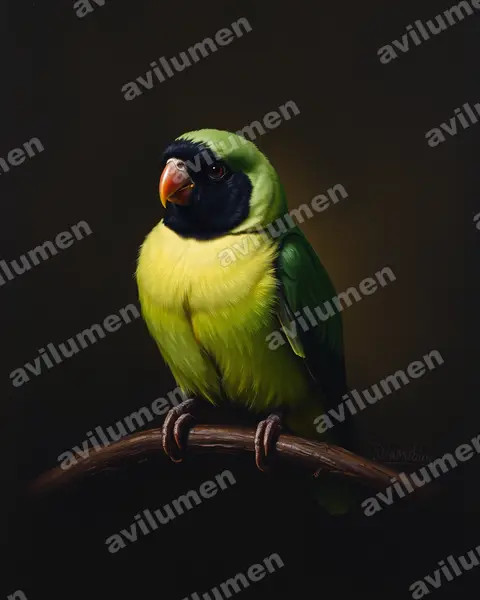
Oil 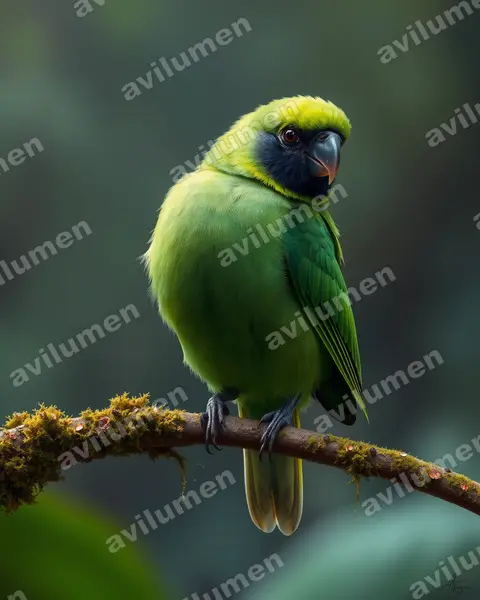
Realistic 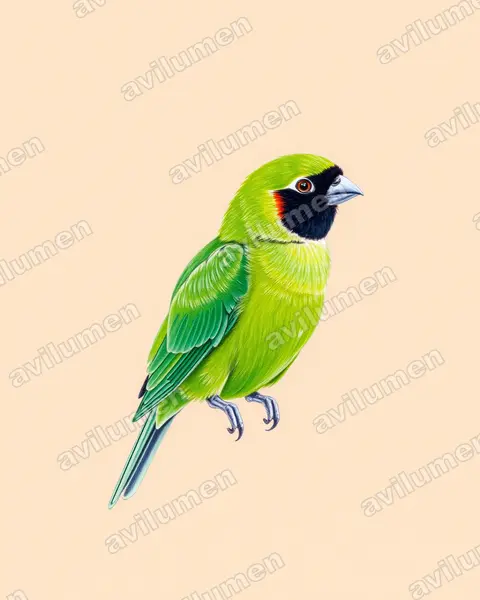
Colored pencil
Digital editions
HD Digital Art Pack — Black-cheeked Lovebird
Digital download: 6 high-resolution illustrations of the Black-cheeked Lovebird (Agapornis nigrigenis), print-ready. This is a digital file; no animal or physical item is included.
AI Avatar — Black-cheeked Lovebird
Generate an avatar fusing your face with the Black-cheeked Lovebird (Agapornis nigrigenis). Delivered digitally in 8K, watermark-free. Digital product; no animals are sold or brokered.
Instant download. No live birds are sold.
Frequently asked questions
- Is Agapornis nigrigenis (Black-cheeked Lovebird) endangered?
- The IUCN Red List places Agapornis nigrigenis, commonly known as the Black-cheeked Lovebird, in the «Vulnerable» category. «Vulnerable» means it faces a high risk of extinction in the medium term.
- Where does Agapornis nigrigenis (Black-cheeked Lovebird) live?
- Agapornis nigrigenis (Black-cheeked Lovebird) is found in Africa.
- What family does Agapornis nigrigenis (Black-cheeked Lovebird) belong to?
- Agapornis nigrigenis (Black-cheeked Lovebird) belongs to the family Psittaculidae, in the order Psittaciformes.
- What colour is Agapornis nigrigenis (Black-cheeked Lovebird)?
- The plumage of Agapornis nigrigenis (Black-cheeked Lovebird) combines these colours: Green and Brown.
More from the same family
 Least concern
Grey-headed Lovebird
Agapornis canus
The gray-headed lovebird or Madagascar lovebird is a small species of parrot of the lovebird genus. It is a mainly green parrot. The species is sexually dimorphic and only the adult male has grey on its upper body. They are native on the island of Madagascar and are the only lovebird species which are not native on the African continent. They are the smallest of the lovebird species.
from $1.99
 Near threatened
Fischer's Lovebird
Agapornis fischeri
Fischer's lovebird is a small parrot species of the genus Agapornis. They were originally discovered in the late 19th century. They are named after the 19th century German explorer of East Africa Gustav Fischer.
from $1.99
 Near threatened
Lilian's Lovebird
Agapornis lilianae
Lilian's lovebird, also known as the Nyasa lovebird, is a small African parrot species of the lovebird genus. It is mainly green and has orange on its upper chest and head. It is 13 cm (5 inches) long and is the smallest parrot on mainland Africa. In captivity, it is uncommon and difficult to breed.
from $1.99
 Extinct
Agapornis longipes
Agapornis longipes
Agapornis longipes is an extinct species of lovebird that lived in what is now Gauteng, South Africa during the Early Pleistocene epoch, about 2.5–1.38 million years ago. The fossilized remains of this bird were first discovered in the Kromdraai fossil site and reported in 1969 by T.N. Pocock, though the species would not be named until decades later in 2024.
from $4.99