Yellow-collared Lovebird
Agapornis personatus
Avilumen editorial team ·

The yellow-collared lovebird, also called masked lovebird, black-masked lovebird or eye ring lovebird, is a monotypic species of bird of the lovebird genus in the parrot family Psittaculidae. They are native to Arusha Region of Tanzania and have been introduced to Burundi and Kenya.
The yellow-collared lovebird (Agapornis personatus), also called masked lovebird, black-masked lovebird or eye ring lovebird, is a monotypic species of bird of the lovebird genus in the parrot family Psittaculidae. They are native to Arusha Region of Tanzania and have been introduced to Burundi and Kenya. Although they have been observed in the wild in Puerto Rico, they are probably the result of escaped pets, and no reproduction has been recorded. They have also been observed in Arizona.
Description
The yellow-collared lovebird is a mainly green small parrot about 14.5 cm (5.5 in) long. Its upperparts are a darker green than its lower surfaces. Its head is black, and it has a bright red beak with white above it and white eyerings. Yellow on the breast is continuous with a yellow collar and an expansion of yellow over the nape of the neck. Male and female have an identical external appearance.
Breeding
During courtship, the male bird moves his head up and down and slides excitedly towards the female. They breed primarily colonially and build nests with strips of twigs and bark.
The yellow-collared lovebird brings nesting material in its beak to a tree cavity for their nest. The eggs are white and there are usually four to five in a clutch. The female incubates the eggs for about 23 days and the chicks leave the nest about 42 days after hatching.
Housing
White eye-rings lovebirds, of which masked lovebirds are part, are reportedly less aggressive in comparison to the slightly larger peach-faced lovebird. They are frequently housed in aviaries with other species of their genus, a practice which although can be convenient, and wonderfully aesthetic, may lead to hybridization. This can especially be concerning where other species may not be as locally common e.g. black-cheeked lovebird and Lilian's lovebird. It may be advisable to house lovebirds either by themselves, or if a mixed collection is desired, ensure they are kept in a large flight with a few feeding stations, and assertive species e.g. red-rumped parrot, kākāriki, rose-ringed parakeet or cockatiels. They can usually be kept safely with quails and pheasants in aviaries.
Breeding cages should be 400mm x 400mm x 500mm, or these birds can be housed in colonies, or have in some cases been "kept at liberty". There was a mixed flock of masked, peach-faced lovebird, and a few hybrids near Napier, New Zealand for a number of years in the mid-2000s. There is also a small feral population in France, which contains the Blue mutant, and mixes with larger proportion of Fischer's lovebirds - also from aviary origin.
Aviaries, and cages need perches in a range of diameters. Natural perches in the form of branches are ideal, especially if they have a variety of forks, angles, and a bit of bounce in them. The reason for this is to give the captives stimuli; it also keeps their feet healthy, and nimble. Research (suitability, and toxicity) must be carried out on all plant material going into any cages. Cherry wood is poisonous, as is broom, kōwhai, and avocado (its fruit being surprisingly poisonous to parrots), to mention just a few examples.
Nesting boxes are usually utilised throughout the year as sleeping quarters. It is advisable to clean them, but keep them up even after breeding season. The risk of losing a bird to egg laying complications (in the unlikely event they do decide to breed in the winter), is out-weighed by the benefit of keeping the birds content, keeping pair-bonds strong, and the reduced risk of losing a bird to the cold. A supply of willow branches and roughly slivered corn or maize husk can be given in the aviary as nesting box lining: it will be ripped up and carried into the nest box by the female.
Lovebirds are reasonably difficult to sex. A "pair" will often be of the same sex, even though they are exhibiting signs of mutual affection. This usually arises when inexperienced bird keepers house two birds alone, and wait on behavioral signs that they're a "true pair", with the intention of swapping one out for another lovebird if they're not, then becoming excited when they see birds "pair up", even though they may both be of the same sex. These bonds are artificial and can be broken, or tested if the "pair" are re-housed communally (or split up by the keeper). One or both of a pair of males may go, and breed with lone hens, despite staying connected to their original partner. Alternatively, the same sex pair's bond may completely dissolve immediately.
Colour varieties
The blue mutation was originally found in wild birds in the 1920s and is the oldest colour mutation known in the lovebird genus. The other mutations are a result of selective breeding in aviculture, such as two cobalts which will make a mauve (black). Various colour mutations exist, including blue, cobalt, mauve, slate, diluted slate, violet, lutino and albino.
The blue and the lutino mutations are where some colour genes have not been passed on, or have been suppressed from the original wild colour form. In the case of the lutino, the micro-structure which creates the blue based colours in the normal form is not passed on to offspring when it arises; hence, the parrot is orange around its face and yellow everywhere else. In the case of the original blue, none of the yellow or red pigment genes are passed on. The albino is the latest "colour" which is a combination of the lutino and the blue ("wild" colouring minus blue, red and yellow results in no colour, so it is completely white).
The dilute mutation is a lightening of the darker feathers, most noticeable in the wings, and face. It was first noted from green (wild) coloured parents, and originally called "yellow". This new colour was soon built up in numbers by passionate aviculturelists, and once secure was bred to blue coloured birds. The result was then known as "white", but it is now called "dilute blue".
Text adapted from Wikipedia · CC BY-SA 4.0
Distribution

Taxonomy
- Order
- Psittaciformes
- Family
- Psittaculidae
- Genus
- Agapornis
- Conservation status
- Least concern
Listen to its call
No recording yet
Care guide
Lovebird Care Guide: Diet, Housing and Breeding
How to care for lovebirds: diet, cage size, whether they need a mate, health, breeding, color mutations and legal status. A practical guide for owners.
Read the guide →Illustration gallery
6 illustrations of Agapornis personatus (Yellow-collared Lovebird) in different styles, true to its real plumage. Shown watermarked; the art pack includes the high-resolution originals, ready to print.
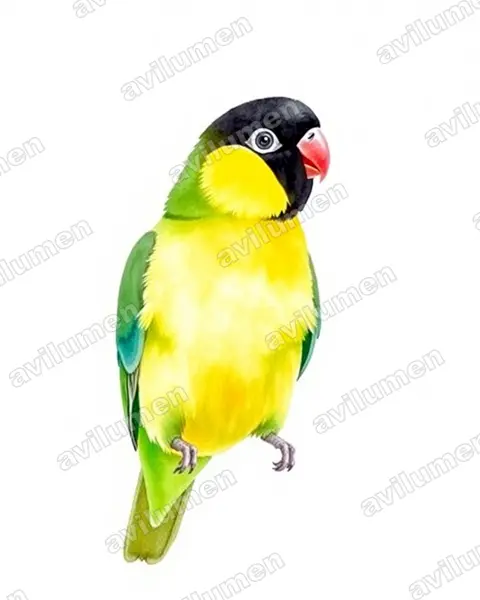
Watercolor 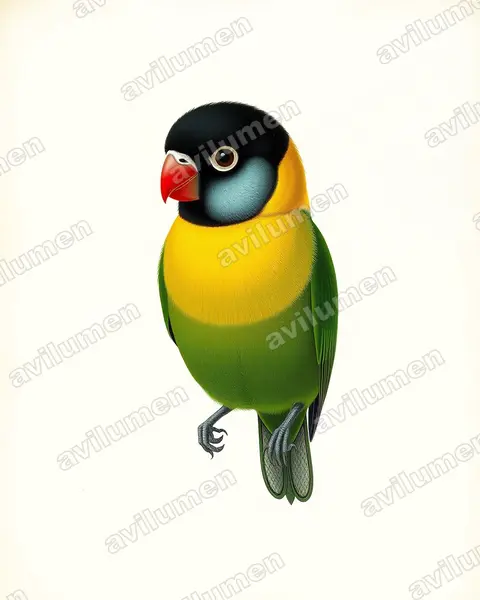
Vintage plate 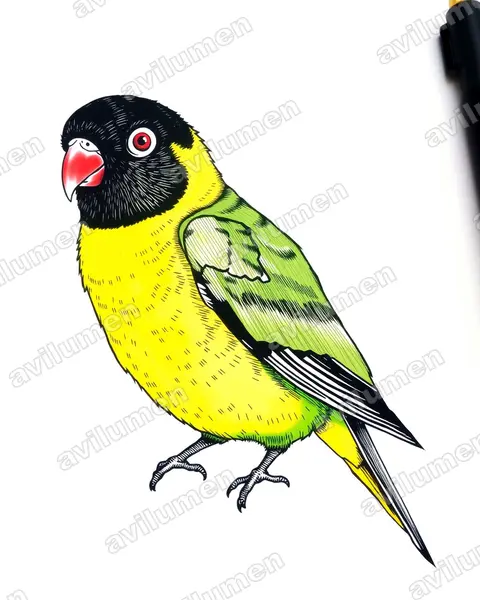
Ink 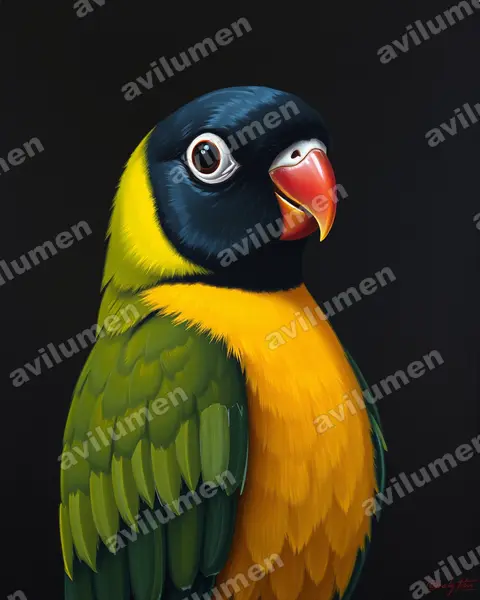
Oil 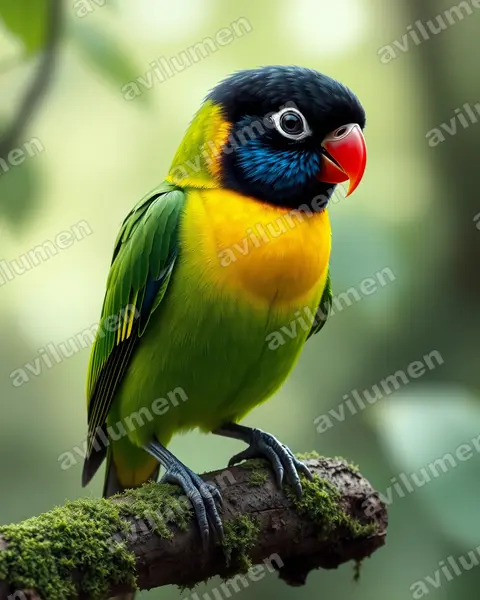
Realistic 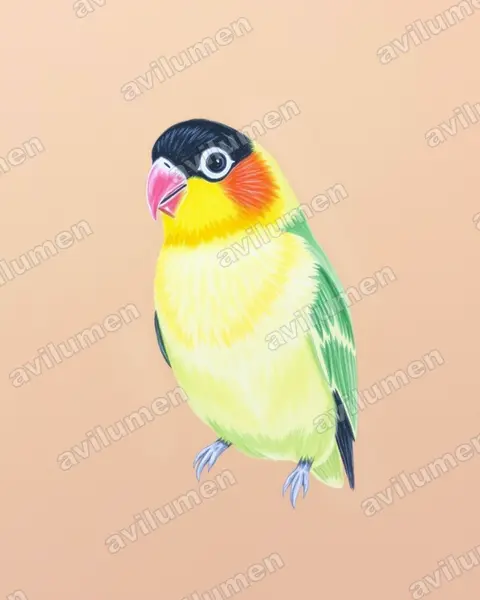
Colored pencil
Digital editions
HD Digital Art Pack — Yellow-collared Lovebird
Digital download: 6 high-resolution illustrations of the Yellow-collared Lovebird (Agapornis personatus), print-ready. This is a digital file; no animal or physical item is included.
AI Avatar — Yellow-collared Lovebird
Generate an avatar fusing your face with the Yellow-collared Lovebird (Agapornis personatus). Delivered digitally in 8K, watermark-free. Digital product; no animals are sold or brokered.
Instant download. No live birds are sold.
Frequently asked questions
- Is Agapornis personatus (Yellow-collared Lovebird) endangered?
- The IUCN Red List places Agapornis personatus, commonly known as the Yellow-collared Lovebird, in the «Least concern» category. «Least concern» means it is not currently threatened.
- Where does Agapornis personatus (Yellow-collared Lovebird) live?
- Agapornis personatus (Yellow-collared Lovebird) is found in Africa.
- What family does Agapornis personatus (Yellow-collared Lovebird) belong to?
- Agapornis personatus (Yellow-collared Lovebird) belongs to the family Psittaculidae, in the order Psittaciformes.
- What colour is Agapornis personatus (Yellow-collared Lovebird)?
- The plumage of Agapornis personatus (Yellow-collared Lovebird) combines these colours: Green, Black, and Yellow.
More from the same family
 Least concern
Grey-headed Lovebird
Agapornis canus
The gray-headed lovebird or Madagascar lovebird is a small species of parrot of the lovebird genus. It is a mainly green parrot. The species is sexually dimorphic and only the adult male has grey on its upper body. They are native on the island of Madagascar and are the only lovebird species which are not native on the African continent. They are the smallest of the lovebird species.
from $1.99
 Near threatened
Fischer's Lovebird
Agapornis fischeri
Fischer's lovebird is a small parrot species of the genus Agapornis. They were originally discovered in the late 19th century. They are named after the 19th century German explorer of East Africa Gustav Fischer.
from $1.99
 Near threatened
Lilian's Lovebird
Agapornis lilianae
Lilian's lovebird, also known as the Nyasa lovebird, is a small African parrot species of the lovebird genus. It is mainly green and has orange on its upper chest and head. It is 13 cm (5 inches) long and is the smallest parrot on mainland Africa. In captivity, it is uncommon and difficult to breed.
from $1.99
 Extinct
Agapornis longipes
Agapornis longipes
Agapornis longipes is an extinct species of lovebird that lived in what is now Gauteng, South Africa during the Early Pleistocene epoch, about 2.5–1.38 million years ago. The fossilized remains of this bird were first discovered in the Kromdraai fossil site and reported in 1969 by T.N. Pocock, though the species would not be named until decades later in 2024.
from $4.99