Chestnut-bellied hummingbird
Amazilia castaneiventris
Avilumen editorial team ·

The chestnut-bellied hummingbird is a Near Threatened species of hummingbird in the "emeralds", tribe Trochilini of subfamily Trochilinae. It is endemic to Colombia.
The chestnut-bellied hummingbird (Saucerottia castaneiventris) is a Near Threatened species of hummingbird in the "emeralds", tribe Trochilini of subfamily Trochilinae. It is endemic to Colombia.
Taxonomy and systematics
The chestnut-bellied hummingbird was formerly placed in the genus Amazilia. A molecular phylogenetic study published in 2014 found that the genus Amazilia was polyphyletic. In the revised classification to create monophyletic genera, the chestnut-bellied hummingbird was moved by most taxonomic systems to the resurrected genus Saucerottia. However, BirdLife International's Handbook of the Birds of the World (HBW) retains it in Amazilia.
The chestnut-bellied hummingbird is monotypic.
Description
The chestnut-bellied hummingbird is about 9 cm (3.5 in) long. Both sexes have a black bill with a red base to the mandible. The adult male has bronze-green upperparts and a chestnut tail. Its throat and upper breast are glittering green, the belly chestnut, and the undertail coverts chestnut with greenish edges. The female is similar but with a slightly paler belly and white bars near the end of some throat feathers. Immatures are similar to the female with rufous edges on the feathers of the neck and rump.
Distribution and habitat
The chestnut-bellied hummingbird appears to be restricted to the dryer parts of the Magdalena Valley of Colombia, with a core known range in the Chicamocha, Suárez and Chucurí River valleys. As of 2019 it was known from at least 14 sites. However, it is not regularly documented at most of them, perhaps because of unknown seasonal movements. Most records are from arid brushy canyons with a few from the lower edges of humid montane forest. Most records are from elevations between 500 and 1,500 m (1,600 and 4,900 ft) but some extend to between 340 and 2,200 m (1,100 and 7,200 ft) and one is at 120 m (390 ft).
Movement
The chestnut-bellied hummingbird is believed to move from higher to lower elevations after the breeding season.
Feeding
Details are lacking about the chestnut-bellied hummingbird's feeding technique and diet, but it is known to take nectar from Salvia and Trichanthera. It also feeds on small arthropods.
Breeding
Specimens of chestnut-bellied hummingbird in breeding condition suggest that its breeding season is from August to December. Nothing else is known about its breeding phenology and its nest has not been described.
Vocalization
The chestnut-bellied hummingbird's song is "a short rhythmic phrase of three squeaky notes that sounds like a rusty door-hinge, 'krey-ki-cheep ... tsew ... krey-ki-cheep ...'." It also makes calls described as " a slightly buzzy 'tzee', a high-pitched 'see' and a stuttering high-pitched chattering."
Status and threats
The IUCN originally assessed the chestnut-bellied hummingbird as Threatened, then in 1994 Endangered, in 2000 Critically Endangered, in 2009 again Endangered, and since 2019 as Near Threatened. Its population is estimated at between 10,000 and 20,000 mature individuals and believed to be decreasing.
The chestnut-bellied hummingbird is located in the dense population region of Colombia. In the twenty-first century there has been expansive economic growth, due to a gold rush in 1996 and also increasing logging. Not only are the forests being cut down, but also sugar and coffee plantations are replacing them. Decreased habitats and increased pollution and human migration accompanied these new industries. Although these businesses are benefitting the Colombian economy, they are by far the largest threats to the habitat of the species.
Text adapted from Wikipedia · CC BY-SA 4.0
Distribution

Taxonomy
- Order
- Apodiformes
- Family
- Trochilidae
- Genus
- Amazilia
- Conservation status
- Near threatened
Listen to its call
No recording yet
Illustration gallery
6 illustrations of Amazilia castaneiventris (Chestnut-bellied hummingbird) in different styles, true to its real plumage. Shown watermarked; the art pack includes the high-resolution originals, ready to print.
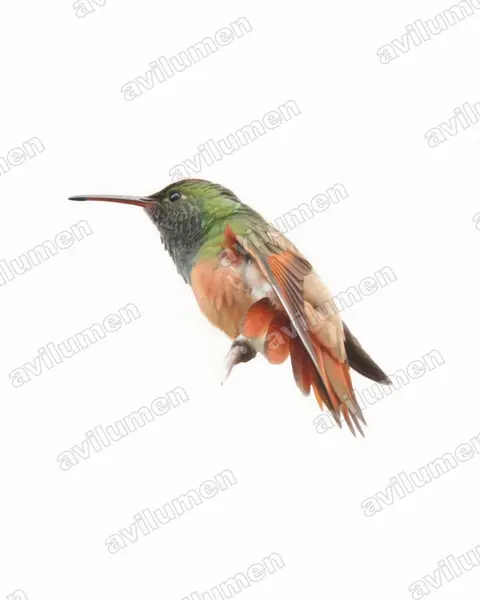
Watercolor 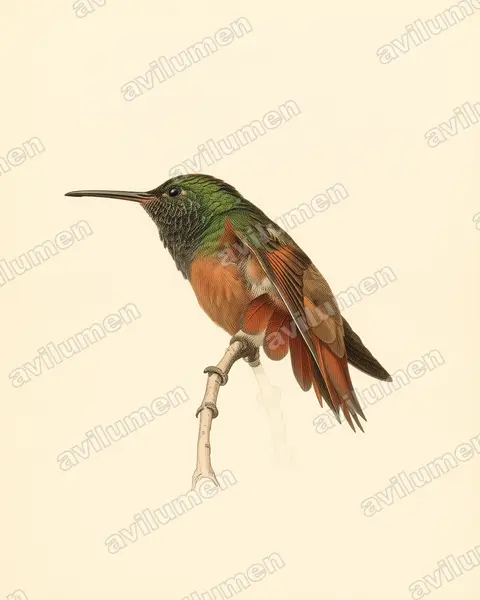
Vintage plate 
Ink 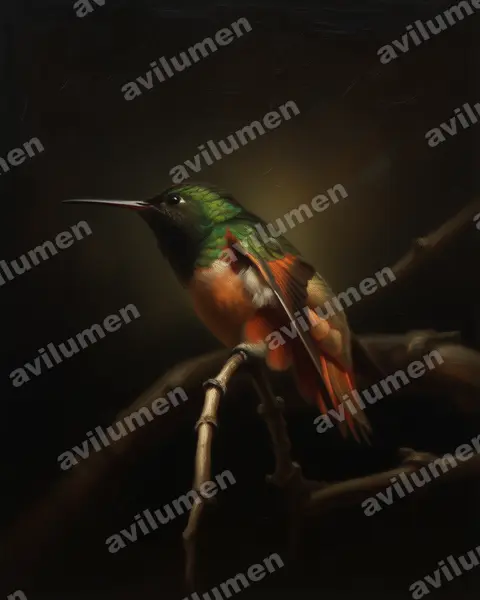
Oil 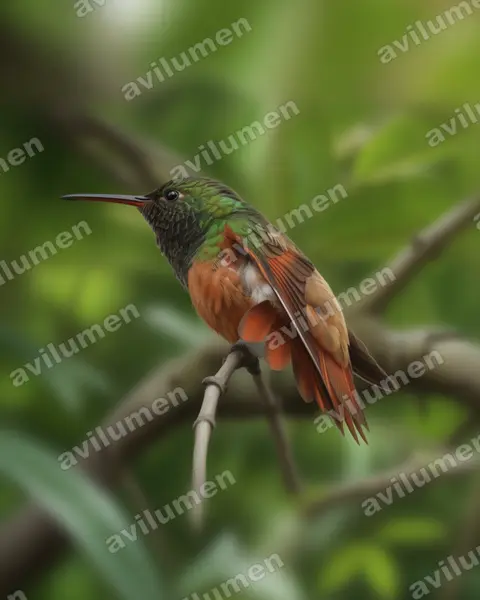
Realistic 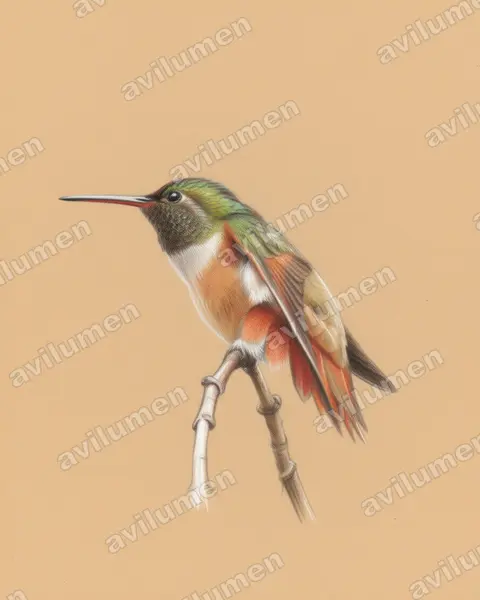
Colored pencil
Illustrations based on the photograph by Félix Uribe from Rionegro, Antioquia, Colombia (CC BY-SA 2.0), from Wikimedia Commons.
Digital editions
HD Digital Art Pack — Chestnut-bellied hummingbird
Digital download: 6 high-resolution illustrations of the Chestnut-bellied hummingbird (Amazilia castaneiventris), print-ready. This is a digital file; no animal or physical item is included.
AI Avatar — Chestnut-bellied hummingbird
Generate an avatar fusing your face with the Chestnut-bellied hummingbird (Amazilia castaneiventris). Delivered digitally in 8K, watermark-free. Digital product; no animals are sold or brokered.
Instant download. No live birds are sold.
Frequently asked questions
- Is Amazilia castaneiventris (Chestnut-bellied hummingbird) endangered?
- The IUCN Red List places Amazilia castaneiventris, commonly known as the Chestnut-bellied hummingbird, in the «Near threatened» category. «Near threatened» means it is not threatened yet, but is close to becoming so.
- Where does Amazilia castaneiventris (Chestnut-bellied hummingbird) live?
- Amazilia castaneiventris (Chestnut-bellied hummingbird) is found in Colombia.
- What family does Amazilia castaneiventris (Chestnut-bellied hummingbird) belong to?
- Amazilia castaneiventris (Chestnut-bellied hummingbird) belongs to the family Trochilidae, in the order Apodiformes.
- What colour is Amazilia castaneiventris (Chestnut-bellied hummingbird)?
- The plumage of Amazilia castaneiventris (Chestnut-bellied hummingbird) combines these colours: Brown and Green.
More from the same family
 Least concern
Emerald-chinned Hummingbird
Abeillia abeillei
The emerald-chinned hummingbird is a species of hummingbird in the "emeralds", tribe Trochilini of subfamily Trochilinae.
from $1.99
 Least concern
Speckled hummingbird
Adelomyia melanogenys
The speckled hummingbird is a species of hummingbird. It is the only member of the genus Adelomyia. It inhabits Neotropical montane cloud forests at elevations of 1,000–2,500 meters and is confined to the Andes of Argentina, Bolivia, Peru, Ecuador, Colombia and Venezuela; as well as to some isolated montane forests in western Ecuador and Venezuela.
from $1.99
 Vulnerable
Purple-backed sunbeam
Aglaeactis aliciae
The purple-backed sunbeam is a bird species in the family Trochilidae. It is found only in Peru.
from $1.99
 Near threatened
White-tufted sunbeam
Aglaeactis castelnaudii
The white-tufted sunbeam is a species of hummingbird in the family Trochilidae. It is found only in Peru. Its natural habitats are subtropical or tropical moist montane forest and subtropical or tropical high-altitude shrubland.
from $1.99