Lilac-crowned Amazon
Amazona finschi
Avilumen editorial team ·

The lilac-crowned amazon, also known as the lilac-crowned parrot, Finsch's parrot or Finsch's amazon, is a parrot endemic to the Pacific slopes of Mexico. Also known as Finsch's amazon, it is characterised by green plumage, a maroon forehead, and a violet-blue crown and neck.
The lilac-crowned amazon (Amazona finschi), also known as the lilac-crowned parrot, Finsch's parrot or Finsch's amazon, is a parrot endemic to the Pacific slopes of Mexico. Also known as Finsch's amazon, it is characterised by green plumage, a maroon forehead, and a violet-blue crown and neck.
In 2006, BirdLife International classified this species as vulnerable. In 2014, IUCN uplisted this species to Endangered.
The species name of this bird, finschi, commemorates the German naturalist and explorer Otto Finsch.
Description
The plumage of an adult lilac-crowned amazon is primarily green with yellowish underparts and black edging.
The forehead is a maroon colour with a light blue-lilac neck, nape, and crown.
The cheeks and ear coverts are a greenish yellow that lacks the edging that is present in most of the plumage.
The primary feathers are dark blue with the secondary feathers being green while being tipped with the same dark blue colouring.
Furthermore, the initial five secondary feathers have a bright red speculum on the edge of the feathers.
The wing coverts, the underside of the flight feathers, and the tail are green while the tail is tipped with a yellowish colouring similar to that of the cheeks and ear coverts.
Their beak, orbital rings, and legs are a pale brown-grey colouring.
The irides of adult lilac-crowned parrots are amber-coloured.
Juvenile lilac-crowned amazons are visually similar to their adult forms except for minor differences. One difference is that the iris of juveniles is a dark brown as opposed to the amber colouring that is found in adults.
The other major difference is that there less maroon coloured feathers on the forehead of juveniles. After about one-year juveniles begin to acquire these adult features.
Range and habitat
The lilac-crowned amazon's endemic range spans along the pacific coast of Mexico, beginning in southeastern Sonora and southwestern Chihuahua down to southern Oaxaca. In Sinaloa and northern Nayarit the geographic range of the lilac-crowned parrot is above 375 meters of elevation; the range does not descend to sea level until southern Nayarit, where it remains so through Jalisco and Oaxaca.
The lilac-crowned amazon's natural habitat in Mexico is often threatened. The decline in population size has been recorded in almost all of its natural habitat locations. Based on a collection of data and resident accounts, Amazona finschi population range has decreased by 20% due to habitat loss.
An increasingly growing population of approximately 100 individuals is found in Southern California, especially in the San Gabriel Valley and Orange Country.
This increase could also be attributed to a more reliable source of measurement of population than in past years. These populations often are found in residential areas and occasionally in nesting groups with red-crowned parrots in native conifer forests or non-native captive plants.
Breeding
The lilac-crowned amazon's breeding season is from February to June. They have a 28 day incubation period and a 60 day period of nestling growth.
They tend to nest in the natural cavities of trees in dry forests. Females have a clutch size ranging from 1–4 eggs which usually results in an average brood size of 1.8 nestlings and a reproductive output of 0.99 fledglings per egg-laying female.
Ultimately outcomes of reproductive efforts result in 0.70 independent young per egg-laying pair.
These low success rates could be attributed to the climate variability in dry forests, which could have an effect on clutch size, reproductive output and success.
Aviculture
Hand-reared lilac-crowned amazons can be quite friendly in captivity and can learn quite a vocabulary, even though they are not known as talkers. They make good companion parrots.
Text adapted from Wikipedia · CC BY-SA 4.0
Distribution

Taxonomy
- Order
- Psittaciformes
- Family
- Psittacidae
- Genus
- Amazona
- Conservation status
- Endangered
Listen to its call
No recording yet
Care guide
Amazon, African Grey and Eclectus Parrot Care Guide
How to care for Amazon parrots, African greys, eclectus and pionus: diet, cage setup, health, behavior and CITES requirements for medium and large parrots.
Read the guide →Illustration gallery
6 illustrations of Amazona finschi (Lilac-crowned Amazon) in different styles, true to its real plumage. Shown watermarked; the art pack includes the high-resolution originals, ready to print.
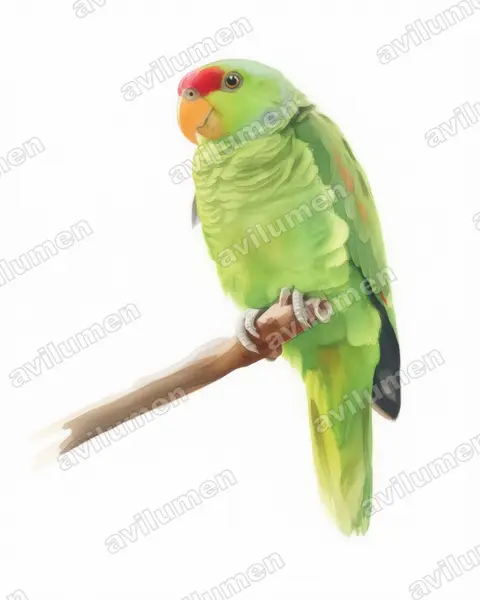
Watercolor 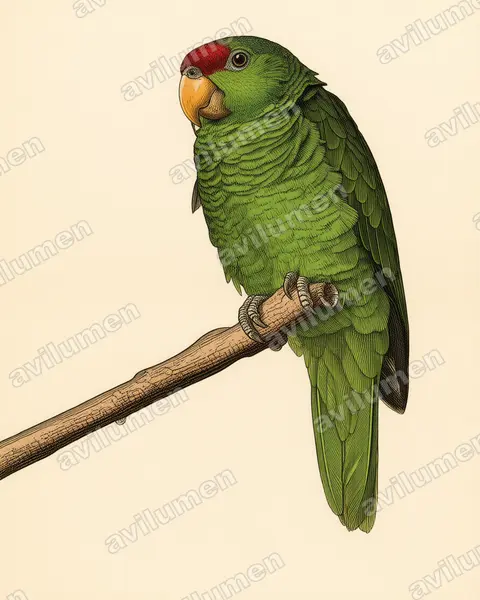
Vintage plate 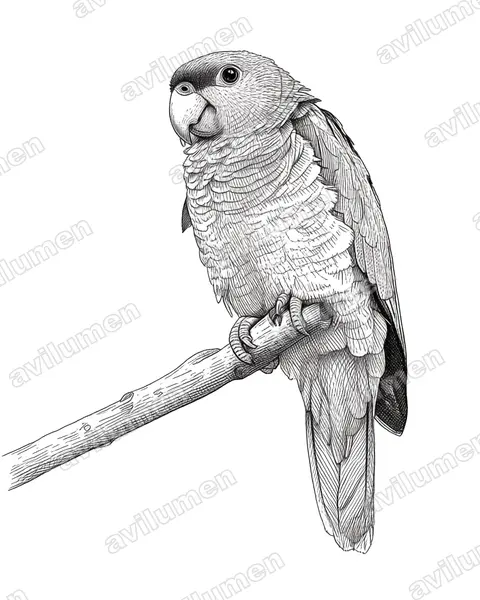
Ink 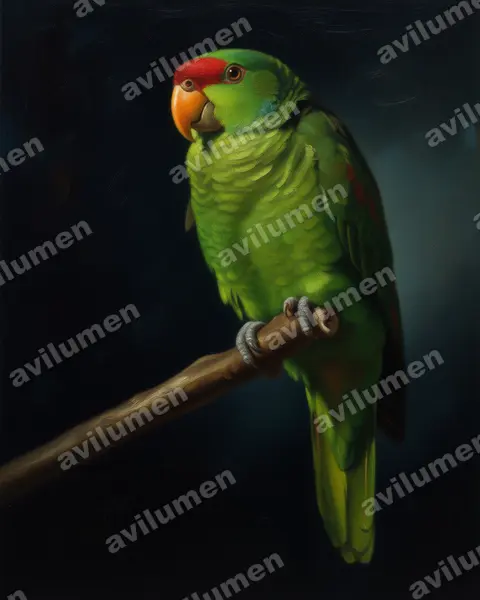
Oil 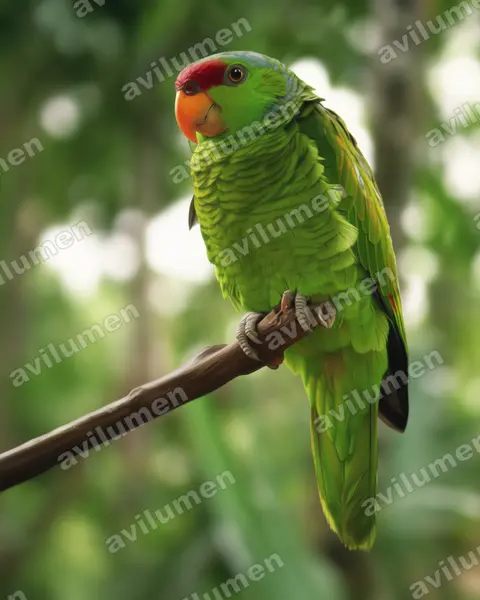
Realistic 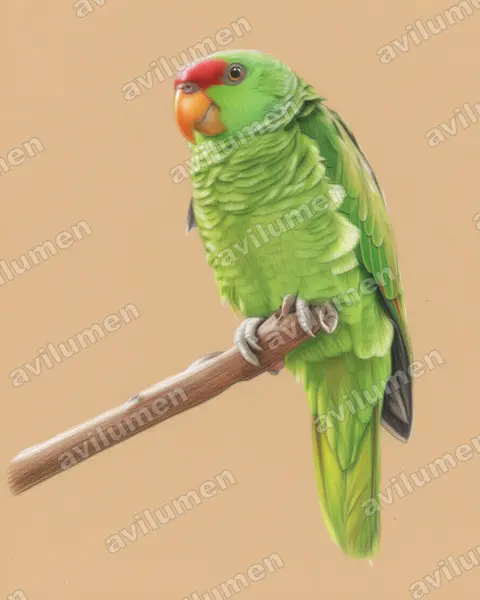
Colored pencil
Illustrations based on the photograph by Tomasz Wagner from Burnaby, BC, Canada (CC BY-SA 2.0), from Wikimedia Commons.
Digital editions
HD Digital Art Pack — Lilac-crowned Amazon
Digital download: 6 high-resolution illustrations of the Lilac-crowned Amazon (Amazona finschi), print-ready. This is a digital file; no animal or physical item is included.
AI Avatar — Lilac-crowned Amazon
Generate an avatar fusing your face with the Lilac-crowned Amazon (Amazona finschi). Delivered digitally in 8K, watermark-free. Digital product; no animals are sold or brokered.
Instant download. No live birds are sold.
Frequently asked questions
- Is Amazona finschi (Lilac-crowned Amazon) endangered?
- The IUCN Red List places Amazona finschi, commonly known as the Lilac-crowned Amazon, in the «Endangered» category. «Endangered» means it faces a very high risk of disappearing in the wild.
- What family does Amazona finschi (Lilac-crowned Amazon) belong to?
- Amazona finschi (Lilac-crowned Amazon) belongs to the family Psittacidae, in the order Psittaciformes.
- What colour is Amazona finschi (Lilac-crowned Amazon)?
- The plumage of Amazona finschi (Lilac-crowned Amazon) combines these colours: Green and Violet.
More from the same family
 Near threatened
Yellow-faced Parrot
Alipiopsitta xanthops
The yellow-faced parrot, formerly also known as the yellow-faced amazon, is the only species of the genus Alipiopsitta. It is a Neotropical parrot, and was classified in the genus Amazona for many years. It is a predominantly green and yellow-plumaged bird with a yellow head. It is a semi-nomadic species found in the cerrado region of Brazil and adjacent Bolivia.
from $1.99
 Least concern
Moluccan King Parrot
Alisterus amboinensis
The Moluccan king parrot is a parrot endemic to Peleng Island, Maluku, and West Papua in Indonesia. It is sometimes referred to as the Ambon king parrot or Amboina king parrot, but this is potentially misleading, as it is found on numerous other islands than Ambon. The male and female are similar in appearance, with a predominantly red head and underparts, green wings, and blue back and tail.
from $1.99
 Least concern
Papuan King Parrot
Alisterus chloropterus
The Papuan king parrot, also known as the green-winged king parrot, is a species of parrot in the family Psittaculidae found in New Guinea. Its natural habitats are subtropical or tropical moist lowland forest and subtropical or tropical moist montane forest.
from $1.99
 Least concern
Australian King Parrot
Alisterus scapularis
The Australian king parrot is a species of parrot endemic to eastern Australia ranging from Cooktown in Queensland to Port Campbell in Victoria. Found in humid and heavily forested upland regions of the eastern portion of the continent, including eucalyptus wooded areas in and directly adjacent to subtropical and temperate rainforest. They feed on fruits and seeds gathered from trees or on the ground.
from $1.99