Australian King Parrot
Alisterus scapularis
Avilumen editorial team ·

The Australian king parrot is a species of parrot endemic to eastern Australia ranging from Cooktown in Queensland to Port Campbell in Victoria. Found in humid and heavily forested upland regions of the eastern portion of the continent, including eucalyptus wooded areas in and directly adjacent to subtropical and temperate rainforest. They feed on fruits and seeds gathered from trees or on the ground.
The Australian king parrot (Alisterus scapularis) is a species of parrot endemic to eastern Australia ranging from Cooktown in Queensland to Port Campbell in Victoria. Found in humid and heavily forested upland regions of the eastern portion of the continent, including eucalyptus wooded areas in and directly adjacent to subtropical and temperate rainforest. They feed on fruits and seeds gathered from trees or on the ground.
Taxonomy
The Australian king parrot was first described by the German naturalist Martin Lichtenstein in 1816 as Psittacus scapularis. The species belongs to the genus Alisterus, whose three members are also known as king parrots. The species are sometimes allied to the genus Aprosmictus.
Two subspecies are recognised, which are differentiated by size:
A. s. minor (Mathews, 1911)
A. s. scapularis (Lichtenstein, 1816)
Naturally occurring hybrids with the red-winged parrot (Aprosmictus erythropterus) have been recorded from Bell in southeastern Queensland.
"Australian king parrot" has been designated the official name by the International Ornithologists' Union (IOC).
Description
Adults of both sexes are about 43 cm (17 in) in length, including the long, broad tail. The adult male has a red head, breast, and lower undersides, with a blue band on the back of the neck between the red above and green on the back, the wings are green and each has a pale green shoulder band, the tail is green, and the rump is blue. The male has a reddish-orange upper mandible with a black tip, a black lower mandible with an orange base, and yellow irises. The plumage of the female is very different from the male having a green head and breast, a grey beak, and the pale shoulder band is small or absent. Juveniles of both sexes have brown irises and a yellowish beak, and otherwise resemble the female.
The two subspecies are A. s. minor, found at the northern limit of the species range and is similar in appearance to the nominate subspecies but smaller, typically about 5 cm (2 in) smaller in length.
On those rare individuals which have areas without melanin, feathers are orange to yellow. Such a bird can look startingly different from the more common scarlet and green variety.
Distribution and habitat
Australian king parrots range from north and central Queensland to southern Victoria. They are frequently seen in small groups with various species of rosella. Further from their normal eastern upland habitat, they are also found in Canberra during winter, the outer western and northern suburbs of Sydney, and the Carnarvon Gorge in central Queensland.
Aviculture
In their native Australia, king parrots are occasionally bred in aviaries and kept as calm and relatively quiet household pets if hand-raised.
As pets, they have limited "talking" ability and normally prefer not to be handled, but they do bond readily to people and can be very devoted.
They tend to be selective in their choice of seeds that they eat, preferring black sunflower seeds and tend not to ingest small seeds found in pre-packaged retail bags.
They are relatively unknown outside Australia. Life expectancy in the wild is unknown, but some pets have been known to live up to 25 years.
King parrots are near the bottom of the pecking order. At a food source of seeds, the approximate order is as follows: cockatoo, rainbow lorikeet, magpie, corella, galah, king parrot, crimson rosella.
Text adapted from Wikipedia · CC BY-SA 4.0
Distribution

Taxonomy
- Order
- Psittaciformes
- Family
- Psittacidae
- Genus
- Alisterus
- Conservation status
- Least concern
Listen to its call
No recording yet
Care guide
Budgie, Conure and Parakeet Care Guide
How to care for budgies, conures, parrotlets, ringnecks and other parakeets: diet, cage setup, health, behavior, breeding and legal status for owners.
Read the guide →Illustration gallery
6 illustrations of Alisterus scapularis (Australian King Parrot) in different styles, true to its real plumage. Shown watermarked; the art pack includes the high-resolution originals, ready to print.
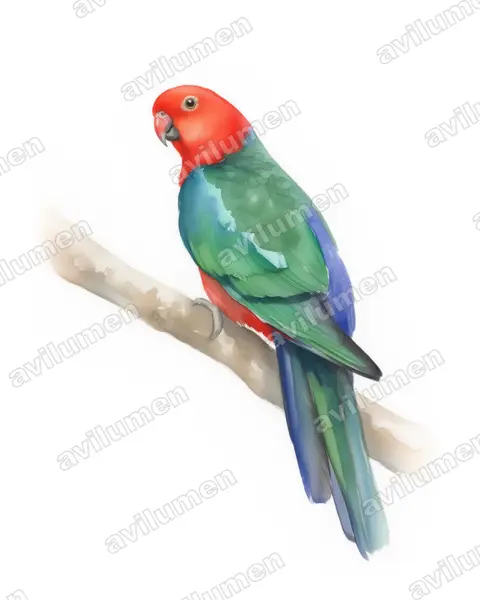
Watercolor 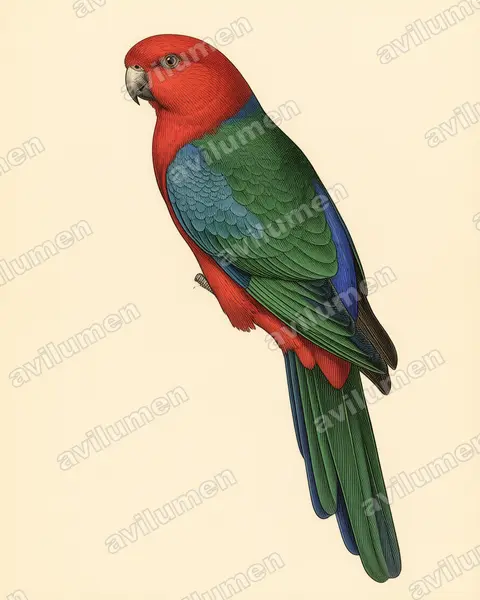
Vintage plate 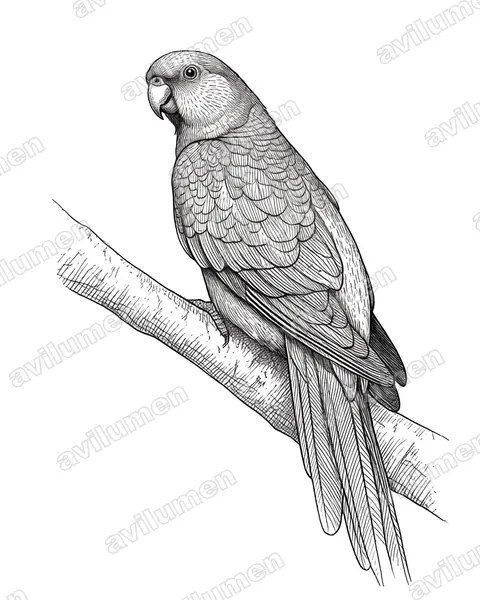
Ink 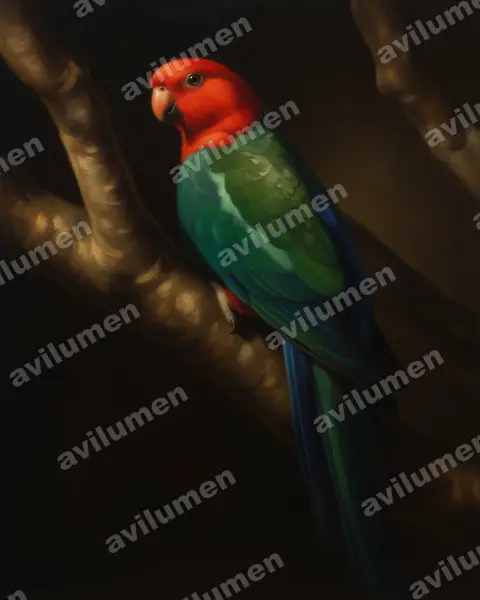
Oil 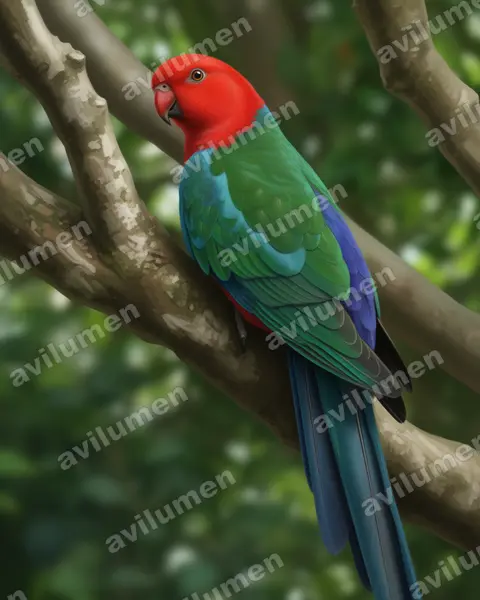
Realistic 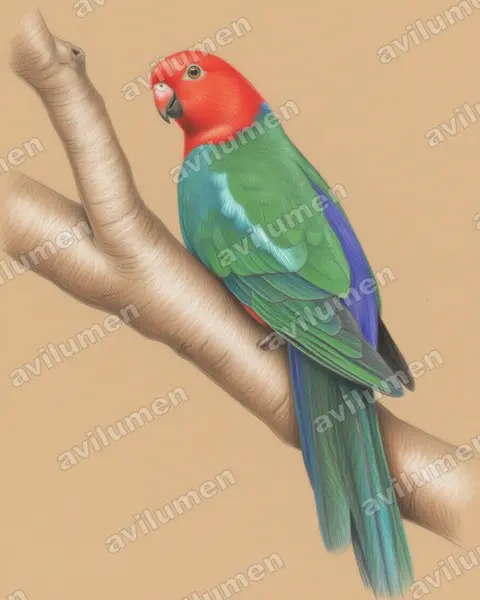
Colored pencil
Illustrations based on the photograph by Joseph C Boone (CC BY-SA 4.0), from Wikimedia Commons.
Digital editions
HD Digital Art Pack — Australian King Parrot
Digital download: 6 high-resolution illustrations of the Australian King Parrot (Alisterus scapularis), print-ready. This is a digital file; no animal or physical item is included.
AI Avatar — Australian King Parrot
Generate an avatar fusing your face with the Australian King Parrot (Alisterus scapularis). Delivered digitally in 8K, watermark-free. Digital product; no animals are sold or brokered.
Instant download. No live birds are sold.
Frequently asked questions
- Is Alisterus scapularis (Australian King Parrot) endangered?
- The IUCN Red List places Alisterus scapularis, commonly known as the Australian King Parrot, in the «Least concern» category. «Least concern» means it is not currently threatened.
- Where does Alisterus scapularis (Australian King Parrot) live?
- Alisterus scapularis (Australian King Parrot) is found in Australia.
- What family does Alisterus scapularis (Australian King Parrot) belong to?
- Alisterus scapularis (Australian King Parrot) belongs to the family Psittacidae, in the order Psittaciformes.
- What colour is Alisterus scapularis (Australian King Parrot)?
- The plumage of Alisterus scapularis (Australian King Parrot) combines these colours: Red and Green.
More from the same family
 Near threatened
Yellow-faced Parrot
Alipiopsitta xanthops
The yellow-faced parrot, formerly also known as the yellow-faced amazon, is the only species of the genus Alipiopsitta. It is a Neotropical parrot, and was classified in the genus Amazona for many years. It is a predominantly green and yellow-plumaged bird with a yellow head. It is a semi-nomadic species found in the cerrado region of Brazil and adjacent Bolivia.
from $1.99
 Least concern
Moluccan King Parrot
Alisterus amboinensis
The Moluccan king parrot is a parrot endemic to Peleng Island, Maluku, and West Papua in Indonesia. It is sometimes referred to as the Ambon king parrot or Amboina king parrot, but this is potentially misleading, as it is found on numerous other islands than Ambon. The male and female are similar in appearance, with a predominantly red head and underparts, green wings, and blue back and tail.
from $1.99
 Least concern
Papuan King Parrot
Alisterus chloropterus
The Papuan king parrot, also known as the green-winged king parrot, is a species of parrot in the family Psittaculidae found in New Guinea. Its natural habitats are subtropical or tropical moist lowland forest and subtropical or tropical moist montane forest.
from $1.99
 Near threatened
Blue-fronted Parrot
Amazona aestiva
The blue-fronted amazon, also called the blue-fronted parrot, the turquoise-fronted amazon and the turquoise-fronted parrot, is a South American species of amazon parrot and one of the most common amazon parrots kept in captivity as a pet or companion parrot. Its common name is derived from the distinctive blue/turquoise marking on its head just above its beak.
from $1.99