Yellow-faced Parrot
Alipiopsitta xanthops
Avilumen editorial team ·

The yellow-faced parrot, formerly also known as the yellow-faced amazon, is the only species of the genus Alipiopsitta. It is a Neotropical parrot, and was classified in the genus Amazona for many years. It is a predominantly green and yellow-plumaged bird with a yellow head. It is a semi-nomadic species found in the cerrado region of Brazil and adjacent Bolivia.
The yellow-fronted parrot (Poicephalus flavifrons) from Africa is occasionally called "yellow-faced parrot".
The yellow-faced parrot (Alipiopsitta xanthops), formerly also known as the yellow-faced amazon, is the only species of the genus Alipiopsitta. It is a Neotropical parrot (tribe Arini), and was classified in the genus Amazona for many years. It is a predominantly green and yellow-plumaged bird with a yellow head. It is a semi-nomadic species found in the cerrado region of Brazil and adjacent Bolivia. As the yellow-faced parrot has disappeared from parts of its former range due to habitat destruction and generally occurs in low densities, it was considered vulnerable by the IUCN, but it remains locally fairly common, occurs in several protected areas and can survive in fragmented habitats, leading to its downlisting to near-threatened.
Taxonomy
The German naturalist Johann Baptist von Spix first described the species in 1824 as Psittacus xanthops. Its species name is derived from the Ancient Greek xanthos "yellow", and ops "face". For many years, it was placed within the genus Amazona, although Alípio de Miranda Ribeiro proposed the new genus Salvatoria in 1920 due to differences in the bill and plumage. A 1995 study showed its distinctness genetically, followed up by more data which showed it to be much more closely related to the short-tailed parrot (Graydidascalus brachyurus) and to the members of the genus Pionus. Following this discovery, it was briefly placed in the genus Salvatoria again, until this name was found to be pre-occupied by a group of polychaete worms from the superfamily Nereidoidea, thus leading to the transferral of the yellow-faced parrot to the new genus Alipiopsitta.
Description
Measuring about 27 cm (11 in) in length, the yellow-faced parrot has a stocky body and short tail. It is a predominantly green and yellow-plumaged bird that in adults has a yellow crown, lores, cheeks and auriculars. The rest of the head, upperparts and chest are green with some yellowish-green scalloping. The sides of the belly are often mottled orange and yellow, and the belly is often yellow. However, there are significant variations in the amount of yellow to the underparts, and some show virtually none. The wings are predominantly green, occasionally with some yellow spots. There is blue edging on the primary coverts. The central feathers of the short tail are green, while the lateral ones are more yellow-green and have orange-red bases. The bill is yellowish-horn with a dark culmen, the cere is pinkish, and the iris is yellow. The legs are light grey. There is no sexual dimorphism; the male and female are alike in plumage and size. Immatures have less yellow to the head.
Distribution and habitat
The majority of its range is in central and eastern Brazil, where found from Maranhão and Piauí to São Paulo and Mato Grosso do Sul. It inhabits the cerrado on the plateau of Brazil, as well as the dryer Caatinga scrubland. There are two records from Beni in northeastern Bolivia. Despite occasionally being listed for Paraguay, evidence supporting its presence in this country is lacking. Within its range it appears to be semi-nomadic. Much of its habitat is being converted to agricultural land and the populations are declining.
Behaviour
The yellow-faced parrot forages for and eats the fruit and seeds of trees including Anacardium species, Salacia crassifolia and Astronium fraxinifolium. Flocks have also been recorded raiding crops of mango and unripe guava trees. Termites are another diet item.
Until recently, comparatively little was known of its habits. It has been studied in Emas National Park in Brazil. Its breeding season there is May to October. Nests are hollows in termite mounds. The eggs are incubated for 19–22 days, while the young take up to 45 days to leave the nest.
Like most species of parrots, the yellow-faced parrot is protected by the Convention on International Trade in Endangered Species of Wild Fauna and Flora (CITES) with its placement on the Appendix II list.
Text adapted from Wikipedia · CC BY-SA 4.0
Where it lives
Distribution

Taxonomy
- Order
- Psittaciformes
- Family
- Psittacidae
- Genus
- Alipiopsitta
- Conservation status
- Near threatened
Listen to its call
No recording yet
Care guide
Amazon, African Grey and Eclectus Parrot Care Guide
How to care for Amazon parrots, African greys, eclectus and pionus: diet, cage setup, health, behavior and CITES requirements for medium and large parrots.
Read the guide →Illustration gallery
6 illustrations of Alipiopsitta xanthops (Yellow-faced Parrot) in different styles, true to its real plumage. Shown watermarked; the art pack includes the high-resolution originals, ready to print.
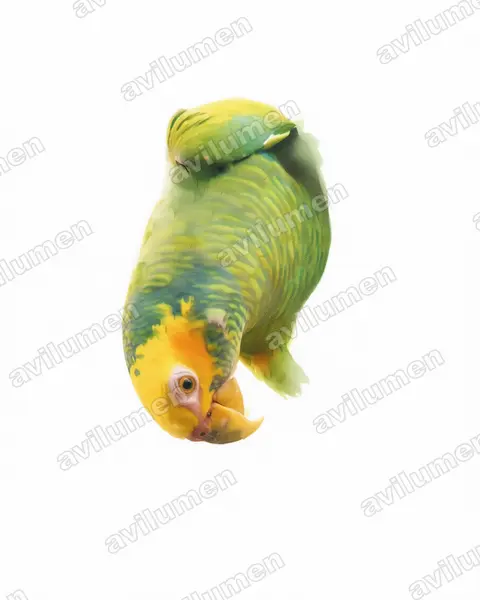
Watercolor 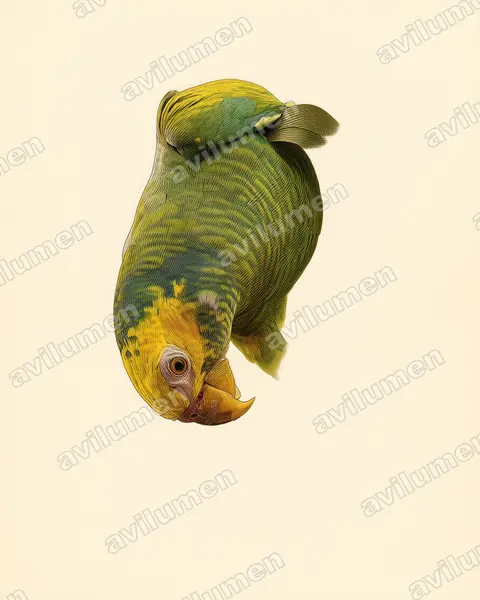
Vintage plate 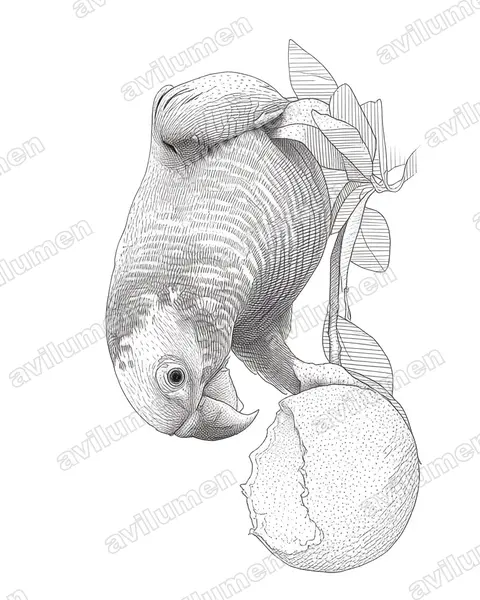
Ink 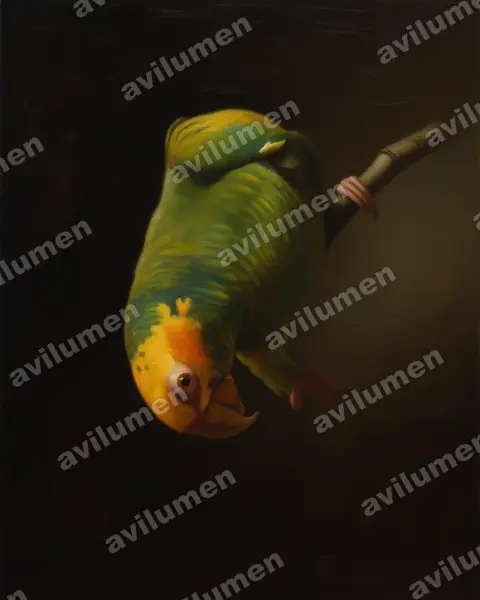
Oil 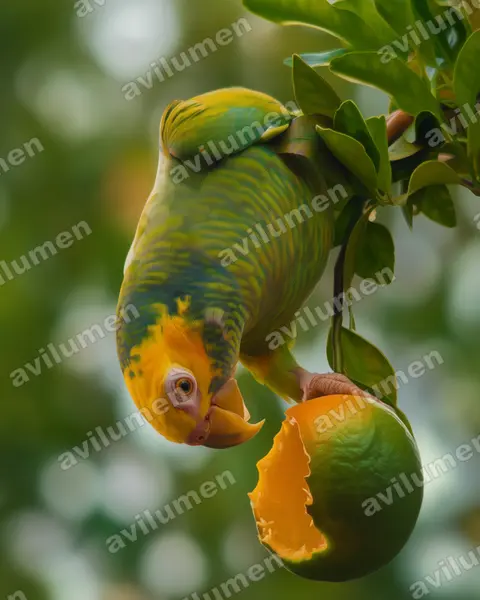
Realistic 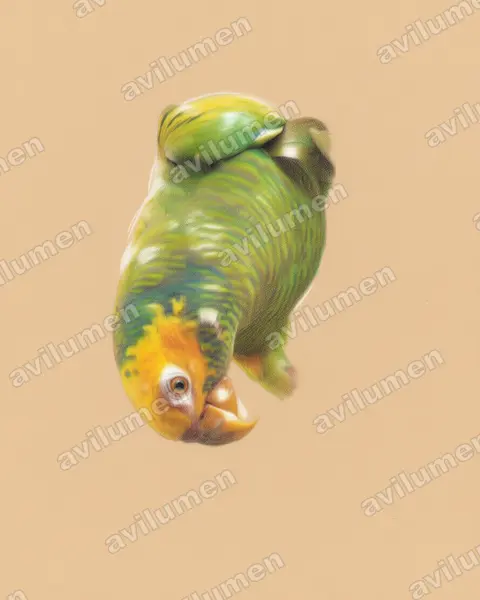
Colored pencil
Illustrations based on the photograph by Jairmoreirafotografia (CC BY-SA 4.0), from Wikimedia Commons.
Digital editions
HD Digital Art Pack — Yellow-faced Parrot
Digital download: 6 high-resolution illustrations of the Yellow-faced Parrot (Alipiopsitta xanthops), print-ready. This is a digital file; no animal or physical item is included.
AI Avatar — Yellow-faced Parrot
Generate an avatar fusing your face with the Yellow-faced Parrot (Alipiopsitta xanthops). Delivered digitally in 8K, watermark-free. Digital product; no animals are sold or brokered.
Instant download. No live birds are sold.
Frequently asked questions
- Is Alipiopsitta xanthops (Yellow-faced Parrot) endangered?
- The IUCN Red List places Alipiopsitta xanthops, commonly known as the Yellow-faced Parrot, in the «Near threatened» category. «Near threatened» means it is not threatened yet, but is close to becoming so.
- Where does Alipiopsitta xanthops (Yellow-faced Parrot) live?
- Alipiopsitta xanthops (Yellow-faced Parrot) is found in Brazil and South America.
- What family does Alipiopsitta xanthops (Yellow-faced Parrot) belong to?
- Alipiopsitta xanthops (Yellow-faced Parrot) belongs to the family Psittacidae, in the order Psittaciformes.
- What colour is Alipiopsitta xanthops (Yellow-faced Parrot)?
- The plumage of Alipiopsitta xanthops (Yellow-faced Parrot) combines these colours: Green and Yellow.
More from the same family
 Least concern
Moluccan King Parrot
Alisterus amboinensis
The Moluccan king parrot is a parrot endemic to Peleng Island, Maluku, and West Papua in Indonesia. It is sometimes referred to as the Ambon king parrot or Amboina king parrot, but this is potentially misleading, as it is found on numerous other islands than Ambon. The male and female are similar in appearance, with a predominantly red head and underparts, green wings, and blue back and tail.
from $1.99
 Least concern
Papuan King Parrot
Alisterus chloropterus
The Papuan king parrot, also known as the green-winged king parrot, is a species of parrot in the family Psittaculidae found in New Guinea. Its natural habitats are subtropical or tropical moist lowland forest and subtropical or tropical moist montane forest.
from $1.99
 Least concern
Australian King Parrot
Alisterus scapularis
The Australian king parrot is a species of parrot endemic to eastern Australia ranging from Cooktown in Queensland to Port Campbell in Victoria. Found in humid and heavily forested upland regions of the eastern portion of the continent, including eucalyptus wooded areas in and directly adjacent to subtropical and temperate rainforest. They feed on fruits and seeds gathered from trees or on the ground.
from $1.99
 Near threatened
Blue-fronted Parrot
Amazona aestiva
The blue-fronted amazon, also called the blue-fronted parrot, the turquoise-fronted amazon and the turquoise-fronted parrot, is a South American species of amazon parrot and one of the most common amazon parrots kept in captivity as a pet or companion parrot. Its common name is derived from the distinctive blue/turquoise marking on its head just above its beak.
from $1.99