Moluccan King Parrot
Alisterus amboinensis
Avilumen editorial team ·

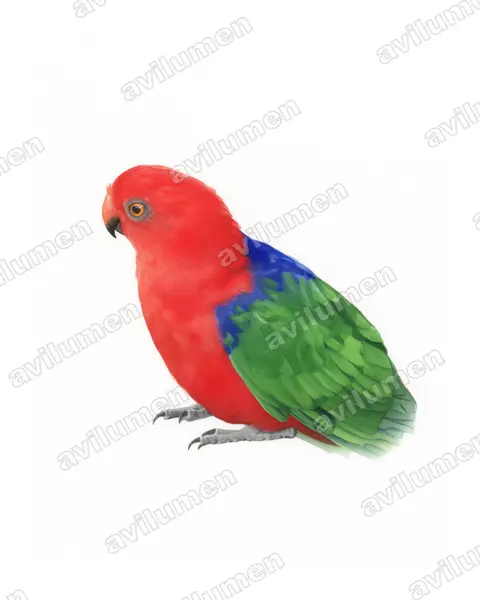
The Moluccan king parrot is a parrot endemic to Peleng Island, Maluku, and West Papua in Indonesia. It is sometimes referred to as the Ambon king parrot or Amboina king parrot, but this is potentially misleading, as it is found on numerous other islands than Ambon. The male and female are similar in appearance, with a predominantly red head and underparts, green wings, and blue back and tail.
The Moluccan king parrot (Alisterus amboinensis) is a parrot endemic to Peleng Island, Maluku, and West Papua in Indonesia. It is sometimes referred to as the Ambon king parrot or Amboina king parrot, but this is potentially misleading, as it is found on numerous other islands than Ambon. The male and female are similar in appearance, with a predominantly red head and underparts, green wings (blue in one subspecies), and blue back and tail. Six subspecies are recognised, but only a few of these are regular in aviculture. In the wild, it inhabits rainforests and feeds on fruits, berries, seeds and buds.
Taxonomy
In 1760 the French zoologist Mathurin Jacques Brisson included a description of the Moluccan king parrot in his Ornithologie based on a specimen collected on the island of Ambon in Indonesia. He used the French name La perruche rouge d'Amboine and the Latin name Psittaca amboinensis coccinea. Although Brisson coined Latin names, these do not conform to the binomial system and are not recognised by the International Commission on Zoological Nomenclature. When in 1766 the Swedish naturalist Carl Linnaeus updated his Systema Naturae for the twelfth edition he added 240 species that had been previously described by Brisson. One of these was the Moluccan king parrot. Linnaeus included a terse description, coined the binomial name Psittacus amboinensis and cited Brisson's work. This species is now placed in the genus Alisterus which was introduced by the Australian amateur ornithologist Gregory Mathews in 1911.
The Moluccan king parrot is one of three species collectively known as king parrots found in Australia, Papua New Guinea, and Indonesia.
There are six subspecies:
A. a. amboinensis (Linnaeus, 1766) is the nominate subspecies and found on Ambon and Seram.
A. a. buruensis (Salvadori, 1876) is found on Buru in central Maluku.
A. a. dorsalis (Quoy & Gaimard, 1830) is found in West Papua. The red plumage is slightly darker in this subspecies.
A. a. hypophonius (S. Müller, 1843) has all blue wings and is endemic to Halmahera in northern Maluku.
A. a. sulaensis (Reichenow, 1881) is found on the Sula Islands.
A. a. versicolor Neumann, 1939 is endemic to the island of Peleng of the Banggai Islands.
Description
An adult Moluccan king parrot measures 35–40 cm (14 in) in length and has a red head and chest, outer wings dull green (except in subspecies A. a. hypophonius, which are blue), mantle, lesser wing coverts and tail-coverts dark purple-blue. Tail darker blackish blue, irises orange, and the legs are dark grey. The lower mandible is blackish, and the upper mandible is orange-red with a blackish tip, except in the subspecies A. a. buruensis, where the entire bill is blackish. Unlike the other species of king parrots, the Moluccan king parrot does not display sexual dimorphism; that is, the sexes have similar plumage. Juvenile birds have a dark-brown bill tipped paler, greenish mantle, dark brown irises and red-tips to lateral tail feathers. Birds reach maturity in one year.
Behavior
Encountered alone or in pairs, occasionally in small groups, it mainly frequents dense cover in the lower and mid-levels of forests. It is inconspicuous and rather quiet, except in flight. It consumes fruit, berries, seeds and buds. Nesting takes place in a tree-hollow. The breeding season begins in February and March, although breeding has not been observed in the wild, in captivity the clutch consists of two eggs which are incubated for 19 days. After hatching the chicks are ready to fledge at nine weeks old.
Habitat and status
The Moluccan king parrot inhabits rainforests, but sometimes enters nearby plantations and gardens. Exceptionally, it occurs at altitude up to 2100 m, but more commonly below 1200 m (New Guinea) or 1600 m (Maluku).
It is generally uncommon due to habitat loss and capture for the parrot trade, but remains locally common at least on the Sula Islands, Halmahera, and Buru. Overall, the species is not believed to be in immediate danger, and consequently is listed as least concern by BirdLife International and IUCN. As most parrots, the Moluccan king parrot is listed in Appendix II of CITES.
Aviculture
Until recently, only the subspecies A. a. amboinensis and A. a. hypophonius were regularly seen in aviculture, but A. a. buruensis and A. a. dorsalis are now also present, at least in zoos. It has regularly been bred in captivity, for example in Denmark.
Text adapted from Wikipedia · CC BY-SA 4.0
Taxonomy
- Order
- Psittaciformes
- Family
- Psittacidae
- Genus
- Alisterus
- Conservation status
- Least concern
Listen to its call
No recording yet
Care guide
Budgie, Conure and Parakeet Care Guide
How to care for budgies, conures, parrotlets, ringnecks and other parakeets: diet, cage setup, health, behavior, breeding and legal status for owners.
Read the guide →Illustration gallery
6 illustrations of Alisterus amboinensis (Moluccan King Parrot) in different styles, true to its real plumage. Shown watermarked; the art pack includes the high-resolution originals, ready to print.
Watercolor 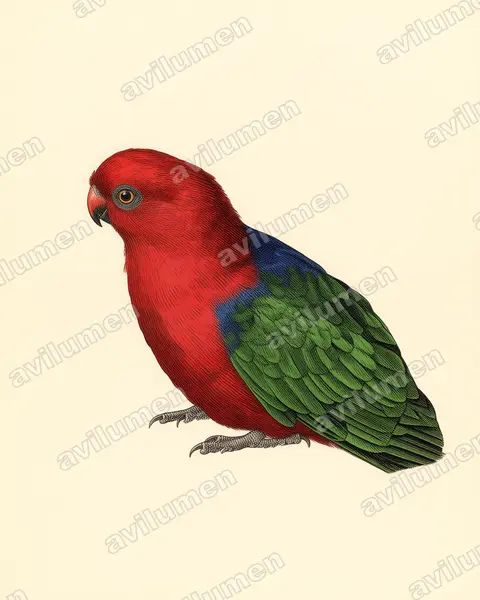
Vintage plate 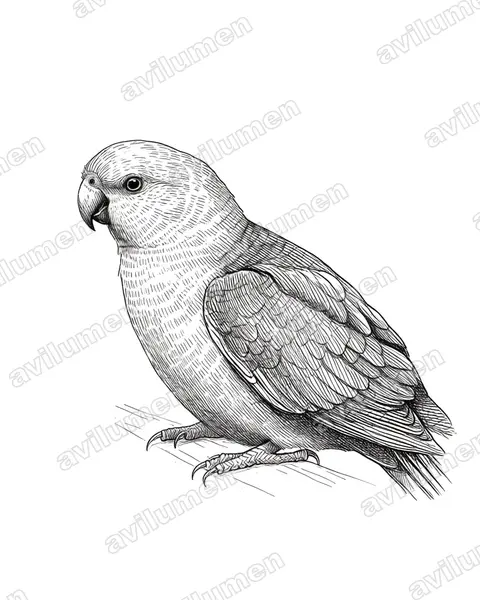
Ink 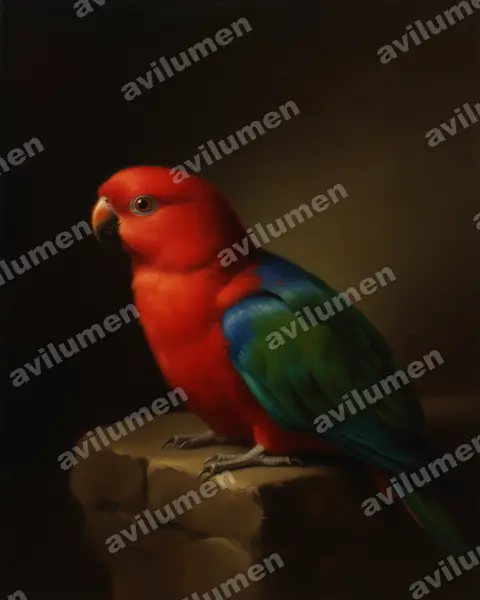
Oil 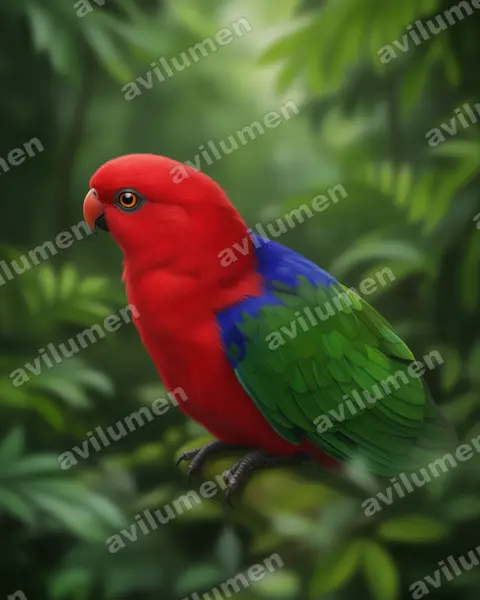
Realistic 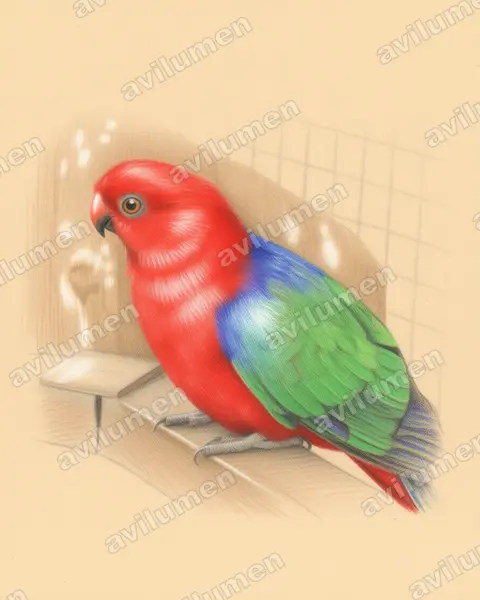
Colored pencil
Illustrations based on the photograph by Alisterus_amboinensis_-Brevard_Zoo-8b.jpg: Scott Hamlin derivative work: Snowmanradio (talk) (CC BY-SA 2.0), from Wikimedia Commons.
Digital editions
HD Digital Art Pack — Moluccan King Parrot
Digital download: 6 high-resolution illustrations of the Moluccan King Parrot (Alisterus amboinensis), print-ready. This is a digital file; no animal or physical item is included.
AI Avatar — Moluccan King Parrot
Generate an avatar fusing your face with the Moluccan King Parrot (Alisterus amboinensis). Delivered digitally in 8K, watermark-free. Digital product; no animals are sold or brokered.
Instant download. No live birds are sold.
Frequently asked questions
- Is Alisterus amboinensis (Moluccan King Parrot) endangered?
- The IUCN Red List places Alisterus amboinensis, commonly known as the Moluccan King Parrot, in the «Least concern» category. «Least concern» means it is not currently threatened.
- Where does Alisterus amboinensis (Moluccan King Parrot) live?
- Alisterus amboinensis (Moluccan King Parrot) is found in Indonesia.
- What family does Alisterus amboinensis (Moluccan King Parrot) belong to?
- Alisterus amboinensis (Moluccan King Parrot) belongs to the family Psittacidae, in the order Psittaciformes.
- What colour is Alisterus amboinensis (Moluccan King Parrot)?
- The plumage of Alisterus amboinensis (Moluccan King Parrot) combines these colours: Red, Green, and Blue.
More from the same family
 Near threatened
Yellow-faced Parrot
Alipiopsitta xanthops
The yellow-faced parrot, formerly also known as the yellow-faced amazon, is the only species of the genus Alipiopsitta. It is a Neotropical parrot, and was classified in the genus Amazona for many years. It is a predominantly green and yellow-plumaged bird with a yellow head. It is a semi-nomadic species found in the cerrado region of Brazil and adjacent Bolivia.
from $1.99
 Least concern
Papuan King Parrot
Alisterus chloropterus
The Papuan king parrot, also known as the green-winged king parrot, is a species of parrot in the family Psittaculidae found in New Guinea. Its natural habitats are subtropical or tropical moist lowland forest and subtropical or tropical moist montane forest.
from $1.99
 Least concern
Australian King Parrot
Alisterus scapularis
The Australian king parrot is a species of parrot endemic to eastern Australia ranging from Cooktown in Queensland to Port Campbell in Victoria. Found in humid and heavily forested upland regions of the eastern portion of the continent, including eucalyptus wooded areas in and directly adjacent to subtropical and temperate rainforest. They feed on fruits and seeds gathered from trees or on the ground.
from $1.99
 Near threatened
Blue-fronted Parrot
Amazona aestiva
The blue-fronted amazon, also called the blue-fronted parrot, the turquoise-fronted amazon and the turquoise-fronted parrot, is a South American species of amazon parrot and one of the most common amazon parrots kept in captivity as a pet or companion parrot. Its common name is derived from the distinctive blue/turquoise marking on its head just above its beak.
from $1.99