Green-throated mango
Anthracothorax viridigula
Avilumen editorial team ·

The green-throated mango is a species of hummingbird in the subfamily Polytminae. It is found in Brazil, the Guianas, Trinidad, and Venezuela.
The green-throated mango (Anthracothorax viridigula) is a species of hummingbird in the subfamily Polytminae. It is found in Brazil, the Guianas, Trinidad, and Venezuela.
Taxonomy and systematics
The green-throated mango was described by the French polymath Georges-Louis Leclerc, Comte de Buffon in 1780 in his Histoire Naturelle des Oiseaux from a specimen collected in Cayenne, French Guiana. The bird was also illustrated in a hand-colored plate engraved by François-Nicolas Martinet in the Planches Enluminées D'Histoire Naturelle which was produced under the supervision of Edme-Louis Daubenton to accompany Buffon's text. Neither the plate caption nor Buffon's description included a scientific name but in 1783 the Dutch naturalist Pieter Boddaert coined the binomial name Trochilus viridigula in his catalogue of the Planches Enluminées. The green-throated mango is now placed in the genus Anthracothorax that was introduced by the German zoologist Friedrich Boie in 1831. The species is monotypic.
The generic name combines the Ancient Greek anthrax meaning "coal" (i.e. black) and thōrax meaning "chest". The specific epithet viridigula is from the Latin viridis meaning "green" and gula meaning "throat".
Description
The green-throated mango is 10.5 to 12.5 cm (4.1 to 4.9 in) long. Males weigh 7.5 to 8.5 g (0.26 to 0.30 oz), and females weigh about 6.0 g (0.21 oz). The longish black bill is slightly decurved. The male has glossy bronzy-green upperparts. Its throat and underparts are green with a black central line on the breast and belly. The central tail feathers are dark brown to green, and the others are shiny purple, with the outermost ones having dark blue tips. The female green-throated mango's upperparts are also bronzy-green but with more of a reddish tinge than the male's. She has white underparts with a black central stripe. The tail is similar to the male's but with white tips on the outermost feathers. Juveniles resemble females but have chestnut underparts.
This species closely resembles the related black-throated mango. While the male green-throated mango has less extensive black coloring on the underparts, confirming the bird's identity can be challenging in the field as both species may appear entirely black. The females of the two species are nearly indistinguishable, though the green-throated mango typically exhibits more extensive coppery upperparts than its relative.
Distribution and habitat
The green-throated mango is found along the coast from northeastern Venezuela through Guyana, Suriname, and French Guiana into Brazil, as far east as Maranhão and along the Amazon River inland to the Negro River. It is also present in Trinidad but not Tobago. This bird inhabits mangrove swamp, moist lowland savannas, and similar swampy areas with scattered large trees. Its elevation range is from sea level up to 500 m (1,600 ft).
Movement
The green-throated mango is sedentary in the coastal part of its range; inland it moves seasonally to follow the flowering of trees.
Feeding
The green-throated mango feeds on the nectar of tall flowering trees, where males defend feeding territories. The species is also notably insectivorous, catching small arthropod prey on the wing or by gleaning from foliage.
Breeding
Green-throated mango nests have been found year round, though in the Guianas most have been noted between January and March. Females build a cup nest on an exposed horizontal branch of a large tree, typically at least 10 m (33 ft) above ground. The clutch size is two eggs. The incubation time is 14 to 15 days with fledging usually 24 to 25 days after hatch.
Vocalization
The green-throated mango is not highly vocal. Its song has been described as a "very high, slightly descending, trill, like 'f'srrrrrrih-tjew tjuh'." It makes a "chep...chep..." call in flight or when hovering at flowers.
Status
The IUCN has assessed the green-throated mango as being of Least Concern, though its population size is not known and is believed to be decreasing. It is generally locally common in the coastal zone and less so along the Amazon. It is rare in Trinidad due to habitat loss.
Text adapted from Wikipedia · CC BY-SA 4.0
Where it lives
Distribution

Taxonomy
- Order
- Apodiformes
- Family
- Trochilidae
- Genus
- Anthracothorax
- Conservation status
- Least concern
Listen to its call
No recording yet
Illustration gallery
6 illustrations of Anthracothorax viridigula (Green-throated mango) in different styles, true to its real plumage. Shown watermarked; the art pack includes the high-resolution originals, ready to print.
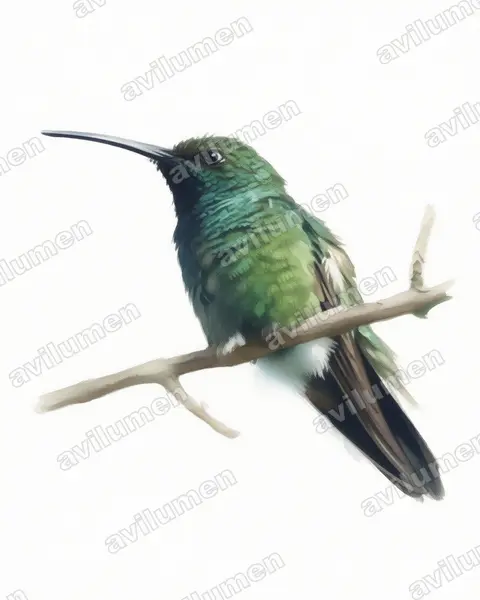
Watercolor 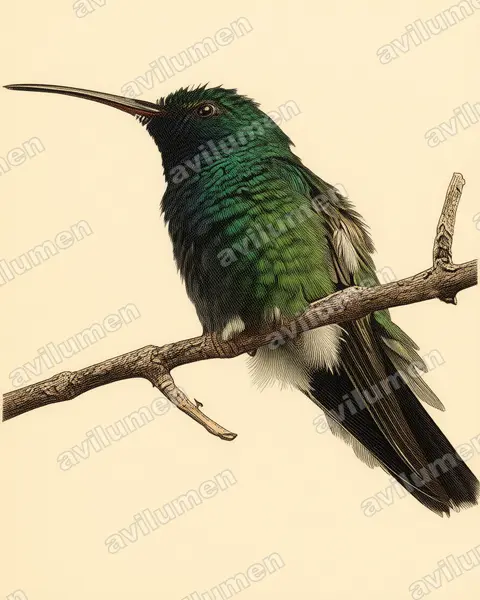
Vintage plate 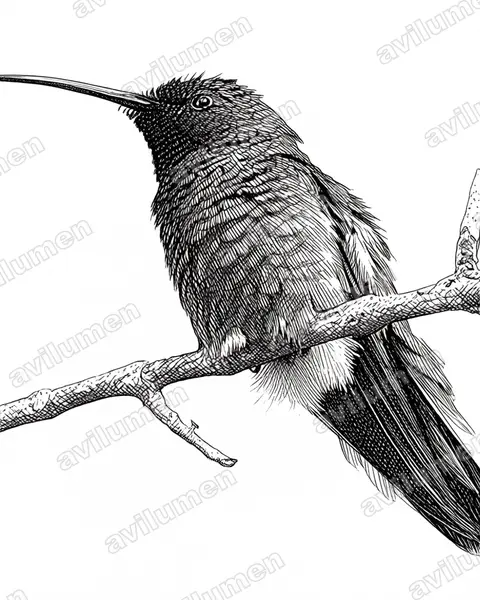
Ink 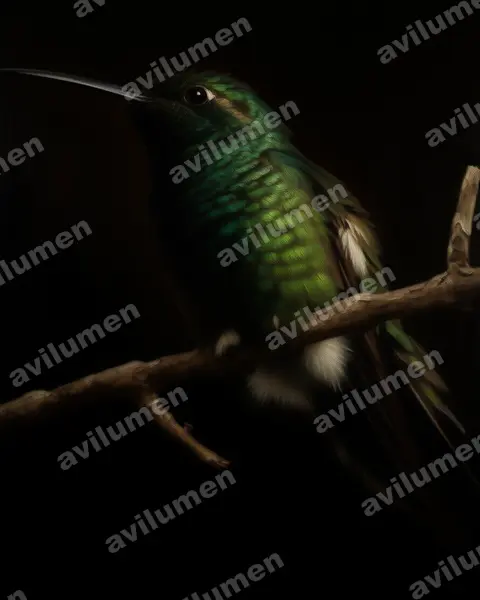
Oil 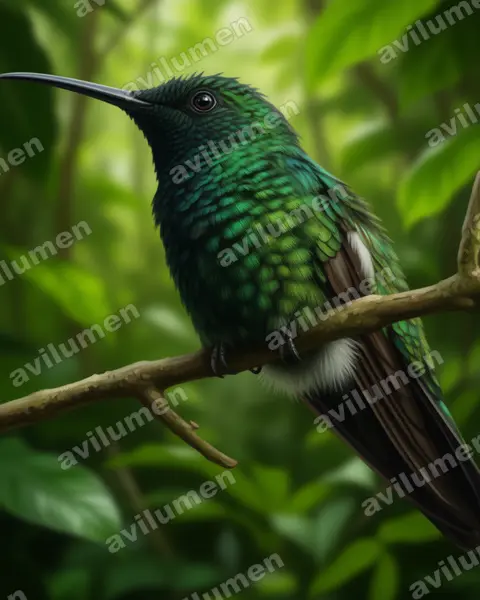
Realistic 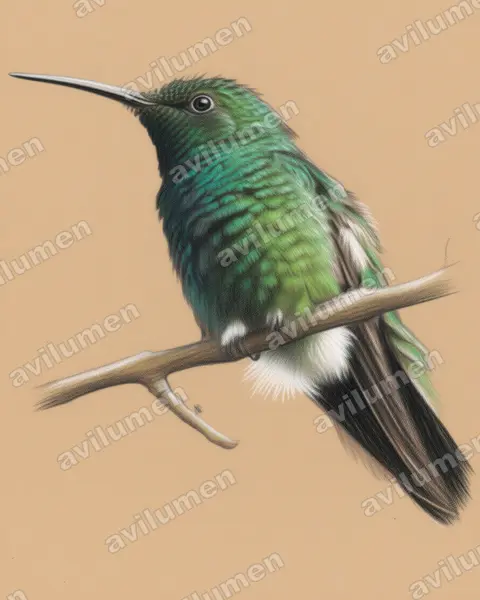
Colored pencil
Illustrations based on the photograph by Steve Garvie from Dunfermline, Fife, Scotland (CC BY-SA 2.0), from Wikimedia Commons.
Digital editions
HD Digital Art Pack — Green-throated mango
Digital download: 6 high-resolution illustrations of the Green-throated mango (Anthracothorax viridigula), print-ready. This is a digital file; no animal or physical item is included.
AI Avatar — Green-throated mango
Generate an avatar fusing your face with the Green-throated mango (Anthracothorax viridigula). Delivered digitally in 8K, watermark-free. Digital product; no animals are sold or brokered.
Instant download. No live birds are sold.
Frequently asked questions
- Is Anthracothorax viridigula (Green-throated mango) endangered?
- The IUCN Red List places Anthracothorax viridigula, commonly known as the Green-throated mango, in the «Least concern» category. «Least concern» means it is not currently threatened.
- Where does Anthracothorax viridigula (Green-throated mango) live?
- Anthracothorax viridigula (Green-throated mango) is found in Brazil and South America.
- What family does Anthracothorax viridigula (Green-throated mango) belong to?
- Anthracothorax viridigula (Green-throated mango) belongs to the family Trochilidae, in the order Apodiformes.
- What colour is Anthracothorax viridigula (Green-throated mango)?
- The plumage of Anthracothorax viridigula (Green-throated mango) combines these colours: Green and Brown.
More from the same family
 Least concern
Emerald-chinned Hummingbird
Abeillia abeillei
The emerald-chinned hummingbird is a species of hummingbird in the "emeralds", tribe Trochilini of subfamily Trochilinae.
from $1.99
 Least concern
Speckled hummingbird
Adelomyia melanogenys
The speckled hummingbird is a species of hummingbird. It is the only member of the genus Adelomyia. It inhabits Neotropical montane cloud forests at elevations of 1,000–2,500 meters and is confined to the Andes of Argentina, Bolivia, Peru, Ecuador, Colombia and Venezuela; as well as to some isolated montane forests in western Ecuador and Venezuela.
from $1.99
 Vulnerable
Purple-backed sunbeam
Aglaeactis aliciae
The purple-backed sunbeam is a bird species in the family Trochilidae. It is found only in Peru.
from $1.99
 Near threatened
White-tufted sunbeam
Aglaeactis castelnaudii
The white-tufted sunbeam is a species of hummingbird in the family Trochilidae. It is found only in Peru. Its natural habitats are subtropical or tropical moist montane forest and subtropical or tropical high-altitude shrubland.
from $1.99