Hooded visorbearer
Augastes lumachella
Avilumen editorial team ·

The hooded visorbearer is a small species of hummingbird in the family Trochilidae. Endemic to the east Brazilian state of Bahia, it is found only at higher altitudes in the Chapada Diamantina region. The species is sexually dimorphic. It resides in the campo rupestre, an arid, high-elevation area characterized by rocky outcrops, poor soils, open habitats, and harsh climatic conditions.
The hooded visorbearer (Augastes lumachella) is a small species of hummingbird in the family Trochilidae. Endemic to the east Brazilian state of Bahia, it is found only at higher altitudes in the Chapada Diamantina region. The species is sexually dimorphic.
It resides in the campo rupestre, an arid, high-elevation area characterized by rocky outcrops, poor soils, open habitats, and harsh climatic conditions. There, it feeds primarily on nectar, though it also takes insects. Its breeding ecology remains largely undescribed, though it is known to build its nest from cactus spines. The International Union for Conservation of Nature rates it as a near-threatened species, primarily because of the relatively small size of its range. It is threatened by habitat loss, brought about primarily by unregulated mining and the conversion of the campo to pastureland and human habitation. Climate change is projected to cause a major contraction of its range – perhaps by as much as 90%.
Taxonomy and systematics
Rene Primevere Lesson first described the hooded visorbearer for science in 1838, using a specimen collected in Bahia, Brazil. He named it Ornismya lumachella. Five years later, Lesson moved it and four other species to his newly created genus Amazilis. John Gould moved it again in 1849, when he created the genus Augastes for this species and the hyacinth visorbearer, another east Brazilian endemic. There are no subspecies. DNA studies have shown that the two Augastes hummingbirds are sister species, and that the genus is most closely related to Geoffroy's daggerbill.
The genus name Augastes comes directly from the Ancient Greek augastes, meaning "radiant" or "light-giver". The species name lumachella is an Italian word for fire marble – a dark limestone that contains fossilised shells; it is a diminutive of the word for snail (lumacha). Although the species name is sometimes written as lumachellus rather than lumachella, this is incorrect; because it is an Italian word (rather than a Latinized one), it is considered to be invariable.
Description
The hooded visorbearer is a small hummingbird, measuring 8.3–10 cm (3.3–3.9 in) in length and weighing 4–4.8 g (0.14–0.17 oz). Its short, straight bill is black. The species is moderately sexually dimorphic. The male is an iridescent bronzy-green color on the upperparts and underparts. His forehead and throat are an iridescent golden-green with a narrow border of bluish-green at the lower edge of the throat. The sides and crown of his head are black, and a thin line of black borders his gorget. He has a narrow white breast band with a golden-orange spot in the center and purplish-brown wings. His tail is a deep bronzy-crimson. The female's coloring is more subdued. She is more bronzy on her upperparts and underparts, and her head is green instead of black. She has a gray face and the sides of her head are brown, rather than black. The green on her throat is less colorful and iridescent than that of the male's, with a stronger border of bluish-green at the lower edge; the color does not extend to her forehead. Immature birds are bronzy-green above and brown below, with a white throat speckled with green. Their tails are a coppery-bronze above and crimson below, less brilliantly-colored than those of adults. The combination of head pattern and tail color is said to make this species "unmistakable" within its small natural range.
Voice
The song of the hooded visorbearer is described as "nasal" and "dry". Transcribed as tru tweé tru zee, its short phrases are typically repeated more than three times in a row.
Range and habitat
The hooded visorbearer is endemic to eastern Brazil. Found only in the Chapada Diamantina region of Bahia, it is restricted to campo rupestre, a high-elevation ecoregion that is characterized by poor soils, open vegetation, rocky outcrops and harsh climatic conditions. Its occurs at elevations ranging from 900 to 2,000 m (3,000 to 6,600 ft), and is considered to be one of South America's obligate grassland birds. It is found in rocky, semi-arid areas with cactus and low shrubs on the summits of mountains and mesas.
Feeding
Like all hummingbirds, the hooded visorbearer feeds primarily on nectar, though it will also take insects. It typically forages low, often less than 1 m (3 ft 3 in) from the ground. It is known to visit Vriesea flowers early in the day, while the flowers (which are primarily bat-pollinated) still hold some residual nectar.
Breeding
Little is known of the breeding ecology of the hooded visorbearer. It builds its nest from cactus spines, usually about a metre (just over three feet) off the ground.
Conservation and threats
For several decades in the 20th century, the species was thought to have gone extinct. Then, in 1961, Brazilian naturalist Augusto Ruschi led an expedition to an area where they had been collected in the past, and rediscovered them. The International Union for Conservation of Nature now rates the hooded visorbearer as a near-threatened species, based primarily on its relatively small range. The decline of suitable habitat in both size and quality is ongoing, primarily as a result of uncontrolled fires and climate change. Projections suggest that the visorbearer's range may shrink by as much as 90% by 2060 due to the effects of climage change. The mining of gold, diamonds, quartz and manganese within its range detrimentally affects habitat, as does the conversion of natural areas to animal pasturage and human habitation. Although its population has not been quantified, its numbers are thought to be declining.
Relationship with humans
The hooded visorbearer is considered to be among the handful of birds in the Chapada Diamantina that prove particularly attractive to birdwatchers. Trails have been created in the Chapada Diamantina National Park to enable ecotourists to enter the habitat in which they are found.
Text adapted from Wikipedia · CC BY-SA 4.0
Where it lives
Distribution

Taxonomy
- Order
- Apodiformes
- Family
- Trochilidae
- Genus
- Augastes
- Conservation status
- Near threatened
Listen to its call
No recording yet
Illustration gallery
6 illustrations of Augastes lumachella (Hooded visorbearer) in different styles, true to its real plumage. Shown watermarked; the art pack includes the high-resolution originals, ready to print.
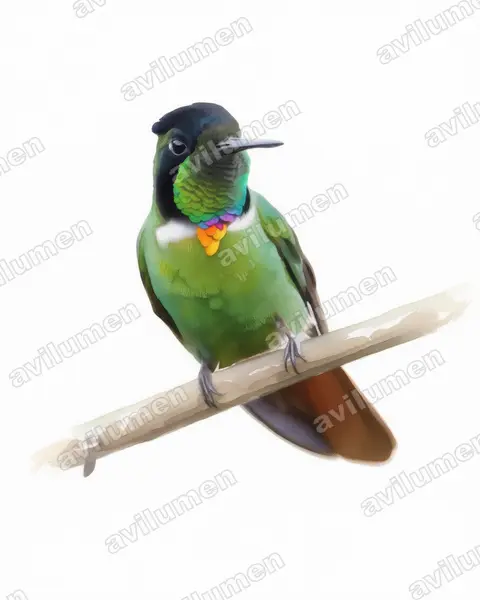
Watercolor 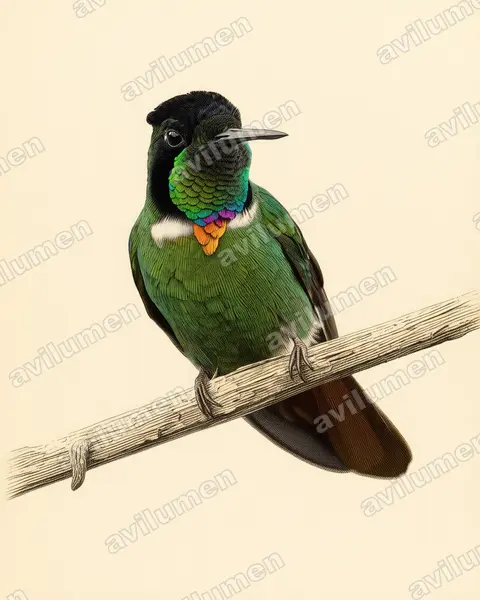
Vintage plate 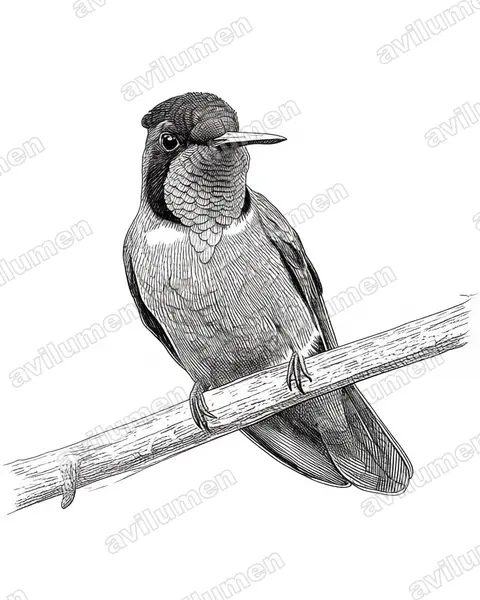
Ink 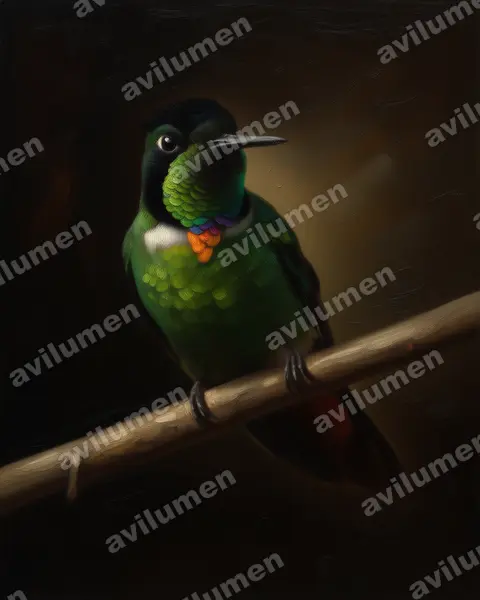
Oil 
Realistic 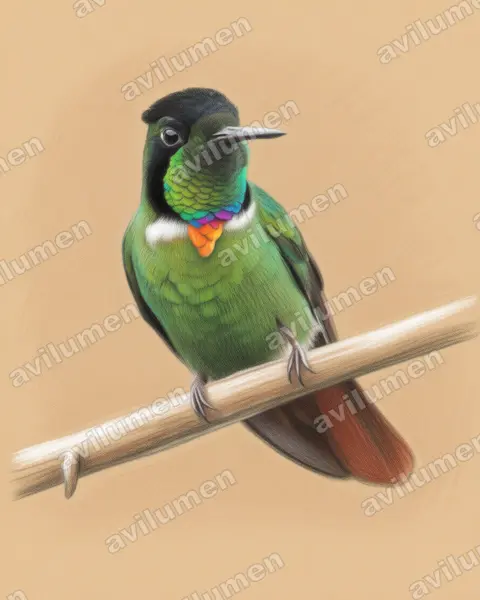
Colored pencil
Illustrations based on the photograph by Joao Quental (CC BY 2.0), from Wikimedia Commons.
Digital editions
HD Digital Art Pack — Hooded visorbearer
Digital download: 6 high-resolution illustrations of the Hooded visorbearer (Augastes lumachella), print-ready. This is a digital file; no animal or physical item is included.
AI Avatar — Hooded visorbearer
Generate an avatar fusing your face with the Hooded visorbearer (Augastes lumachella). Delivered digitally in 8K, watermark-free. Digital product; no animals are sold or brokered.
Instant download. No live birds are sold.
Frequently asked questions
- Is Augastes lumachella (Hooded visorbearer) endangered?
- The IUCN Red List places Augastes lumachella, commonly known as the Hooded visorbearer, in the «Near threatened» category. «Near threatened» means it is not threatened yet, but is close to becoming so.
- Where does Augastes lumachella (Hooded visorbearer) live?
- Augastes lumachella (Hooded visorbearer) is found in Brazil and South America.
- What family does Augastes lumachella (Hooded visorbearer) belong to?
- Augastes lumachella (Hooded visorbearer) belongs to the family Trochilidae, in the order Apodiformes.
- What colour is Augastes lumachella (Hooded visorbearer)?
- The plumage of Augastes lumachella (Hooded visorbearer) combines these colours: Green and Blue.
More from the same family
 Least concern
Emerald-chinned Hummingbird
Abeillia abeillei
The emerald-chinned hummingbird is a species of hummingbird in the "emeralds", tribe Trochilini of subfamily Trochilinae.
from $1.99
 Least concern
Speckled hummingbird
Adelomyia melanogenys
The speckled hummingbird is a species of hummingbird. It is the only member of the genus Adelomyia. It inhabits Neotropical montane cloud forests at elevations of 1,000–2,500 meters and is confined to the Andes of Argentina, Bolivia, Peru, Ecuador, Colombia and Venezuela; as well as to some isolated montane forests in western Ecuador and Venezuela.
from $1.99
 Vulnerable
Purple-backed sunbeam
Aglaeactis aliciae
The purple-backed sunbeam is a bird species in the family Trochilidae. It is found only in Peru.
from $1.99
 Near threatened
White-tufted sunbeam
Aglaeactis castelnaudii
The white-tufted sunbeam is a species of hummingbird in the family Trochilidae. It is found only in Peru. Its natural habitats are subtropical or tropical moist montane forest and subtropical or tropical high-altitude shrubland.
from $1.99