Rhinoceros Hornbill
Buceros rhinoceros
Avilumen editorial team ·

The rhinoceros hornbill is a large species of forest hornbill. In captivity, it can live for up to 35 years. It is found in lowland and montane, tropical and subtropical climates and in mountain rain forests up to 1,400 metres in the Malay Peninsula from southern Thailand; and the islands of Singapore, Borneo, Sumatra and Java.
The rhinoceros hornbill (Buceros rhinoceros) is a large species of forest hornbill. In captivity, it can live for up to 35 years. It is found in lowland and montane, tropical and subtropical climates and in mountain rain forests up to 1,400 metres in the Malay Peninsula from southern Thailand; and the islands of Singapore, Borneo, Sumatra and Java.
The rhinoceros hornbill is the state bird of the Malaysian state of Sarawak and the country's national bird. It is scheduled as a "totally protected animal" under Sarawak law through the 1998 Wild Life Protection Ordinance.
Taxonomy
The rhinoceros hornbill was formally described by the Swedish naturalist Carl Linnaeus in 1758 in the tenth edition of his Systema Naturae. He placed it with the great hornbill in the genus Buceros and coined the binomial name Buceros rhinoceros, where he specified the location as India. The genus name comes from Ancient Greek βοῦς boûs meaning "ox", and κέρας kéras meaning "horn"; the species epithet rhinoceros comes from how the species' bill resembles a rhinoceros' horn.
Three subspecies are recognised:
B. r. borneoensis Schlegel & Müller, S, 1845 – Borneo
B. r. rhinoceros Linnaeus, 1758 – south Malay Peninsula and Sumatra
B. r. silvestris Vieillot, 1816 – Java
Description
The rhinoceros hornbill is a large arboreal hornbill, 80 to 90 cm (31–35 in) long. The weight varies by sex, with males weighing around 2,465 to 2,960 g (87.0–104.4 oz) and the females 2,040 to 2,330 g (72–82 oz). The plumage is predominantly black, with white legs and vent and a white tail with a black band. The huge bill and casque are orange and red, the colour coming from preen oil rubbed on from the preen gland above the tail. The eyes of the male are red with black rims, and white with red rims in the female.
Diet and feeding
The diet of the rhinoceros hornbill is dominated by fruit, but it will take any insect, small reptile, rodent, and smaller birds that it can catch.
Breeding
The courtship and bonding of these birds are critical, as the female must trust the male to provide her with everything when she is incubating and raising chicks. These hornbills make their nests inside tree trunks, and the female stays inside with the eggs and then with the chicks, while the male brings them food. After the eggs are laid, the male collects mud, and the pair pack that mud, along with food and feces, to wall up the entrance to the tree cavity. They leave a very small hole, just large enough for the male to feed the female, and later the chicks, and for the female to defecate through the hole. Once the chicks are fully feathered and old enough to leave the nest, the parents chip away the dry mud to let the chicks out.
There has been recording interbreeding between the rhinoceros hornbill and the great hornbill, with successful raising of the chicks.
Status and conservation
The rhinoceros hornbill faces a number of threats, including loss of its rainforest habitat, as well as hunting for its meat, and its skull and feathers. Habitat destruction has led to the loss of the large trees the species requires for breeding, which in turn makes it easier for poachers to find the rhinoceros hornbill. It is frequently shot at by poachers due to confusion with the highly sought-after helmeted hornbill. Due to this, the species was uplisted to vulnerable from near threatened on the IUCN Red List in 2018.
Cultural significance
Some Dayak people, especially the Ibanic groups, believe it to be the chief of worldly birds or the supreme worldly bird, and its statue is used to welcome the god of the augural birds, Sengalang Burong, to the feasts and celebrations of humankind. Contrary to some misunderstandings, the rhinoceros hornbill does not represent their war god, who is represented in this world by the brahminy kite.
It is featured on the reverse of the 5 Malaysian ringgit bill.
Text adapted from Wikipedia · CC BY-SA 4.0
Taxonomy
- Order
- Bucerotiformes
- Family
- Bucerotidae
- Genus
- Buceros
- Conservation status
- Vulnerable
Listen to its call
No recording yet
Illustration gallery
6 illustrations of Buceros rhinoceros (Rhinoceros Hornbill) in different styles, true to its real plumage. Shown watermarked; the art pack includes the high-resolution originals, ready to print.
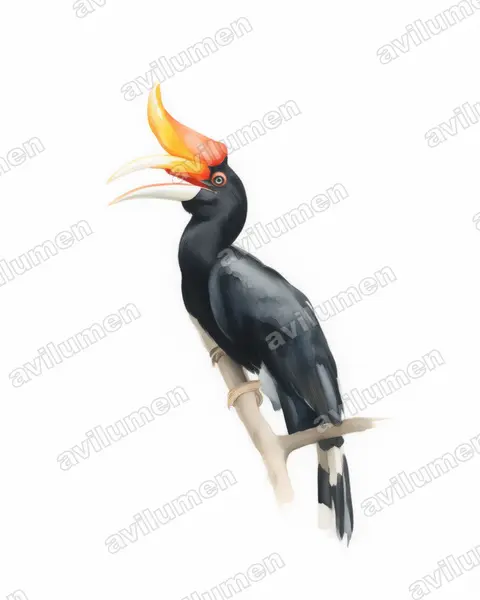
Watercolor 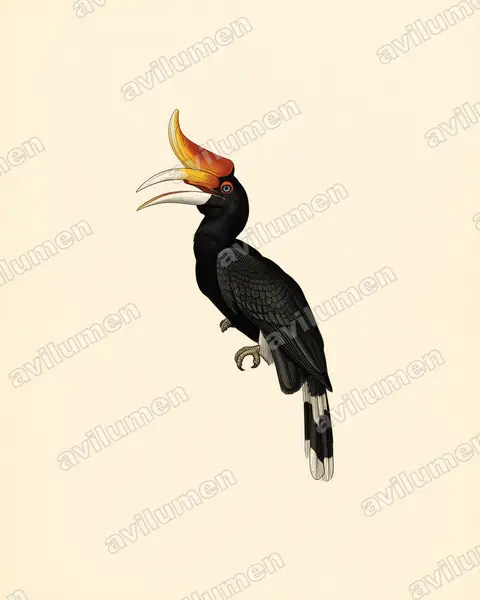
Vintage plate 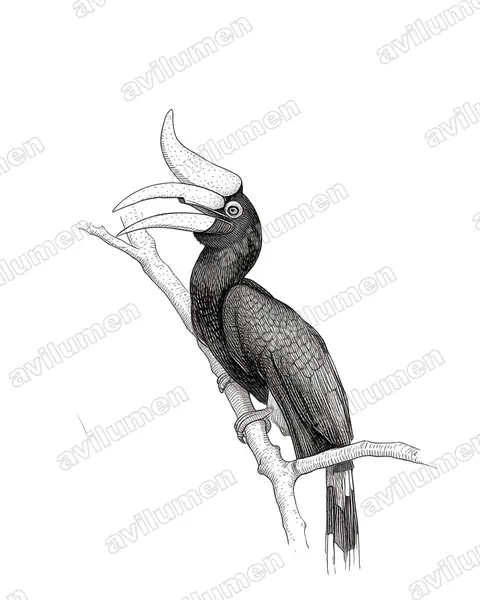
Ink 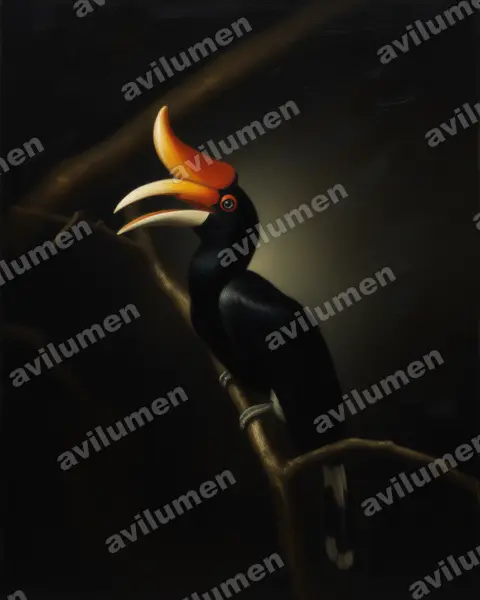
Oil 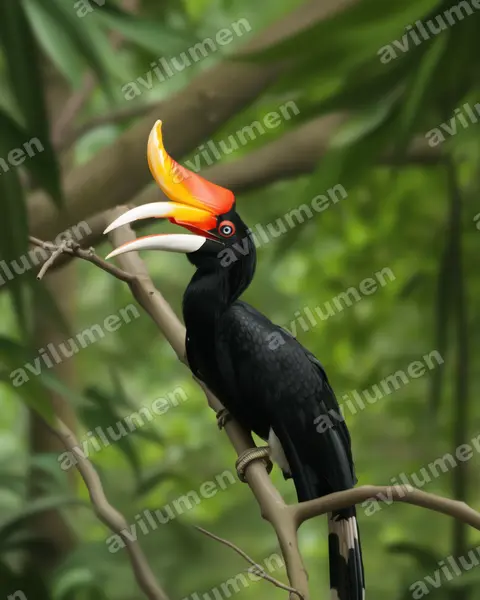
Realistic 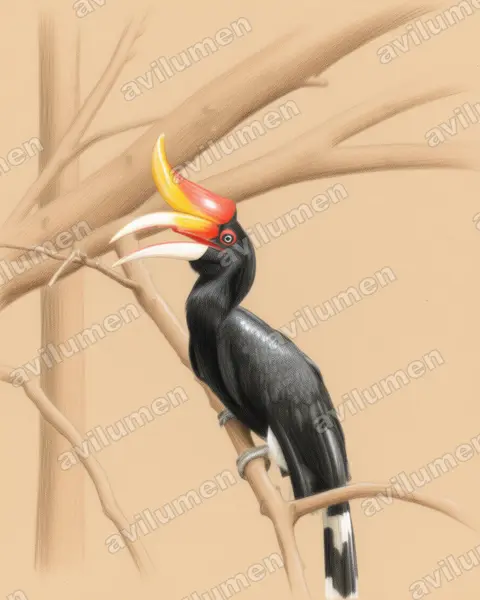
Colored pencil
Illustrations based on the photograph by Stefan Fussan (CC BY-SA 3.0), from Wikimedia Commons.
Digital editions
HD Digital Art Pack — Rhinoceros Hornbill
Digital download: 6 high-resolution illustrations of the Rhinoceros Hornbill (Buceros rhinoceros), print-ready. This is a digital file; no animal or physical item is included.
AI Avatar — Rhinoceros Hornbill
Generate an avatar fusing your face with the Rhinoceros Hornbill (Buceros rhinoceros). Delivered digitally in 8K, watermark-free. Digital product; no animals are sold or brokered.
Instant download. No live birds are sold.
Frequently asked questions
- Is Buceros rhinoceros (Rhinoceros Hornbill) endangered?
- The IUCN Red List places Buceros rhinoceros, commonly known as the Rhinoceros Hornbill, in the «Vulnerable» category. «Vulnerable» means it faces a high risk of extinction in the medium term.
- Where does Buceros rhinoceros (Rhinoceros Hornbill) live?
- Buceros rhinoceros (Rhinoceros Hornbill) is found in Indonesia.
- What family does Buceros rhinoceros (Rhinoceros Hornbill) belong to?
- Buceros rhinoceros (Rhinoceros Hornbill) belongs to the family Bucerotidae, in the order Bucerotiformes.
- What colour is Buceros rhinoceros (Rhinoceros Hornbill)?
- The plumage of Buceros rhinoceros (Rhinoceros Hornbill) combines these colours: Black and White.
More from the same family
 Vulnerable
Rufous-necked Hornbill
Aceros nipalensis
The rufous-necked hornbill is a species of hornbill in Bhutan, northeastern India, especially in Arunachal Pradesh, Indian subcontinent and Southeast Asia. It is locally extinct in Nepal due to hunting and significant loss of habitat. There are less than 10,000 adults left in the wild. With a length of about 117 cm (46 in), it is among the largest Bucerotine hornbills.
from $1.99
 Near threatened
Austen's Brown Hornbill
Anorrhinus austeni
Austen's brown hornbill, also known as the white-throated brown hornbill or brown hornbill, is a medium-sized species of hornbill found in forests from northeastern India to Vietnam and northern Thailand. It is rare throughout its range and is threatened by habitat loss and fragmentation.
from $1.99
 Near threatened
Bushy-crested Hornbill
Anorrhinus galeritus
The bushy-crested hornbill is a bird in the hornbill family. It is found in Brunei, Indonesia, Malaysia, Myanmar, and Thailand. Its natural habitat is subtropical or tropical moist lowland forests.
from $1.99
 Near threatened
Austen's Brwon Hornbill
Anorrhinus tickelli
Tickell's brown hornbill, also known as the rusty-cheeked hornbill, is a species of hornbill found in forests in Burma and adjacent western Thailand. Austen's brown hornbill is sometimes considered as a subspecies of Tickell's brown hornbill.
from $1.99